


- REVIEWS
Camera Reviews 
More Reviews Mobile Reviews Photography Reviews - GALLERIES
- VIDEOS
- BUYER'S GUIDES

Big Bend National Park, Texas; The Glories Of Southwestern Light
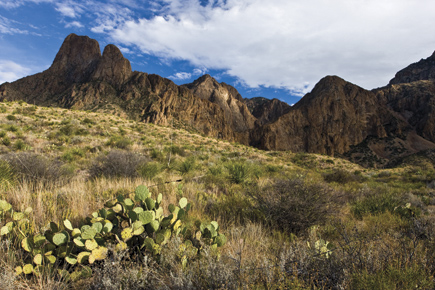
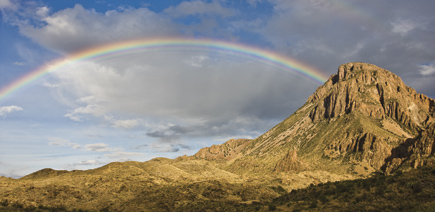
It was late afternoon on my last day in Big Bend National Park. I faced east where the Chisos Mountains rose up in steep cliffs from the desert. A few days after the New Year, there was a slight chill in the air but I was not thinking about the temperature. Rather, I was concentrating on the rapidly shifting light as the sun sank and clouds moved back and forth. With my camera mounted on a tripod, I composed, focused, pressed the shutter, adjusted position, and repeated until the sunlight vanished from the mountains.
 |
|
|
When the last of the light slipped off the tops of the cliffs I stood upright, stretched my back, and peered off across the darkening desert. Out of caution, I pulled the memory card from the camera and placed it carefully in its case. After the remarkable light show I’d just witnessed, which had included rainbows, cloud shadows, steep lights, and deep shadows, it was one set of images I didn’t want to lose.
That evening came at the end of four days in Big Bend National Park. With about 300,000 visitors a year, Big Bend is one of the least visited parks in the lower 48. This sounds like a lot of people until it is compared to a park such as Wyoming’s Yellowstone, which sees more than three million tourists each year. In part because of the low visitation, Big Bend is off the radar for most photographers. This is despite the fact that the park is home to a rugged and beautiful desert landscape and to more species of birds than any other national park.
 |
Located in West Texas along the Mexican border, Big Bend is far away from major population centers. The closest major airport, El Paso, is a five to six hour drive to the northwest. Even small towns are scarce around the park. Alpine (population 5736), 60 miles to the north, is the nearest sizeable town. Summer temperatures can be brutally hot, even in the high-elevation parts of the park, making any midday activity uncomfortable or even dangerous. Due to the difficult summer conditions, most visitors, as I did, choose to visit in the late autumn, winter, or early spring. Photographers who wander far off the beaten path also need to be careful to carry enough water, a first-aid kit, and to be aware that rattlesnakes are not uncommon. Parts of the park are so remote that help could be hours away, so it’s best to be prepared.
Though all of West Texas is surprisingly beautiful with its many small ranges of jagged mountains, it is not until you drive through the gates of the park that the photographic potential of the area comes into focus. Most photographers, rightfully, head straight to the center of the park toward the narrow road that winds through the desert and up into the Chisos. The higher elevation there (up to 7825 ft) creates a wetter microclimate and the mountains are covered in forests of stunted junipers, oaks, and pines.
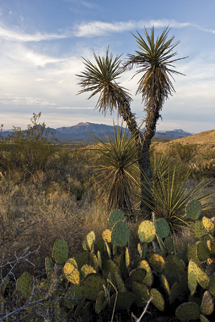 |
Tucked into the middle of the mountains lies a small visitor’s center, a campground, a store, and the only hotel inside the park, the Chisos Mountains Lodge. This is where I was headed during my first day in Big Bend. I arrived at the lodge in the late afternoon after taking a 5-mile hike to a nearby ridgetop along the Lost Mine Trail. Though the midday light during my hike was not ideal for photography, the outstanding views, thorn-clad vegetation, and desert birds provided a sampling of the park’s offerings.
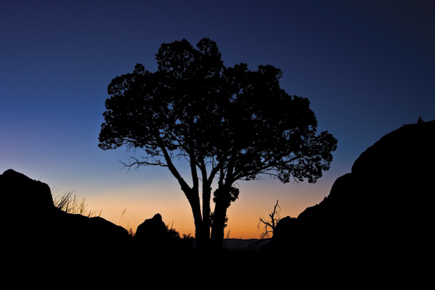
After getting settled in the comfortable, if basic, room, I gathered my equipment and walked a short distance down the Window Trail. The Window Trail is a gap in the mountains framed by thousand-foot cliffs, which provides views to the west over the surrounding desert. As I was framing shots with my 70-200mm lens, I heard a bird chatter. I turned in time to watch an Acorn Woodpecker land on a juniper snag 20 yards behind me. Quickly I lowered my backpack, pulled out my 500mm, swapped lenses, and mounted the big glass on the tripod. I fired off a burst of shots as the woodpecker foraged up the tree. When the bird moved on I turned again to the view where the last of the sunlight was throwing long shadows across the landscape. Again, I swapped lenses, and started experimenting with wide angles, then with silhouettes of trees, then telephotos of the dark rock formations.
 |
I learned a lesson that night about shooting in Big Bend: don’t give up early. There had been a couple of other photographers mingling about during the early part of the sunset, but they had headed back to their rooms or tents just after the last of the sun left the landscape. But that wasn’t the end of the show. The slow loss of light from the sky created lingering color that grew deeper and more intense as night gathered. My best images of that day were the last ones I made.
During my winter visit, the sweet desert light of the mornings and evenings lingered on the landscape. In between these hours I hiked, went birding, and explored the park. Outside of the Chisos, the vegetation is very different. The forests of the mountains are lush in comparison to the scrubby desert plants, which cling with tenacity to the rocky soil. The southern border of the park offers another sort of oasis, in the form of the Rio Grande. There, the river flows through a series of deep canyons and is lined with cottonwoods and willows.
 |
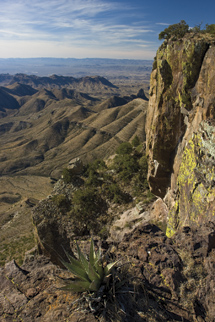
Despite the variety of the park, it is the high Chisos which most held my fascination. One morning I packed some lunch, a first-aid kit, and nearly a gallon of water to head out on a long 15-mile hike which carried me from the lodge to the South Rim of the mountains and back. My path took me along ridges dropping, in steep cliffs, 3000 ft to the desert. I walked along small creeks that offered their precious water to the local wildlife and passed through forests of scrubby oaks filled with bright blue Mexican Jays and small Chisos white-tailed deer. I learned that Big Bend is a rich place, though stark, rugged, and inhospitable at first glance, but to a person with a camera, a love for the landscape, and a bit of curiosity, it is something of a paradise.
David Shaw is a free-lance writer/photographer, wilderness guide, and wildlife biologist living in Fairbanks, Alaska. You can see more images, find out about his photography and nature tours, and read his blog at: www.wildimagephoto.com.
| ||
|
||
- Log in or register to post comments



















 FEATURED VIDEO



Get the Latest Photo Tips, News & Reviews from Shutterbug!







| Camera Reviews Other Reviews | |
Mobile Reviews Photography Reviews Columns | |
News | |
Features | |
How-To | |
Resources |
 © 2024 Shutterbug
AVTech Media Americas Inc., USA
All rights reserved