


- REVIEWS
Camera Reviews 
More Reviews Mobile Reviews Photography Reviews - GALLERIES
- VIDEOS
- BUYER'S GUIDES

Tokina’s AT-X 100mm f/2.8 PRO D Macro Lens; Close-Ups For Digital And Film
Although many zoom lenses are labeled as "macro" that designation generally refers only to moderately close focusing ability. With a few exceptions, such zooms are not adequate for a dramatic frame-filling image unless the subject is quite large. (A few tele macro zoom lenses are capable of much higher magnification, however.) On the other hand, true macro lenses can focus extremely close, for very high magnification. And, because they're optimized for great sharpness in extreme close focusing, they can provide superior image quality.
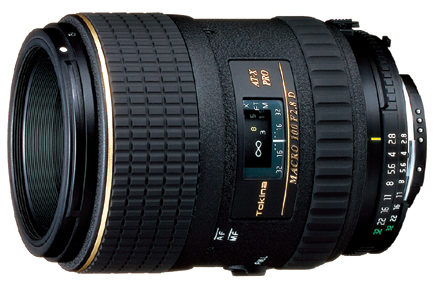
A few macro lenses are designed only for moderate 0.5x magnification, but most can produce full 1x magnification, also called a 1:1 reproduction ratio. The new Tokina AT-X 100mm f/2.8 PRO D lens falls into the 1x category. A special helicoid shifts internal elements, moving the optical center further from the film plane--closer to the subject--for greater magnification. When focused to 11.8" it can reproduce a tiny subject as life size on a 35mm film frame or a full-frame digital sensor. Mount the lens on a digital camera with a smaller sensor and it provides higher "apparent magnification," as discussed in our Magnification Issues sidebar.
This multi-platform lens is optimized for digital capture but it's just as suitable for film photography. It benefits from entirely new types of multilayered coatings to minimize internal flare. That's important because a silicon sensor (and its protective glass cover) is far more reflective than photographic film. When light reflects from the almost mirror-like surface, it bounces to the rear lens element and may create flare that degrades image contrast and apparent sharpness. In extremely bright light, internal reflections can also cause "ghosting" (reflections in the shape of the lens diaphragm), most noticeable when shooting at very wide apertures.
Note, too, that the front element of this Tokina macro lens is recessed a full 1.25", regardless of the focused distance. That feature--plus the multilayered coatings and 2" deep lens hood--offers additional flare protection from external light sources in extremely bright sidelighting.
 |
|
 |
|
|
|
|
|

Design Characteristics
As expected with a rugged tele macro lens, this Tokina model is quite heavy due to the wide aperture and extensive use of metal. The f/2.8 maximum aperture made focusing on a bright viewing screen a pleasure in low-light conditions. Finished in matte black and only 3.74" long, the aluminium-alloy barrel fits nicely even in small camera bags but the internal barrel extends by a full 2" at the minimum focus distance. Magnification and distance scales are provided under glass, in tiny numerals.
Surprisingly, there's no depth of field scale on the internal barrel, perhaps because two scales would be required: one for use with 35mm and full-frame digital SLRs and another for use with digital SLRs that employ APS-C size sensors. (The depth of field issue is also discussed in our Magnification Issues sidebar.) Because most SLR cameras include depth of field preview for assessing the range of acceptably sharp focus at any aperture, there's little need for a depth of field scale.
The focusing system is worth considering in detail. At first glance, this 100mm Tokina macro resembles a manual focus lens, thanks to the 1.25" wide (rubberized/knurled) focus ring. When the ring is in the AF position, autofocus is provided. Although the internal barrel shifts in and out, the focus ring does not rotate so the effect of a polarizer is always maintained.
Focusing is not super fast because of the great distance the helicoid mechanism must travel between the infinity position and the minimum focusing distance. The process produces a metallic hum, but it is not loud enough to scare off any potential nature subjects. For longer distance shooting, as in portraiture, the Focus Limiter mechanism can be useful. This lock prevents the lens from trying to focus at very short distances, helping to accelerate the autofocus process.
Switching to manual focus calls for pulling the focus ring back by 1/4" to the MF position. In Tokina literature this feature is called a One Touch Focus Clutch Mechanism; it's quick and easy to use. And this lens is ideal for manual focusing, with a well-damped mechanism that provides plenty of friction for a familiar "feel." Shifting from infinity to the minimum focusing distance requires a 300Þ rotation. That can take some time, but I consider this design to be perfect for a macro lens. The mechanism allowed me to adjust focus in tiny increments with great convenience, important in extreme close-up photography where a focus shift of even a millimeter makes a huge difference.
|
|
 |
|
|
||

| |||||||||
|

| ||||||||
- Log in or register to post comments






















 FEATURED VIDEO



Get the Latest Photo Tips, News & Reviews from Shutterbug!







| Camera Reviews Other Reviews | |
Mobile Reviews Photography Reviews Columns | |
News | |
Features | |
How-To | |
Resources |
 © 2024 Shutterbug
AVTech Media Americas Inc., USA
All rights reserved