


- REVIEWS
Camera Reviews 
More Reviews Mobile Reviews Photography Reviews - GALLERIES
- VIDEOS
- BUYER'S GUIDES

Web Wandering
Staying On Top Of The Technology With Seth Resnick
For Boston based photographer Seth Resnick and many others in the industry the regional markets have transformed into a global marketplace. What was once a conceptual dream has become a reality. Resnick, a commercial, editorial, corporate, and fine arts photographer for the past 20 years, has an active and productive web site. "As photographers," he says, "we should utilize new technologies that offer us the ability to enhance our acquired skills. The web is growing at a rate that has been unsurpassed by any other form of media in history. Over 197,000 people are signing on every day. Speed and bandwidth are being increased with Digital Subscriber Lines (DSL), cable and T-1 lines. I have a dual DSL that allows me to move a 15MB file in about 21/2 minutes and I pay only $79 a month for it. Two years ago it would have cost $3000 a month. The individual photographer can be a player in a global game now, participating and competing in real time. We can change a portfolio for a specific client in an instant, deliver a stock image to Indonesia in a blink, and collect funds from foreign vendors with the click of a button." |
|||
Resnick, a dynamo with an artistic
sensibility, describes himself as a 42-year-old fireball of energy who
believes in 30 hour days. His site was birthed in the form it is taking
now in January of 1994, though he went on the web in '92 and recalls
how there were only 300 web sites that weren't a branch of the government.
"Just being able to change my name from standard helvetica to bold
face was a huge deal," he recalls. "I was on a chat group
called Delphi and it was mind-boggling to think I could communicate with
someone in real time." |
|||
Resnick's stock business provides a large part of his income and three or four years ago it was hard to sell his own stock. "If you wanted to market a picture in 17 countries your only mode was through a stock agency," he says. "They had the upper hand and you paid 50-50 catalog fees. The web has changed that and a lot of long-term agencies are disappearing or being eaten up by large conglomerates. It is not because Tony Stone or Corbis has all the money behind them but because the large agencies have very substantial web development in place for distribution now. They are realizing that someone like me can compete neck and neck with them. When someone goes on the web to look for a picture now I have as much of a chance to be found as does Tony Stone. If you go onto the AltaVista search engine and type in `stock photography research,' Seth Resnick comes up first and in the others it appears in the top five listings. This has taken lots of programming and the key is that I can do it because I have learned the technology and can now compete with anyone. It is no longer a matter of who has the most money, but rather of understanding how the web works. Being found is what it's all about and it is becoming scary to the big players as photographers learn how to reach out around the world." |
|||
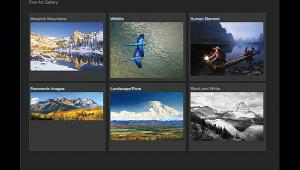
Resnick's site goes
far beyond the usual artist's showcase. However, do not expect to
just walk in. Visitors are tracked through a registration page so that
privacy is ensured and his images don't become public domain. A
comprehensive site, the homepage links to his portfolio, stock images,
research, picture stories, stock pricing tables, a global database of
photographers with their e-mail addresses, and an up-to-date exhibit of
his hottest selling images and their history. He shares his own favorite
sites with practicing photographers and soon-to-be pros, giving four stars
to Gary Gladstone and Jack Reznicki's virtual photographic community
as well as to Stock Photo Research that is dedicated to providing photographers
with a place to be found online. |


| ||
|
||












 FEATURED VIDEO


Get the Latest Photo Tips, News & Reviews from Shutterbug!







| Camera Reviews Other Reviews | |
Mobile Reviews Photography Reviews Columns | |
News | |
Features | |
How-To | |
Resources |
 © 2026 Shutterbug
AVTech Media Americas Inc., USA
All rights reserved