


- REVIEWS
Camera Reviews 
More Reviews Mobile Reviews Photography Reviews - GALLERIES
- VIDEOS
- BUYER'S GUIDES
Olympus’ E-300 EVOLT
An Affordable 8-Megapixel Digital SLR
Photos © 2004, Peter K. Burian, All Rights Reserved
Shortly after the professional Olympus E-1 was introduced in 2003, the company made a commitment to design a more affordable model as well. And Olympus delivered with the E-300 EVOLT for photo enthusiasts who don't want to spend over $1000 on their digital SLR. This camera employs a similar "Four Thirds" CCD sensor found in the E-1, but boasts much higher 8-megapixel (vs. 5-megapixel) resolution. In spite of the lower price, this is definitely not a stripped-down model. While it's missing a few E-1 capabilities, the E-300 EVOLT is a full-featured camera with a few extras such as pop-up flash and multiple Program modes with intelligent automation.
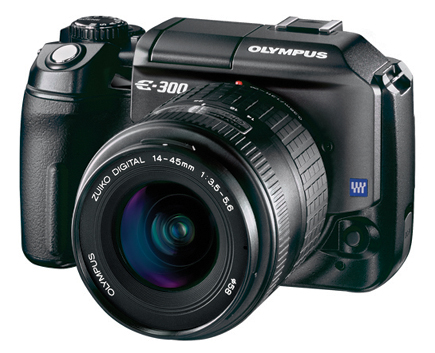
Design And Capabilities
Although it's not built like a tank, the body includes an aluminum top
cover, die-cast aluminum chassis, metal lens mount, and durable shutter. This
SLR resembles a rangefinder camera because there's no penta-prism hump
on the top. The sleek style was achieved through the use of an optical porro
finder with four mirrors plus a reflex mirror that swings sideways. The combination
reflects light up to the viewfinder without the need for a penta-prism. The
viewfinder is not exceptionally bright or large, but it's fine in most
situations. In spite of a fairly thick body, the lack of a penta-prism makes
the E-300 EVOLT smaller in cubic inches, and hence, lighter, than most of its
competitors.
 |
|
|
The camera sports many analog controls, including a mode selector dial, for
quick operation without the need for frequent access to the electronic menus.
The buttons and dials are logically located and well marked, making the E-300
EVOLT more convenient than the E-1. Select SCENE on the mode dial and you can
choose any of 14 subject-specific programs. Information as to the intent of
each is then displayed on the LCD monitor; for example, Landscape program is
described as providing "vivid reproduction of blues and greens."
All of this is quite simple, great for the novice.
Experienced shooters will also find everything they want, including three metering
patterns; TIFF, raw, and JPEG recording modes; adjustments for contrast, sharpness,
and color saturation; two color space settings; and more. I was particularly
impressed with the incredible number of options for adjusting white balance
and color tone. Some of the uncommon features call for a review of the instruction
manual for full specifics as to the purpose and value of each option.
 |
|
|
The 17.3x13mm CCD sensor produces a 2x focal length magnification factor, actually field of view crop. That's great for anyone who loves telephoto photography, because there's less need for very long, heavy lenses. For a wide angle perspective, very short lenses are required, such as the compact Zuiko Digital 14-45mm or 11-22mm zooms. The Four Thirds CCD, manufactured by Kodak, uses "frame-transfer"--not the common " interline-transfer"--technology that's said to produce excellent color and very low digital noise plus wide dynamic range for great highlight and shadow detail.
Evaluation: In its basic operation, the E-300 EVOLT is no more complicated than some compact digicams but it will also satisfy serious photographers. Many of the advanced options require access to the electronic menus but overall navigation is uncomplicated. In terms of versatility, this camera scores near the top of its category in the sub-$1250 price range.
 |
|
|
In-Use Performance
During the test period, I made hundreds of images with this incredibly versatile,
compact digital SLR. Subjects included portraits of a belly dancing instructor,
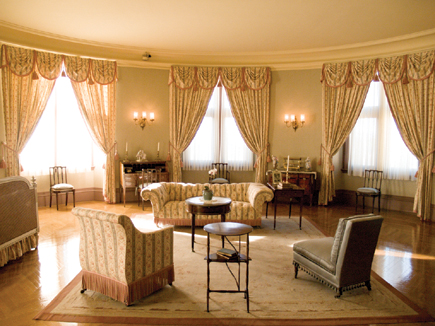
interiors and exteriors at the lavish Biltmore Estate in Asheville, North Carolina,
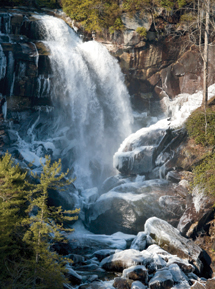
several nearby waterfalls, as well as models strutting during Olympus Fashion
Week in New York. In most situations, I was impressed with the speed and reliability
of this camera.
Start up took only 2 seconds, including the time required for automatic sensor cleaning. The camera responded almost instantly, without any noticeable shutter lag, making it useful for capturing just the right instant in bright areas of, for example, a fashion show. Autofocus performance was absolutely first rate with outdoor subjects such as ice-covered rocks in a stream. The Continuous AF system had no difficulty tracking the motion of aircraft approaching the Charlotte, North Carolina, airport and most frames in a series were sharply rendered. While shooting inside dark rooms of the Vanderbilt's Biltmore Estate, focus acquisition took longer: about a 1/2 sec. That's still quite fast, and achieved without the focus-assist system that's available with flash.
 |
|
|
In Continuous Drive mode, I was able to shoot four full-resolution raw or Super High Quality JPEG images, at 2.5 fps, before the camera paused to begin clearing its "buffer" (storage bank). That took 4-6 seconds, but I could take a shot or two even while it was recording data to the memory card. Consequently, I rarely experienced frustration because the camera was usually ready to take another shot.
Images made without any in camera overrides exhibit punchy colors (especially in Adobe RGB color space) and snappy contrast. Surprisingly, the camera occasionally underexposed "average" scenes by a 1/2 stop with multi-zone metering. The Auto White Balance system was a bit disappointing, especially when shooting indoors without flash. All of this was easily solved with in camera features or later with minor tweaks in imaging software. The built-in flash produced pleasing results, without redeye in people pictures. When using an optional FL-series flash unit, the output was excessive for nearby subjects, calling for a -1 flash exposure compensation for a more subtle effect.
| |||||||||
|

| ||||||||


 FEATURED VIDEO


Get the Latest Photo Tips, News & Reviews from Shutterbug!







| Camera Reviews Other Reviews | |
Mobile Reviews Photography Reviews Columns | |
News | |
Features | |
How-To | |
Resources |
 © 2026 Shutterbug
AVTech Media Americas Inc., USA
All rights reserved