


- REVIEWS
Camera Reviews 
More Reviews Mobile Reviews Photography Reviews - GALLERIES
- VIDEOS
- BUYER'S GUIDES

Locations; Big City Butterflies; Photographing At The American Museum Of Natural History’s Conservatory
Every year, New York City's American Museum of Natural History (AMNH)
comes to life with a teeming array of mesmerizing and vibrantly colorful butterflies
(and some moths) from around the world. The Butterfly Conservatory houses numerous
specimens reflecting the rich diversity of insects known collectively as Lepidoptera.
In fact, this collection even includes the world's largest moth species,
the Atlas moth.
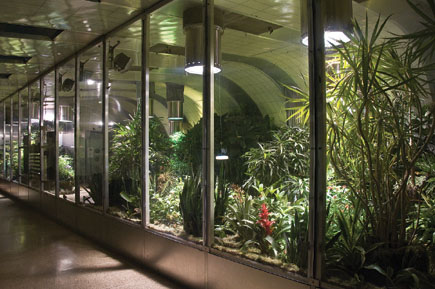
The greenhouse is housed on the second floor of the museum. You'll step
through one set of swinging doors on your way in, another on the way out--designed
to acclimate you and prevent escapes. No reservations are required (but you
need a ticket). You can stay as long as you want, if you don't mind the
tropical conditions.
Conservatory |
|
 |
|
|
Be Aware Of Your Surroundings
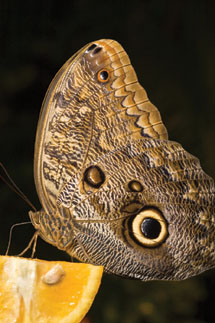
Many butterflies will flutter past you, but many more can be found feeding.
They may feed on a flower's nectar, or can even be found sucking up the
juice from oranges or colorful feeders strategically placed around the exhibit.
Butterflies and moths remain relatively still while feeding, long enough for
you to take a few pictures. Early in the morning--in fact, as soon as the
exhibit opens--is the best time, because the insects are still somewhat
torpid, requiring exposure to the heat lamps to energize them, making them appear
more cooperative. And newly emerged butterflies need to "compose"
themselves before venturing out into the world, providing more opportunities
to photograph a stationary subject.
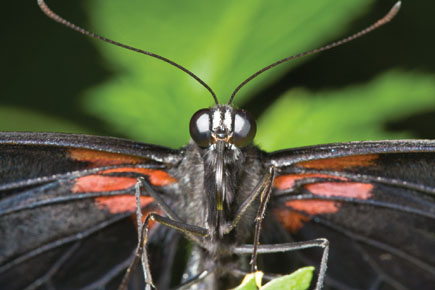
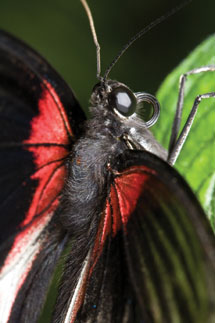
Great Mormon |
|
 |
|
 |
|
|
As you look around you, butterflies and moths are everywhere. Some will come
to rest on windows and overhead fixtures, but most alight on plants and flowers
(including orchids) within easy reach of your lens. Some butterflies will even
land on the floor, at your feet, so step cautiously. And they've been
known to rest on a head or shoulder--or even a camera. Never handle the
butterflies and moths--leave that to the experts. A friend or even the
friendly staff can help point out some worthwhile subjects while you're
busy in another corner of the conservatory.
When shooting close-ups, pull back at some point for a wider shot--to get
a sense of the environment (and as a reminder of the insect's orientation--right-side
up, upside down, or somewhat vertical, facing up or down). With tight shots,
the orientation may not matter, since there's often no frame of reference.
Orange Eater |
|
 |
|
|
Recipe For Success: Simple Ingredients
For serious butterfly photography, you'll need an SLR. If you have to
change lenses (or film), do it in the vestibule.
I prefer a 100mm macro lens on my Canon EOS 5D. I favor the short telephoto
because it affords more breathing room between me and my potentially flighty
subjects than a shorter focal length. Also, this combo is a good weight to heft,
especially when held in one hand (when shooting with flash off-camera). This
focal length would work as well on an APS-C or Four Thirds-format camera (equals
150mm and 200mm, respectively), although with these formats, something a bit
shorter should be as usable. For starters, shoot at half life size; as you get
more comfortable, move in closer. If you want to tempt fate, add an extension
tube.
| |||||||||
|

| ||||||||






 FEATURED VIDEO


Get the Latest Photo Tips, News & Reviews from Shutterbug!







| Camera Reviews Other Reviews | |
Mobile Reviews Photography Reviews Columns | |
News | |
Features | |
How-To | |
Resources |
 © 2026 Shutterbug
AVTech Media Americas Inc., USA
All rights reserved