Dive In 10 Easy Tips For Underwater Action
Rick Sammon, April, 1999

| |
Want
great depth of field in your close-up photographs, as
illustrated in this picture of a sea anemone? Then shoot
with a wide angle lens set at a small aperture. (Sea&Sea
CX-600 housing, dome port, Canon Rebel G w/14mm lens,
Kodachrome 64.)
Photos © 1998, Rick Sammon, All Rights Reserved
|
|
Last year in Shutterbug,
I offered 10 reasons why a topside photographer might want to dive into
underwater photography. My reasons included: challenging yourself with
one of the most rewarding photo specialties around; putting your photo
skills to work for a marine conservation organization; displaying underwater
pictures on your home or office wall that will delight viewers; and
traveling to tropical paradises around the world to have fun with your
hobby.
This year, I offer 10 catchy phrases to help scuba diving shooters remember
some important photo techniques. Here goes:
1. Testing, 1, 2, 3. If you don’t test your gear,
you may come back from a dive trip with washed out pictures--or your
trip may be a total washout from a picture standpoint.
Here are the three tests I recommend. One, test your camera in a pool
before you leave home. Two, test your camera in a pool once you get
to your vacation destination. Three, shoot a test roll on the reef.
When testing your camera
or housing, try all camera controls, shoot a roll of 36 exposure film,
have your film processed by a reliable lab, and then evaluate your results.
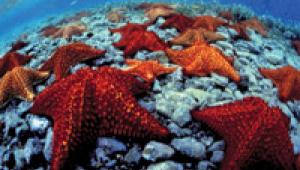
2. The name of the game is to fill the frame. Want
boring pictures? Then include lots of blue water and white sand in your
pictures. Want interesting pictures? Then move in or zoom in close and
fill the frame with interesting subjects: divers, fish, coral formations,
etc.
3. Backlight, shoot tight. Natural-light silhouettes
of manta rays, whale sharks, schools of fish, and divers swimming between
you and the surface of the water can be very dramatic--if you shoot
tight around your subject. If you don’t shoot tight, the background
(underside of the water’s surface) will probably be overexposed
when you shoot on automatic.
|
| |
Two flashes provided shadowless lighting in this portrait
of two long-nose hawkfish. (Ikelite underwater housing,
flat port, Nikon N8008 w/60mm macro lens, Kodachrome 64.)
|
|
4. Hand holding
is a good thing. The biggest enemy of underwater photographers is something
called “backscatter”--particles that are illuminated in the
water when a flash is fired. To eliminate or reduce these annoying and
distracting white dots in a picture (which create what looks like an underwater
snowstorm in a picture), hold your flash off-camera--as far as possible.
When you hold the flash off-camera, only the sides of the particles are
illuminated--and not the part of the particles that are facing the camera.
The particles are still there, but they are less visible--and sometimes
totally invisible.
5. Bracketing begets smiling. If you shoot slide film (like I
do), you will want to bracket your pictures to ensure good results. The
easiest way to bracket is to take multiple exposures varying your ISO
setting with your camera set in an automatic mode. Here’s how to
do it: Take one exposure with your ISO set at the recommend setting, then
take an exposure with the ISO set at 1/2 the ISO number, and then take
another exposure with the ISO set at double the ISO number. Example: Shoot
at ISO 100, then 50, then 200. Remember: Reset your ISO after you are
finished bracketing your exposures.
If you shoot prints, there is no need to bracket because color print film
has a wide (forgiving) exposure latitude. In fact, if you are just starting
out, you may want to use print film while you are mastering the basics
of underwater photography. For beginners, I’d suggest using ISO
400 film because it lets you shoot at a faster shutter speed (to stop
action) and smaller f/stop (for good depth of field) than slower films.
6. Gettin’ up-close counts--big time. Professional
photographers choose wide angle (20mm) and super wide angle (12mm, 14mm,
and 15mm) lenses for most of their underwater photography--because these
lenses let them get close to their subjects--in an environment that is
800 times more dense than air. The wider the lens, the closer the shooter
can get to the subject--and the sharper your pictures will be.
Naturally, close-up lenses and kits, extension tubes, and macro lenses
will produce super sharp and super colorful pictures, too.
|
| |
The
advantage of using two flashes is that you can eliminate
virtually all shadows in a picture, as illustrated by this
picture of a frogfish. (Sea&Sea CX-600 housing, flat
port, Canon Rebel G w/60mm lens, Kodachrome 64.)
|
|
7. Beware
the background. The background can make or break a picture. When composing
a picture, make sure a diver’s fin, fish tail, anchor line, and
so on are not “sticking out of your subject’s head.”
Also, when taking fish and diver portraits, try to choose a plain background--like
the deep blue sea or a evenly colored patch of coral.
8. Tell the whole story. During your dive trip, take
wide angle and close-up pictures--above and underwater. That’s right,
capture the action on your dive boat and around your resort, too. Then,
when you are showing your slides or photo album, your friends and family
can relive your entire experience.
9. Get a camera caddie. If my wife, Susan, reads this,
she’ll kill me. Only kidding. Susan is my partner in our book publishing
venture (we have 20 books). Topside, she helps with the planning, writing,
and production. But underwater, she holds two cameras for me. She’s
a great “camera caddie,” as well as an excellent fish critter
spotter.
My point: If you can get someone to carry a camera or two for you, you
can take a wider variety of pictures than if you are diving with just
one camera.
10. Never give up. Hey, I know, first-hand that underwater
photography can be frustrating--even with the very best equipment. When
you are going through your pictures, please try to remember this: Most
professionals, including yours truly, are happy with one great shot per
roll. So, never give up. Don’t get discouraged.
|
| |
The
old adage, “The name of the game is to fill the frame,”
applies when composing pictures underwater. In other words,
avoid “dead space” (lots of open water and sand)
in your pictures. (Sea&Sea CX-600 housing, dome port,
Canon Rebel G w/20mm lens, Elite Chrome 200.)
|
|
Systems For Scuba Diving
Shooters
There are many underwater cameras
for scuba divers who are just getting their feet wet with underwater photography.
Cameras are also available for serious shooters who are fortunate enough
to have a small fortune to spend on gear.
Here’s a look at just a few of the cameras around--starting with
the least expensive (about $10) going up to most expensive (about $8000).
In reading about the following cameras, please keep in mind that an underwater
flash (from $100-$1000) is a must if you want accurate color, especially
when diving below 10’. In-camera flashes may provide enough light
to bring out the color of a subject, but off-camera flashes are the choice
of advanced amateurs and pros.
One-Time Use Cameras. Topside, 35mm one-time use cameras
deliver surprisingly good results. Underwater, these cameras take okay
natural light pictures--if you follow the recommended shooting distance
(usually about 6’). Another recommendation to follow: Don’t
go deeper than the maximum depth (usually about 15’).
One-Time Use Camera Housing. Ikelite, one of the oldest
names in underwater photo gear, makes a housing for popular 35mm and APS
cameras. The two main advantages of the housing: one, you can use flash-model
cameras underwater; two, the housing features a sports finder for easy
fish framing.
Epoque ET-100 Plus. I’d call this camera the Epoque Easy because
it’s one of the easiest cameras to use underwater. This 35mm camera
has a 45mm lens for fun, fish and fin shots, a built-in flash for flashy
pictures, and auto film wind for action shots.
Sea Life Reef Master. Don’t know a f/stop from a fish cleaning stop
(spots on the reef where fish go to get parasites and dead scales picked
off their body)? Well, check out the Reef Master. It’s a fully automatic
35mm camera for novice dives who are just diving into underwater photography.
Minolta Vectis Weathermatic Zoom. The Advanced Photo
System (APS) has made the news on land. Now, Minolta makes underwater
news with its Vectis Weathermatic Zoom. Want a reef scene? Shoot at the
30mm setting in the “P” (Panorama) mode. How about a fish
portrait? Then switch to the 50mm setting in the “C” (Conventional)
mode. And how about those group shots of divers floating over the reef?
Then shoot in the “H” mode (named after the wide High Definition
Television format).
EWA Marine Underwater Housings. Please. Don’t call
these rugged plastic, flexible housings, complete with optical glass ports,
“plastic bags.” Sure, they look like thick plastic bags, but
they do the job of a sturdy housing. Housings are available for still
and video cameras.
Sea&Sea Motor Marine II EX. Want versatility in a viewfinder-type
camera at an affordable price? Then, this compact and lightweight camera
is worth checking out. Accessory wide angle and close-up lenses are available
that, get this, can be switched underwater. Sea&Sea also offers a
line of flashes and flash accessories for single and dual flash photography.
Nikonos V. This rugged workhorse of a viewfinder-type
camera is popular among professionals and advanced amateurs. It accepts
the super-sharp Nikonos lenses (15mm, 20mm, 28mm, and 35mm) and Nikonos
flashes and accessories (including a close-up kit and extension tubes).
Off-brand lenses and accessories are also available for this time-proven
camera.
Underwater Housings For AF SLR Cameras. Have a Canon, Nikon, Minolta,
Olympus, or Pentax AF SLR? If you do, and if you are serious about having
total control of all camera functions underwater, then you might want
to consider an underwater housing, available from Ikelite, Nikon, and
Sea&Sea, to name a few. Housings, complete with flat ports (for macro
lenses) and dome ports (for wide angle lenses) can run from $1000 to several
thousands of dollars.
A Way Cool Accessory. For the super-serious underwater shooters, Ikelite
offers an underwater flash meter. Cool, don’t you think?
Want in-depth information on the latest and greatest underwater cameras,
systems, and accessories? See the manufacturer’s list above.
Manufacturers/Distributors
Beseler (Epoque;
Novice camera)
1600 Lower Rd.
Linden, NJ 07036
(800) 237-3537
(908) 862-7999
fax: (908) 862-2464
Helix
310 S Racine Ave.
Chicago, IL 60670
(312) 421-6000
fax: (312) 421-2804
Ikelite Underwater Systems
(Housings,
flashes, accessories)
50 West 33rd St.
Indianapolis, IN 46206
(317) 923-4523
Mamiya (Sekonic
underwater light
meters)
8 Westchester Plaza
Elmsford, NY 10523
(914) 347-3300
www.sekonic.com or
www.mamiya.com
Nikon Inc. (Pro/amateur camera,
flashes,
accessories)
1300 Walt Whitman Rd.
Melville, NY 11747
(516) 547-4200
fax: (516) 547-0362
www.nikonusa.com
Pioneer Research and Marketing
(Sea Life Reef Master; Novice camera)
97 Foster Rd., Ste. 5
Moorestown, NJ 08057
(800) 257-7742
(609) 866-9191
fax: (609) 866-8615
www.pioneer-research.com
RTS (EWA Marine; Flexible housings)
40 -11 Burt Drive
Deer Park, NY 11729
(516) 242-6801
fax: (516) 242-6808
Sea&Sea Underwater Photo
(Pro/novice cameras, housings, flashes, accessories)
2105 Camino Vida Oble, Ste. L
Carlsbad, CA 92009
(800) 732-7977
(760) 929-1909
fax: (760) 929-0098
Subal USA (Housings)
201 S Milpas St. #103
Santa Barbara, CA 93103
(805) 965-2290
Underwater Photo Tech (They
can repair your leaky gear)
16 Manning St., Ste. 104
Derry, NH 03038
(603) 432-1997
fax: (603) 432-4702
|
|