Site Links
|
 |
 |
 |
The View From The Sidelines Shooting NFL Football With The Pros
By Jay Abend January, 2004
| |
Sometimes it pays to be out of position—here I set
up behind the line of scrimmage while all the other guys
were about 30 yards downfield. When Packers quarterback
Brett Favre dropped back I got this perfect image of him
with a 300mm lens on a Canon EOS-1 V body with Ektachrome
400 film at ISO 800.
Photos © 2003, Jay Abend, All Rights Reserved
|
|
With the NFL 2003-2004 season
in full swing, you’ll find most American men firmly planted on
the sofa in front of their big TV set every Sunday. While television
coverage of pro football gets better and better, especially with the
advent of network HDTV broadcasts, the sidelines remain jammed with
still photographers jockeying for position.
As a photographer, don’t you scan the sidelines during football
games, looking out for the pro shooters with their huge glass and monopods?
(And doesn’t it hit home when one gets run over by a beefy running
back?) As a commercial photographer, most of my work is in the studio,
with a bit of location work. In my 20 years of shooting I’ve been
asked to shoot two NFL football games, both times for clients who sponsored
the stadiums. I showed up with my slow camera bodies, my f/4 lenses,
and a tripod. While I wasn’t laughed off the field, the working
photojournalists on the sidelines of Giants Stadium had no patience
for an obvious rookie. I got what I needed, but the experience was pretty
intimidating.
|
| |
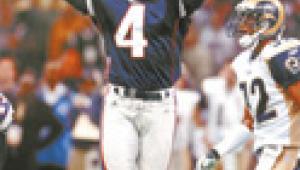
A
tip from a working pro at the game: when a team is close
to scoring you can set up near that team’s sideline.
When the score is made the quarterback usually turns back
toward his teammates on the sideline to celebrate—great
tip and a great shot of Brett Favre after a score.
|
|
10 Years After
Now 10 years later, with the digital camera revolution rolling along,
I approached another NFL game. What to shoot with? Film or digital? How
do you get credentials? Where do I start? All good questions, and the
man to answer them was my pal Jim Mahoney at the Boston Herald. Jim had
already run me through the ins and outs of shooting pro baseball at Boston’s
famed Fenway Park, and his stunning football images have graced the back
pages of the Herald for years. Well, Jim was so good that he was bumped
up from “Legendary Sports Photographer” to the “Director
of Photography” from the Herald. Jim agreed to let me tag along
to an NFL game.
Like most metro dailies, the Herald shoots every single NFL game—exhibition,
regular season, and playoffs. While the 182 game baseball schedule necessitates
a single shooter at home games and reliance on the wire services for away
games, the short 16 game NFL schedule gets at least one staffer at every
single game. As always, Jim was super helpful. No longer shooting games
on a regular basis, Jim had chosen two fine Herald shooters to cover the
NFL beat. My job was to hook up with staffers Matthew West and Michael
Seamans about four hours before a New England Patriots/Green Bay Packers
game. Since they had the coveted stadium parking pass, I carpooled rather
than face the horrors of an NFL Sunday parking fiasco.
Getting In And Plugging
In
As we cruised into the media parking area, I noticed the line of pro shooters
waiting for their credentials. (Hard to miss 15 guys with 600mm f/4 lenses
over their shoulders.) Once we had our field passes it was off to the
media center. Like most modern stadiums, Gillette Stadium in Foxboro,
Massachusetts, has a large modern media room, equipped with T1 Internet
connections for all of the local and out of town media. In the old days
the wire services used to develop negative film right on the spot, then
scan and transmit over phone lines. Well, technology has advanced very
quickly, and the media room was chock full of Nikon D1H and Canon EOS-1D
bodies. While I saw a few older Nikon D1 bodies, Kodak DCS 520/620 bodies,
and even a few “prosumer” Canon bodies, the majority of pros
there had the top of the line pro SLRs, both film and digital. I had a
Canon EOS D60 body and a pair of EOS-1 V film bodies. Besides the piles
and piles of pro camera gear lying about, there were several dozen laptops
open and humming, most of them Apple PowerBooks and iBooks, with only
a very few Windows-based systems.
The Herald shooters have been given their own little office, which was
nothing more than a cement-walled closet with a few tables. Matthew and
Michael set up their Macs, while Jay Malonson of the suburban MetroWest
Daily News and yours truly set up our PC laptops. Since I was not transmitting
my files to a newspaper I didn’t need an Internet connection, but
hooked up anyway to get the latest on the weather. As luck would have
it the weather was cool, drizzly, and very, very gray. Big problem. The
fastest film I had was Ektachrome 400, and my EOS D60 wasn’t really
great above ISO 800. The pros were all set, since the EOS-1D and D1H have
excellent high ISO performance.
|
| |
Even
with a slow-focusing Canon EOS D60 and a Sigma lens I was
able to capture this kind of tight, crisp action—Patriots
quarterback Tom Brady dropping back to pass.
|
|
Kid In A Toy Store
Surveying the assembled still shooters at an NFL game is like stepping
into the greatest camera toy store in the world. The preferred lens for
pro football is the 400mm f/2.8. With the 1.3x multiplying factor of the
EOS-1D you’ve got a 520mm angle of view, and with the D1H it’s
more like a 600mm. Matthew and Michael brought a bunch of lenses from
the Herald’s equipment pool. Matthew shot with Canons and Michael
with Nikons, so they had to bring two complete lens kits—17-35mm
wide zooms; 24-70mm medium zooms; 70-200mm long zooms; 300mm, 400mm, and
600mm long glass; and several digital bodies. It’s so much stuff
that they each have to pack several large Lightware cases. In my case
I had my 17-35mm, 70-200mm, 300mm f/2.8, and a nice 500mm f/4.5 loaned
to me by Sigma.
About a half hour before kickoff the media tends to stake out its position
around the field. The NFL is probably the strictest organizing sports
body as regards the working press. Credentialing is super, super tough.
This year, many decent local papers are complaining that they’re
only getting one credential per game, and the situation is tougher for
working free-lancers. How to get a photo pass for a pro football game?
Simple: you have to be on assignment from a major newspaper, sports magazine,
or wire service—period. (Not including the dozens of excited amateurs;
there as “perks” due to their company’s purchase of
expensive corporate luxury boxes…)
Kickoff Time
Getting set for kickoff with my 500mm Sigma in hand, I’m trying
to get used to that ultra-long view. It’s obvious that football
is way different from most other sports. The key element to shooting football
is positioning and anticipation. Since game-breaking plays can begin at
nearly any point on the field, you have to decide where to position yourself.
The common wisdom is to position yourself about 20 yards in front of the
offense—thus giving you a great view of the quarterback dropping
back to either pass or hand-off, a good view of a pass play that happens
in front of you or on the other sideline, and a decent shot of a touchdown,
albeit from behind the player. The anticipation part is a lot easier if
you’re a fan of football. Knowing ahead of time obvious passing
downs, blitz formations, and even a team’s propensity for “trick”
plays make it easier to follow the action and try and guess where on the
field the action will happen.
|
| |
You think you’ve got some nice gear? How about Thomas
E. Witte’s setup? Two Canon EOS-1D bodies; a Mac PowerBook;
70-200mm, 300mm, 400mm, 600mm tele-converters; monopods;
flash cards—wow!
|
|
Camera Setup
Most pros tend to set a custom white balance with their D-SLR cameras,
rather then rely on Auto White Balance. I did hear mixed feelings on exposure.
Some guys preferred Aperture Priority Auto, while others tended to stick
with Manual. Since you need a shutter speed at 1/500 or above to really
capture fast-moving action, I went with Manual. On this gray afternoon
I shot my film at ISO 400, pushed one stop to 800 at 1/500 at f/4. My
EOS D60 was at ISO 640, 1/500 at f/2.8 with the 300mm f/2.8 lens. I set
a custom white balance with the EOS D60 using the back of the NFL-provided
game roster, and I was ready to roll.
Increase Your Average
If you’re used to watching a football game on TV, with 16 camera
angles and instant replays, you’ll have a tough time adjusting to
the speed of action from the sidelines. As a solo shooter you’ve
got to come to grips with the fact that you’re going to miss most
of the great stuff. That’s a fact. You’ll be out of position
for the big interception, or you’ll have soft focus on that critical
touchdown catch, or you’ll just plain miss the deciding touchdown.
The real skill here is to increase your “average”…to
ensure that you get most of the stuff that happens, crisp and clear, and
not gamble too much on big plays in your area that never happen.
In my day on the sidelines I had a fairly good average. Shooting football
is a fair amount of work, since you need to reposition yourself after
nearly every play, and these football shooters are an aggressive bunch.
For me, the 500mm was a touch long on the EOS D60, so I shot a bunch with
the 300mm f/2.8. Even worse was the autofocus performance of the EOS D60.
While I’ve never had a problem with the EOS D60 with general portraiture
and shots of the family, with a long lens wide-open and pro football players
flying around the field, I found that the autofocus of the EOS D60 couldn’t
keep up. Since this game I’ve added EOS-1D and EOS-1Ds bodies to
my arsenal, and their autofocus performance is light years ahead of the
now-discontinued EOS D60 body. Of course good old-fashioned manual focus
still works fine, but with a long lens this is really an acquired skill.
Most of the pros use the good bodies with super-quick autofocus and the
best prime long lenses.
Team Play
Shooting with two or more photographers makes coverage infinitely easier.
The Herald photographers, even though they’re using different camera
systems, split up the game, with one shooter on the north side of the
field, the other on the south. They make sure that between the two of
them they will never be grossly out of position, and toward the end of
the game one guy positions himself in the end zone behind the offense
of the team that’s losing, to cover the possibility of a last second
interception and run back for a touchdown.
Posting The Take
Back in the media room after the game it’s a race to edit down the
take, fix up the images in Photoshop, and transmit 10, 12, 14, or 16 images
back to the paper for the next morning’s early edition. The edit
tool of choice for initial file viewing, captioning, and game notes is
Photo Mechanic from Camera Bits (www.camerabits.com).
For years this has been the preferred photojournalists’ tool, and
it really is the easiest way to quickly go through hundreds of images.
Most shooters edit down their 600 or 700 images into a new folder containing
maybe 30 images, then open each one in Photoshop, re-size, tone, sharpen,
and save as a JPEG. Once that edit is done it’s a matter of deciding
which images tell the story of the game best, embedding caption information
in the ITPC header, and transmitting your best stuff to the paper.
Meet Two Free-Lancers
Besides the newspaper guys and wire service shooters there are a handful
of assignment free-lancers at every NFL game. A regular at New England
games is Amherst-based shooter Steven E. Frischling. Steven is as aggressive
as they come, constantly hustling looking for free-lance assignments,
shooting everything from sports to breaking news. Getting assigned to
major sporting events is getting tougher every day, but Steven has maintained
a small stable of regular clients. “While covering football I primarily
shoot the NFL for UPI Newspictures and Polaris Images, my NCAA games are
covered for the University of Massachusetts where I serve as the primary
contract athletics photographer, and I cover the Arena Football League’s
AF2 team the Albany Conquest as the team photographer—AFL/AF2,”
he said.
Free-lancers across the country compete mightily for that all-important
NFL credential. One very successful free-lancer in Ohio is Thomas E. Witte.
Thomas is a regular on the sidelines of every Bengals home game, and shoots
an incredible amount of other pro, college, and high school sports all
across the Midwest. Tom still can’t believe how far his career has
come in a decade, telling me, “Ten years ago I was at my first Bengals
game (and during that whole decade I’ve still not seen a winning
season) with a little manual camera and third-party zoom lens. Now I’m
crisscrossing the Midwest every weekend with two 1D’s, a 600mm f/4,
400mm f/2.8, 300mm f/2.8, 70-200mm f/2.8, 50mm f/1.4, 14mm f/2.8, and
1.4x and 2x converters, doing the very thing I love…getting the
best, sharpest, and tightest images I can get.”
Lessons Learned
So what did I learn shooting the NFL? Well, clearly you need to take it
seriously, and prepare with the best equipment you can get. While I think
that you can get decent results with a Nikon D100 or a Canon EOS 10D (after
all, I got great pictures with a EOS D60), the D1H or EOS-1D are pretty
much the minimum required gear these days. Got a 75-300mm f/5.6 zoom that
you fancy? Forget about it. You absolutely need the fastest, crispest
prime glass for pro football.
What are some of the things I didn’t really consider ahead of time?
How about a good lightweight monopod, at least a dozen big and fast flash
cards, kneepads for kneeling on soggy turf, good waterproof boots, protection
for your cameras and lenses in case of rain, a good fanny pack to carry
around your essentials without getting in your way, and of course many
extra batteries for your camera (most pros bring 6-8 batteries).
Is there any way to shoot football from the stands and get pro results?
Sadly, no. While cameras are allowed at all NFL games, “pro”
cameras are not. You probably could sneak in a D-SLR and a zoom lens,
but forget about a pro digital body and a 300mm or 400mm prime lens. If
you want to get good football action think instead about shooting your
local high school or college. In most areas of the country, high school
games are Friday nights, always in poor lighting conditions. Big-time
college games are just as tough to get into as NFL games. The answer for
aspiring football shooters is small college action.
In my area there are a dozen community college and small private college
games every Saturday afternoon. A call to the media department or athletic
director on a Thursday afternoon usually gets me permission to shoot the
game from the sidelines. Remember that the football field is the same
size as the pros, and most NFL shooters have cut their teeth on local
and regional college games. For games shot in broad daylight you certainly
could get decent shots with a mid-level SLR camera and moderate zoom lens.
A great resource for tips and tricks of the pros is the website www.sports
shooter.com. Sports Shooter began in 1998 as an e-mail newsletter created
by USA Today photographer Robert Hanashiro, and has evolved into a community
of over 7000 subscribers. It’s cheap enough, at $25/year, and quite
a thrill to have the top pros in the country answer your questions.
Shooting football can be extremely frustrating, but also quite exciting.
Grabbing the winning touchdown, the game-deciding quarterback sack, or
even the agony of defeat is challenging and rewarding. Sure, major pro
and college games are out of reach for the serious amateur, but there
are still plenty of games played all across America every weekend. While
a fast autofocus camera and long fast glass is a must for the big leagues,
you should be able to get great images with a decent body and medium to
long tele-zoom lens. If you’re willing to really hustle and continually
get into the best position, you should be able to capture pro-quality
images at your local football games.
|
 |
|
 |
|
|
 |
 |
 |
|