Site Links
|
 |
 |
 |
Wedding & Portraiture Cheat Sheet For Bride & Groom Portraits
By Monte Zucker September, 1999
| |
Photo
1.
Photos © 1999, Monte Zucker, All Rights Reserved
|
|
What I wouldn’t have
given for something like this when I was new to the business. Here’s
a quickie shot list of portraits that you can take the next time you’re
photographing a wedding.
Of course, these are a lot easier to look at than they are to set up--unless
you’ve had a lot of practice and the time in which to do them.
But that’s not the issue. Right now, I just want to give you something
to keep by your side when you’re stuck for what to do next. Nothing
wrong with taking these pictures out and copying them. Pretty soon you’ll
find yourself developing your own routine and your own series of portraits.
But for the moment, let’s take a look at a selection of pictures
that I made my first day of class in Las Vegas. Hopefully, you’ll
get some great, simple ideas.
|
|
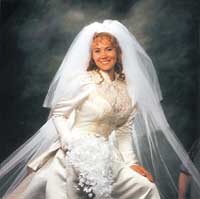
Photo 1. A
3/4 length seated bride is one of my most popular portraits. It shows
great detail in the gown, and shows the bride off at the same time. Notice
how it’s cropped--below her knees. Cropping it up higher loses the
balance of the composition and is much less effective.
Notice, too, how I’ve pulled out the base of her gown and veil at
the bottom of the portrait. This adds a great pyramid base to the picture,
giving the image plenty of support. The camera height is around the middle
of her chest. Her head was positioned while looking through the lens of
my camera. I knew exactly what I was getting when I took the photograph.
Her body is turned at almost a 45° angle to the lens and her head
is turned back toward the camera for a full face view. Undoubt-edly, the
light coming back through the veil is essential to have it look transparent.
She’s sitting on a posing stool that’s been adjusted in height,
so that when she crosses her front leg over the back, her legs slope slightly
downward. Her right arm is pulled back to show her waist line. Her left
arm is extended to form a nice connection with the upright section of
her body to her lap. The bouquet is held low enough, so that it does not
block her body.
|
|
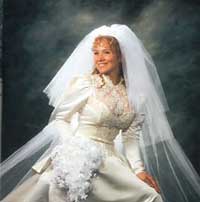
Photo 2. I’ve
changed practically nothing except to turn her head slightly so that the
camera sees her right eye going almost to the edge of her facial outline
(the 2/3 view of her face). Of course, I’ve moved my main light,
too, so that I retain the same light pattern on her face that I had in
Photo 1. This “modified loop light pattern” is pretty standard
in most of my portraits, because I feel that it is the most flattering.
At the same time, it creates a nice three-dimensional effect of her face
and body.
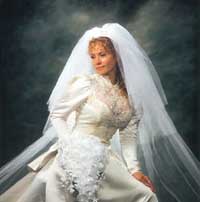
Photo 3. Exactly the same, except she’s looking
down. Notice that her eyes do not appear to be closed, because I’ve
directed her focus on a spot far enough away so that you can still see
the pupils of her eyes.
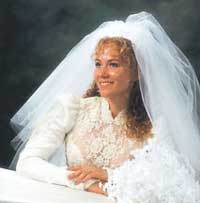
Photo 4. After the first series, I move in closer and
do this next series of portraits. I bring a posing table up, so that when
she rests her arms on it, her hands end up just below her bust line. I
usually pose her so that you can see the engagement ring. Of course, the
position of the camera is higher now. More like shoulder height. Notice
that the basic pose and lighting are the same, except that when I come
in this close, I turn her body straight into the camera for the 2/3 view
of her face.
|
|
Photo 5. While
she’s in that position, I raise the posing table slightly and bring
her hands up to her face. For this picture I’ve raised the camera,
so that the lens is above her eyes. Notice how her fingers are flowing
upward, not sideways. Hand posing is precise.
Photo 6. Here’s the same picture with her looking
downward again. You can still see her eyes, even though she’s looking
down. Also, notice that when her head and eyes are lowered, you have to
lower your main light, so that you still get light into her eyes.
Photo 7. Normally I wouldn’t do all of these, but
this can be a cute picture with the right person, couldn’t it? Notice
how the pictures flow from one to another without having to make a lot
of changes in posing and lighting. That’s what makes this series
so easy to follow.
Photo 8. There is very little change from one portrait
to the next. In this photograph the bride is holding her flowers close
to her face, yet her face still dominates the picture. Look closely at
her hand, too, her fingers are still pointing upward.
|
|
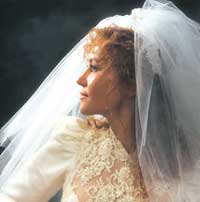
Photo 9. You
have to turn her body to a 45° angle for a profile. Also, lower the
camera, so that you see space between her chin and her shoulder. I usually
tuck the veil and hair behind her profile, so that nothing breaks the
outline of her face. Or I bring the veil forward, so that it begins above
her eye, I like this look, too.
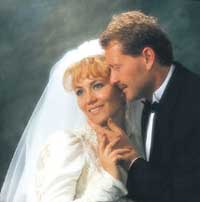
Photo 10. Time for the groom’s portraits. Here’s
an easy one, resting his hands on the edge of a posing table, or whatever
is available. The camera is back down to the middle of his chest for this
one.
Photo 11. Then, just raise the camera up a bit for a
close-up. Pretty easy and quick, huh?
Photo 12. For a little change, you can bring his hand
up to his chin and create a nice base for this simple composition. Notice,
too, the perfect 2/3 angle of his face.
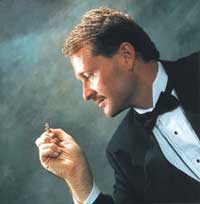
Photo 13. Why not move the light around to profile position
again and have him looking at the bride’s ring? Don’t forget
to lower the camera again for the profile. Also, have a gobo close on
hand to keep the profile light from flaring into the camera’s lens.
|
|
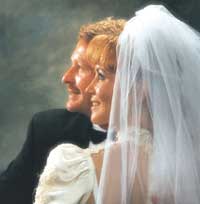
Photo 14.
It’s natural to bring the bride behind the groom for this picture.
No change in lighting or camera position. Be sure to keep her face turned
toward the light. Most photographers turn the second person toward the
profile, lighting the back of the head and keeping the face in dark shadow.
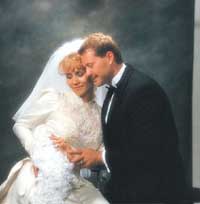
Photo 15. Why not switch them around for a matching portrait.
Try to keep their lips at the same level so that their heads form almost
a heart shape together. That’s what really “makes” this
picture.
Photo 16. With only a slight turn of his head, you have
an entirely new portrait. I keep their faces very close together and watch
to keep the bridge of their noses parallel.
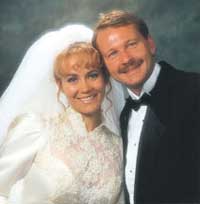
Photo 17. If one portrait is the most popular of them all, this
is it. His mouth is at about the level of her eyes and her left shoulder
is pulled back (under his arm). Their heads are parallel but her arm is
not around him it’s resting on his left hand. Believe me, this is
the most popular portrait of a bride and groom together.
|
|
Photo 18.
Here’s the exact same portrait with a stronger soft focus filter.
Up until now most of my portraits were with a No. 2 soft focus. For this
one I shifted up to a stronger one. You can’t do soft focus, unless
your lighting is direct--no diffusion. If the light is soft to begin with,
this filter will make the picture seem to be either too mushy or out of
focus.
Photo 19. Why not raise the camera up above their eye
level and do a close-up of the same pose?
Photo 20. Place his profile directly over the 2/3 view
of her face and bring their hands up. It’s as simple as that.
Photo 21. Without changing the pose, back up and get
a great picture of the couple looking at their rings. Keep their hands
just below the level of her bust.
|
|
Photo 22.
Then, come in close for a really great picture of their hands. Pretty
simple, huh?
Photo 23. When he brings her hand up and “touches
his lips to her fingers,” you’re ready.
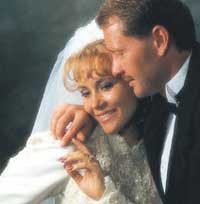
Photo 24. Or, if he puts his arm around her and she rests
her cheek on the back of his hand, you get this.
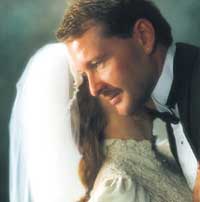
Photo 25. Something like this is often seen in the movies.
Since this is every brides fantasy why not keep up her dreams. This one
(and the bride over his shoulder) certainly performs that task.
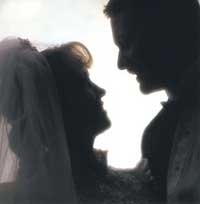
Photo 26. If you’re venturesome, this one is beautiful,
but it requires two main lights. One lighting each profile. You’ll
also need two reflector/gobos to prevent the profile lights from flaring
into your lens.
|
|
Photo 27.
By simply turning off all your lighting, except for a single light on
the background, you can come up with a perfect double profile. A great
way to end the wedding story, don’t you think?
So, what kind of equipment am I using for all of these portraits? My flashes
are all Photogenic, coming out of a single 800w power supply, PM08. I
have two main lights that are pointing straight through Westcott Mini
Apollos. I also use two Monte Illuminators (silver/black reflector-gobo).
My soft focus filters are Tiffen Soft/FX, No. 2 and No. 3--used individually,
or sometimes stacked together. They’re used in a Lindahl shade.
My camera is the Hasselblad. My favorite portrait lens is the 150mm, although
I have a complete assortment of other lenses. Believe it or not, one of
my favorite portrait lenses is the 40mm. I use that when I want to come
in close to my subject, keeping the people large and prominent in the
photograph, while showing a lot of background far behind them. The posing
table I use is from Photogenic, too. The only posing stool I use is the
AIM stool (sometimes referred to as the “Monte” stool). North
Amer-ican Photo is my lab of choice. There is no other, as far as I’m
concerned.
To see more images like these, check out the following web site: www.photo-world.com.
|
|
|
|
|
|
|
|
|
|
|
|
|
|
|
|
|
|
|
 |
|
 |
|
|
 |
 |
 |
|