


- REVIEWS
Camera Reviews 
More Reviews Mobile Reviews Photography Reviews - GALLERIES
- VIDEOS
- BUYER'S GUIDES

A Pro’s Two Fixed Focal Length Portrait Lenses & The Six Reasons He Owns Them; Only For The Not Ready For Full-Frame Players!
Given the current state of technology, a case could be made that a photographer
could exist today with only two lenses--a wide angle to moderate zoom,
and a short tele to long tele-zoom. That would be a mistake. For as good and
flexible as today's zoom lenses are, there are some compelling reasons
to choose fixed focal length lenses on occasion. I'll admit, 90 percent
of the time I've got a zoom on my rig, but I have once again found the
joy in shooting with fixed focal length lenses.
First, let me state that this article is aimed at those of us who do not own
full-frame digital cameras. While the debate about that is beyond the scope
of this article, the fact is that the 1.5 conversion factor of many cameras
make them ideal for portrait photographers who enjoy the image effects delivered
by long lenses and fast apertures. And they can achieve the look for a price
unheard of in medium format days.
 |
|
|
So here's what I'm suggesting as an unbeatable, inexpensive, butt-kicking
combo: a 50mm f/1.8 or faster lens, and a lens in the 80-105mm range at f/2.8
or faster. On my Nikon D200 and Fuji FinePix S2 Pro cameras, that's a
35mm format equivalent of a 75mm lens, and about a 120mm or 160mm lens. You
can do a lot of damage with this combo. Let's see why you should consider
this dynamic duo for yourself.
1) Image Effects
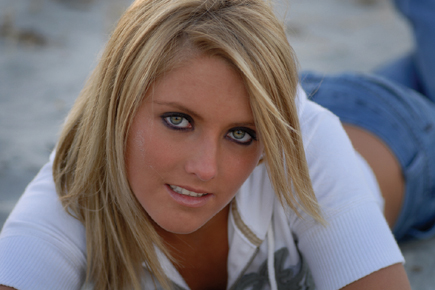
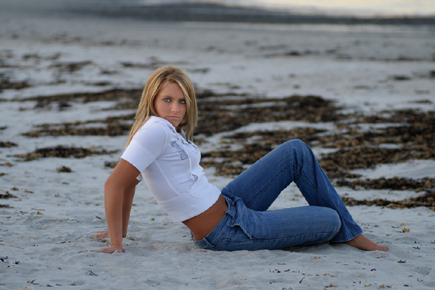
One of the cornerstones of professional outdoor portraiture is the ability to
separate the subject from the background. By shooting with these lenses wide-open,
or close to it, throwing backgrounds and foregrounds out of focus is almost
automatic. The longer lens is obviously more conducive to this because of the
larger image size at any given distance and narrower angle of view. Remember,
all lenses have the same perspective and to change perspective you must change
distance.
2) Price
Here's the best part: these lenses are free! OK, maybe not for everyone
or someone who's new to the game. But for those of us who have been shooting
35mm for years, we may already have these lenses! I still have a Nikon 50mm
f/1.8 lens (used to have a 1.4, darn) that came with one of several Nikons I
used to own. And I bought a Tamron 90mm f/2.8 Macro years ago for shooting flowers
and wedding detail shots. Both lenses are excellent performers. This is a great
combo. A little checking found used Nikon 1.8s for about $60 and new ones for
about $115. The Tamron lens can be had for about $400 new and $250 used. Nikon
also makes an 85mm lens in 1.8 and 1.4 varieties. The fast version is about
$750 new, the slower only about $400. For portraits, I'd say the 1.8 is
plenty fast; only buy the 1.4 if you do weddings in low light. Buy new or do
some checking around in Shutterbug ads to find the combo that's right
for your shooting needs and equipment.
 |
3) Availability
Since these lenses were originally designed for 35mm film cameras there are
plenty of them around. I found some in the camera store across the street. As
mentioned, check the ads in this magazine--you sure won't find them
at Best Buy! Keep in mind that if you're buying a new zoom lens it pays
to get one designed for digital. I've done testing and there is a difference.
The fixed focal length lenses I'm discussing here have all performed admirably
for me with my digital SLRs, so don't hesitate to buy them.














 FEATURED VIDEO


Get the Latest Photo Tips, News & Reviews from Shutterbug!







| Camera Reviews Other Reviews | |
Mobile Reviews Photography Reviews Columns | |
News | |
Features | |
How-To | |
Resources |
 © 2026 Shutterbug
AVTech Media Americas Inc., USA
All rights reserved