


- REVIEWS
Camera Reviews 
More Reviews Mobile Reviews Photography Reviews - GALLERIES
- VIDEOS
- BUYER'S GUIDES

Wedding & Portraiture
See And Think Like Your Lens
If you were a lens, what would you be thinking? If you could answer that, you'd probably be a better photographer. For the moment think about what the lens is doing for us, what it's seeing and how it's reacting. By doing so we can eliminate surprises. We know what to expect before we even see the picture. Why? Because it's there in the viewfinder of our cameras. First of all, you've got to be able to see what is in your viewfinder. Thanks to some of today's marvelous inventions like focusing screens, I am able to see, compose, and focus my camera--even when using wide angle lenses. In order to think like a lens, one has to see like a lens. There's really only one place to be looking when you're refining your photographs--right through your lens. I'm always amazed at how many people spend so much time refining a picture, never knowing what the lens is seeing. Once you and your lens see the exact same thing, it's easy to be the think tank for your lens. |
|||
Let's now go through a series of images that I selected from some of my recent classes. Let's think about what a lens sees and how it sees it. I'm not talking physics here. I really don't understand that stuff. What I do understand is that the lens is attracted to contrasts, where light and dark meet, and that if you want a face to stand out in a portrait you need to blend the clothing with the background. Photo 1 clearly brings that point home. Light wall, light suit, you see the subject! But to see the subject in a three-dimensional form on a flat piece of paper is still another story. What I did here was to select an area where I knew that I would have a simple background. A background with depth--one on which light would fall all the way to the back. I went under the cover of a long porch. Light was coming in from my left side all the way down to the end of the background up to where I was posing JJ and beyond. I couldn't go wrong. |
|||
Now, thinking like the lens, I wanted to see a subject with light that wrapped around, giving me a complete range of tones from highlight to shadow--all of which will print on color paper with detail throughout. I accomplished that by turning my subject so that the soft, diffused light coming from the open side of the porch lit just the right side of his face. I then took my Westcott silver reflector and positioned it camera left, almost facing toward the outside. That way, it picked up some of the daylight coming in and bounced it back onto my subject's face--all coming from the same direction as the main light. I exposed the photograph with my meter pointing toward the lens, measuring the light falling on his face with the reflector in place. I could feel my 150mm lens smiling back at me when I saw JJ's face smiling through it. It liked what it saw and so did I. |
|||
A few feet away from where I was posing JJ were the outside gardens of the Ringling Museum in Sarasota, Florida. You can see in the background a similar line-up of columns to where the previous portrait was made. But what I wanted my lens to see was more of the spectacular location in which we were holding the class. I wanted to capture the whole scene--the gardens, the trees, the statues. I knew that my wide angle 40mm lens would do it. I also knew, thinking about how my lens would react to the scene, that if I posed my subjects in the foreground where they would stand out with so much opposition behind them, I would have to have the same amount of light on them that there was out there in the bright sunshine. No problem. For Photo 2 I posed the couple only 6' from my camera and hit them with a strong flash all the way to my right, so that the light on them would not only be as bright as the sunshine behind them, but at the same time it would also seem to be coming from the same direction as the sunlight. |
|||
Thinking about how the lens was reacting to the scene, I knew that it was also warning me to keep a very plain area at the edge of their faces, so that there would be nothing to take away from the two of them. It wasn't easy with all that busy background. I finally had to make a choice and chose to place their faces where I did against the scene behind them, in spite of the fact that there was a tree coming out right behind his head. It was a matter of choice. The lens and I agreed that I had placed it right where it wanted to be. Photo 3 is part of my favorite family to photograph, JJ, Danielle, and one of her sons. What lens did I pick here and why? The 150mm again, because it selected them and threw the rest of the photograph completely out of focus. I positioned them as I had done many times before in that same location, because I knew it would work. There was an opening in the arches, camera right, and a little light coming in on both sides from more open arches behind them. I positioned them to split light their face with daylight, using a Quantum bare-bulb flash bouncing off the wall, camera right, two f/stops less than the ambient light. The bright light behind them created the high-key background effect. Not bad, huh? That's what you get, thinking with the lens! |
|||
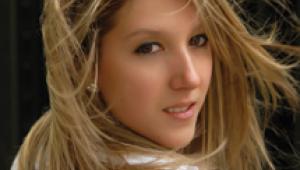
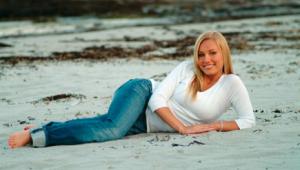
Photos 4 and 5 were made again with my 150mm lens, keeping them in plain, open areas, away from a distracting background. Split lighting from direct sunshine and strong flashes from the same side as the sunlight seem to do the trick. Shadows become transparent and natural looking. You could almost believe that it's the sand itself reflecting light into the dark areas. A close look at the shadows, however, shows you just where the extra light is coming from. So, what lens do you pick when you want to show the whole scene in which you're posing your subjects? The wide angle 40mm on my Hasselblad always works best for me. Look at Photos 6 (Paris Hotel from the Bellagio, Las Vegas), and 7 (Bellagio Hotel atrium staircase). Still, with all the magnificent settings the people stand out as the most significant part of these pictures. That's because they're only a few feet from my lens. In situations like these I'm again exposing for the background and raising the light on my subjects up to the f/stop for the correct exposure of the background. See what happens when you truly begin thinking like your lens! |
|||
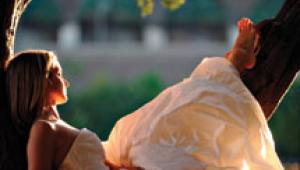
In Photo 7 I tried something different to make it appear as if it were made completely with the ambient light. On my exposure meter, I had the shutter speed set at the actual reading I had determined was correct for the staircase. The flash added just a kiss of light to bring their faces up a little bit to make it closer to the brilliance of the staircase lighting. My new Hasselblad and lenses are all automatic exposure, but I'm still a little afraid of combining ambient light and flash with TTL metering. I'm a little slow making big changes like that. In the meantime, my thinking is becoming more and more automatic. Guess I'm getting closer and closer to being "one" with my lenses! In Photo 6 the backlight on her veil adds a lot to the depth of the picture. There's a backlight in Photo 7, too, because lenses (and I) like to see some separation between the subjects and the backgrounds. |
|||
The lens wants to see fairly even illumination from front to back, so to make certain that I got detail throughout the picture, I thought to myself--you guessed it--expose for the background. Inside, I took a reading by the fireplace wall and set my exposure according to that. Then, I added two Quantum flashes, one at a 90 angle to both of their faces, the other flash fairly frontal, just a little bit camera left. Together, the two flashes equaled the f/stop of the background. Outside, I exposed for the ambient light throughout the scene and brought in a flash slightly under that, just to give me detail in their eyes. Too strong a flash would have made the cloudy, bright background go too dark, of course. I just couldn't resist a few more of my recent photographs where my lens simply captured my heart. |
|||
Photo 8 shows you what you can do with a child who doesn't want to be part of the picture. I knew I would come up with some great shots, and I did. When one of Danielle's boys didn't want to cooperate, I kept on shooting, and I loved the results! The photo was shot in all natural light with a 150mm lens. Photo 9, of another Florida sunset, was a direct steal from another one of my sunset pictures at the same beach with the same Kodak 800 Portra film. Why not? If it worked once, why not try again. This time with another slight twist€ The sky was great and I knew how to handle that. After the sun went below the horizon I took an exposure meter reading of the ambient light where I was standing. I even had a volunteer from my class go into the water behind them and to my left to create a little kicker light coming from behind. Of course, for a final print I could have cropped out the light where it flared slightly into the lens, but I purposely left it in, so that you could see where it was coming from. |
|||
Let's take a final look at Photo 10. You can see that I do use my "normal" lens occasionally. This time, I didn't want to go off the background, so the 80mm was perfect. All in all, I am really thinking and feeling like my lenses. How could I not? I see the image in my mind, and feel it in my heart. With these simple techniques, I'm sharing with you my statement about living, loving, and laughing. My lenses and I enjoy sharing our excitement with all of you. |


| ||
|
||







 FEATURED VIDEO


Get the Latest Photo Tips, News & Reviews from Shutterbug!







| Camera Reviews Other Reviews | |
Mobile Reviews Photography Reviews Columns | |
News | |
Features | |
How-To | |
Resources |
 © 2026 Shutterbug
AVTech Media Americas Inc., USA
All rights reserved