Breaking The Rules Fresh Techniques For People Photography
Jay Abend, April, 2000

| |
Photo 1.
Photos © 2003 Jay Abend, All Rights Reserved
|
|
If you still think of portraits
in terms of main light, fill light, and key light, I think you’re
missing out on some fresh and exciting techniques. While the classic
studio portrait is still practiced by lots of amateurs and practically
every portrait and wedding house in the world, editorial and commercial
photographers have continued to push the boundaries of what can commonly
be referred to as a “portrait.”
Since I’m a commercial photographer shooting almost exclusively
for advertising and corporate clients, I’m rarely asked to shoot
an old-fashioned portrait photo. What I am asked to do is capture a
great image of a person. While the person is sometimes famous or influential,
often it’s just a plain old headshot or environmental portrait
for a corporate brochure, web site, or annual report. Over the years
I’ve figured out a lot of fun and interesting ways to spice up
my people photography. I try and look at the source books like The Black
Book as often as possible to check the pulse of the photo community.
|
|
Even if your goal is not to
receive compensation for your portrait work, you’ll still want to
shoot images of friends and family that impress. Inspiration can come
from any number of sources, including the pages of photography magazines.
(Know any good ones?) I like to look through foreign magazines, especially
Japanese and British pop culture. When my own people photography gets
stale I like to see what they’re doing in other markets, and then
try to incorporate some elements of the best foreign work into my own.
If you’ve been struggling to perfect your own lighting and framing
techniques to get a decent portrait, then throwing away the rules might
not be such a good idea. However, if you’re comfortable with your
equipment and technique, read on.
The Gear. If you’ve read my other articles over
the years, you know that I’m a big proponent of less is more. I
like simple solutions to complex problems, and the cheaper the better.
However, when you’re trying to create fresh looking photos when
faced with too little time, impatient subjects, and fading daylight, you
need the right kind of gear. Now, you don’t have to go overboard,
but you’ll need some basics. For starters, a good selection of fast,
sharp lenses. I use everything from fisheye to super telephotos for people
photography, but if you’re on a budget a 28-70mm zoom and a 70-200mm
will do the trick. When looking for lenses, keep in mind that most inexpensive
zooms don’t focus close enough, can be prone to flare, and don’t
maintain a constant aperture over their zoom range. In short, try and
weigh cost against such attributes as super fast maximum aperture, pro
construction, and macro focusing.
|
|
When it comes to lighting,
you can get great shots with just the sun and a reflector or two. Trying
to rely on the sun on a regular basis you’ll find that you’ll
miss out on a lot of great opportunities. I use a combination of studio
flash units, battery powered pro flash units like my Balcar P2 system,
and shoe mount battery powered flash units like Vivitar 285s. I’ve
found that with a decent array of camera and lighting equipment, you can
do a lot.
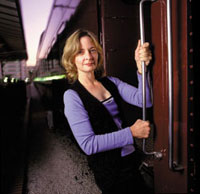
The Wide View. Everyone tends to think of a mild telephoto
lens as a good portrait focal length, but I tend to shoot more images
with normal to wide lenses these days (Photo 1). For this image taken
for a corporate brochure and web site, we scouted out a cool location,
the train tracks in downtown Orlando, Florida. To assure a decent supply
of AC power I rented a Honda gas-powered generator and had it delivered
to the site. Once fired up, we plugged in the flash units and arranged
a head with a Chimera medium softbox just to the left of the camera. Inside
the train I placed an old Soligor MK-10A flash with a Wein HS-XL mini
shoe mount slave eye for some sidelight. To keep the sky bright and add
some movement to the image, I set my camera (a Hartblei 1006SM) to 1 sec
and dialed the lens, a 50mm f/4 Zeiss Flektogon, to f/16.
|
|
When it was time to pose the
subject, I tried a lot of different positions. We tended to like these
shots, hanging off the train. By getting very close with a wide angle
lens I could bring a real sense of immediacy to the image, while also
getting a good sense of the train and the surroundings. The diffused light
provided by the softbox helped lend some nice light to the subject, while
also giving the image some sharpness and strong color.
A Different Angle. For a lot of environmental portraits
I like to introduce a different angle to the shot (Photo 2). By “dutching”
the camera, I add a refreshing look to the image. In this shot I had to
balance a ton of flash on the foreground subject with the ambient streetlights
in the background. While a handheld shot would have resulted in blurring
of the background, sometimes a desirable thing, I chose to mount my Hasselblad
and 150mm lens to a tripod. Once Polaroids established the correct balance
between foreground and background lighting I shot a series of images with
different angles. Certainly I can always turn the image sideways later
on, but I like to fill the frame. Leaving enough room for post-shoot cropping
would have shrunk the image a bit too small for my taste.
|
|
Lighting For Effect.
Sometimes it’s time to bring out the big guns (Photo 3). For this
magazine ad with musician Richard Patterson I brought out all the flash
I had, and used almost all of it.
Once we were set up at New York’s SIR studios I set up a rehearsal
stage with the client’s product. Hours before the artist arrived
I began lighting the stage. Since it would be shot with a Mamiya RZ67
and used as a full page ad, it had to be very sharp. In order to get f/22
with Fuji Velvia rated at EI 40 I needed two Balcar Starflash 2 power
packs firing into Chimera large light banks positioned just to the left
of camera. For the stage backlighting, I placed two Balcar Monobloc 3
monolights with amber gels behind the speaker cabinets. To light the ceiling
and add additional room lighting I positioned Sun Star Strobo MFH-25 heads
on Bogen Magic Arms about the set. In total there was about 10,000 ws
of power. It was a lot of work, but I think the image worked well.
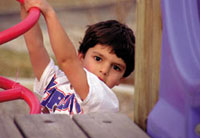
Work With Your Surroundings. Sometimes I like to use
foreground and background objects to “frame” an image (Photo
4). For this portrait I chose a very long lens, a 200mm f/2.8 on a Canon
EOS-1 and looked around the playground for a good mix of color. Satisfied
with the texture of the wood, the bright blue on the right side of the
image, and the red swirl on the left, I positioned myself to shoot through
the playground. The resulting image makes good use of the foreshortening
effect of long lenses.
|
|
I like to use this technique
when shooting executive portraits, often through office windows or through
open doorways. If you can shoot relatively wide open you can limit your
depth of field to make your subject really “pop.”
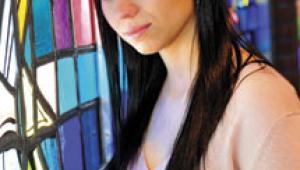
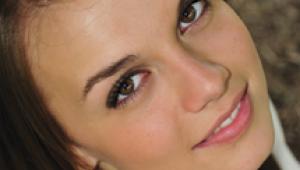
Unconventional Lighting Ap-proaches. I like to shake things up, and sometimes
that means putting light sources where you wouldn’t ordinarily expect
them (Photos 5 and 6). For this shot of model Holly Plunkett I hung a
Photoflex large light bank above her, and a Photek Illuminata on the floor
just to her right. The Balcar head aimed at the background was set to
provide tungsten illumination only, so when I shoot with a 4 sec exposure
I get that ghostly image blurring from my shaky handheld technique. While
the blur is a matter of taste, sometimes placing light sources beneath
your subject or below the camera can work well, as long as it is balanced
with some light from above. Too much light from below can result in a
horror-movie effect that looks very cool, but isn’t terribly flattering.
In general, I’ve found that by continuing to expand the boundaries
of what I would consider a “portrait,” I’ve created
more interesting photographs. While my approach usually involved a pretty
good arsenal of gear, you can recreate all of the shots in this article
with a 35mm camera, a shoe mount flash with extension synch cable, and
a small light modifier like a softbox or bounce card. All that is important
is the desire to change things around and look for interesting portrait
possibilities in unlikely places, with unlikely approaches.
|
|