Site Links
|
 |
 |
 |
People At Work Available Light Portraits
By Joe Farace March, 1999
| |
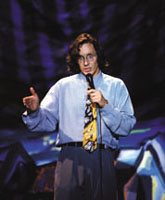
Telling
jokes might not seem like work, but it is for comedian
Jake Johannsen. Portrait made with a 300mm f/2.8 lens
on a Nikon N90 on Kodak’s KPT ISO 320 tungsten-balanced
slide film.
Photos © 1998, Barry Staver, All Rights Reserved
|
|
Over the years, photographers
have come up with a lot of clever names for “available light.”
When working under less than ideal lighting condition, you’ll
hear some people call it “available darkness” or “unavailable
light,” or when using supplementary lighting they may refer to
it as using “every light that’s available.” Out in
the real world, photographers working under whatever light that exists
in a given environment sometimes face many challenges in producing any
images at all. Nowhere is this more challenging than when creating available
light portraits.
Dick Stolley, who many consider Time-Life’s best Managing Editor,
once told People magazine’s contributing photographers that a
successful photograph elicited a “Gasp Factor” from the
viewer. If the image stopped the reader, forced them to take a second
look at it, to read the story’s headline, and then perhaps the
rest of the story, the photograph passed his test. Often the best photographs--the
“gasp factor” ones--are taken under less than ideal lighting
conditions. These “gasp” images are made on dark, cloudy,
stormy days, at the crack of dawn, at sunset, or even during in the
dark of the night. One of those People magazine photographers that Stolley
was talking to was Barry Staver, who took me behind the scenes of some
of his assignments while photographing people at work under less than
perfect lighting conditions. Based on my conversations with him, you
will see there is more to making available light portraits than just
cameras and film. Staver’s style of photojournalism, which emphasizes
the way he works with his subjects, rather than the hardware used to
create the images, places him into the environment so he can capture
action without being noticed.
|
| |
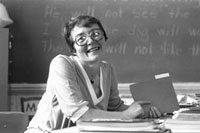
Lenses
used during the teacher assignment included the 24mm f/2.8,
85mm f/1.8, and 180mm f/2.8. This image was made with a
Nikon F3 and 85mm f/1.8 lens. Film was Kodak Tri-X and was
metered with a Minolta Flashmeter III in incident mode.
|
|
In A One-Room Schoolhouse.
One of Staver’s personally rewarding and favorite People
magazine assignments was the “Lowest Paid Teacher in America”
as uncovered by a National Education Association survey. The woman’s
name was Janice Herbranson who taught five elementary school kids in a
100-year-old, one-room schoolhouse in McLeod, North Dakota, a small farming
town near Fargo. Not only did Janice teach kindergarten through sixth
grade; she prepared two hot meals a day for the kids--breakfast and lunch.
She arrived early each morning, in the dark during the winter, to start
cooking a hot breakfast and begin lunch preparation in a small kitchen
off the main classroom. During morning classes she periodically tended
to the lunch being cooked. After school she cleaned the building, sweeping
the wooden floor with a broom. In addition to her duties, she became adept
at the mountains of paperwork needed to obtain grants for the school.
For her efforts to educate the students, feed them two hot meals a day,
and clean the school each night Herbranson earned $6300 per year.
Staver spent two days in early February with Herbranson and her kids.
Outside the temperature was 18° below zero and she sent them outside
for recess. While shooting indoors, Staver took off his boots so he could
quietly move about the small one-room school photographing without disrupting
the activities. It only took the kids a couple of hours to accept him
and stop looking up every time his shutter clicked. The resulting images
were used as the lead “Up Front” story in People magazine.
The piece was 10 pages long and was the first time the magazine led an
issue with a feature story which was told only by the photographs and
captions.
Lighting in the old building was dim, illuminated by bare bulbs hanging
from the high tin ceiling. The snow covered ground and overcast sky blasted
white light through the tall narrow windows. If ever there was a time
for black and white film, Staver thought, “this was it.” One
roll of color was shot for comparison, but none of these images were used.
The rest of the images were shot with a Nikon F3 using Kodak’s Tri-X
film rated at an Exposure Index of 1200, one and a half stops above its
normal ISO 400. Using a higher exposure index made it possible to use
smaller apertures and provided the photographs with more depth of field
and the ability to use faster shutter speeds. It also made it possible
to shoot the assignment completely with available light and eliminated
the need for flash that would have been very distracting to the teacher
and her students as well as ruining the ambiance of the old schoolhouse.
|
| |
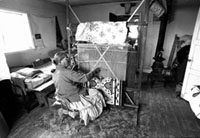
The
Navajo weaver photograph was taken with a Nikon N90 and
24mm f/2.8 lens on Kodak Tri-X black and white film rated
normally. Bracketing was not used because it would have
taken additional time and the weaver was uncomfortable having
strangers in her home.
|
|
It’s Not Always
Easy To Blend In. Another Staver assignment for People magazine
was following a veterinarian as he traveled across a Navajo reservation
in New Mexico reintroducing an all but extinct breed of sheep to the women
of the tribe. This sheep’s wool made for superior weaving into beautiful
Navajo rugs. The Navajo people welcomed the sheep, the wool, and the veterinarian,
but not the photographer. The only reason one of the weavers allowed the
photographer into her home was because he was traveling with the veterinarian.
In addition, since the woman did not speak English, a translator was needed.
In her home, which had no electricity or running water, the loom was the
central fixture. The entire scene was illuminated by light coming from
a window behind Staver’s main camera position and the one on the
left. Since the majority of the photographs he made of the Navajo weaver
are of the same brightness it was easily metered using the camera’s
built-in meter. If the window at the left had been larger or more prominent,
it would have misled the Nikon N90’s built-in meter by telling it
there was more light than there really was--which would have caused the
image to be underexposed. Out of respect for the weaver, Staver only made
a few exposures then left.
One way that Staver ensures that a bright or dark object doesn’t
fool the built-in meter is to point the camera away from the subject while
the light reading is taken, save that exposure using whatever meter lock
system the camera has, and reframe the photograph. Another way to ensure
correct exposure is to bracket your shots. Some photographers perform
the over-under bracketing in 1/3 f/stops. After the “correct”
metered reading has been shot, they shoot -1/3, -2/3, -1 stop. Then they
go the other way, +1/3, +2/3, and +1 full stop. I prefer to use a “biased
bracket” system in which you use the computer built into the top
of your head to determine if the correct exposure will be either over
or under the stated meter’s reading. That way you save film and
get more usable images from a smaller number of bracketed frames.
|
| |
For
this photograph of Robert F. Kennedy, Jr., a Nikon N90s
with 300mm f/4 mounted on a monopod was used. Film was Fuji
ISO 800 color negative film rated at 1600. Exposure was
1/60 sec at f/4.
|
|
Photographing A Speaker.
One of the most common photographs anyone--amateur and professional--gets
to make is that of a person making a speech. On assignment for The Denver
Post, Staver had to photograph Robert F. Kennedy, Jr. while he was making
a speech on a Denver college campus. Lighting in these situations can
be unpredictable, and the Kennedy speech was no exception. The room Staver
worked in had two weak spotlights haphazardly aimed at the stage. One
of the concepts Staver and I agree on is that it is always a good idea
to arrive early for any shoot. In this case, arriving early for the assignment
gave Staver the time to locate the building’s electrician and get
his help in aiming the spots toward the speaker’s podium. The speech
was photographed with two basic lenses: an 80-200mm f/2.8 zoom and a 300mm
f/4 and both lenses were supported by a monopod. A camera-mounted Nikon
SB26 electronic flash was set on TTL mode with flash exposure compensation
set at -2/3 stops to fill in the shadows under the speaker’s eyes.
For general work the 300mm f/4 is a good choice for a telephoto lens.
It’s smaller than its big brother, the 300mm f/2.8, and weighs less.
Fast lenses are a necessity for many available light situations, but a
300mm f/4 is adequate for stationary subjects like people making speeches.
The podium was on an elevated stage placing Kennedy head and shoulders
above the crowd which created another problem for Staver. When you look
up at someone from close range what do you see? You see right up their
noses. It can’t be missed; it’s right there in the center
of their face. Editors don’t like this camera angle any more than
photographers (or subjects for that matter) who care how their work looks.
Using a 300mm lens allowed Staver to be at a camera position farther back
from the stage, which reduced the angle from camera to subject.
|
| |
When
working in a “no light” available situation
there is only one solution: bring your own. While working
in a gold mine, Barry Staver used two Nikon SB24 electronic
flash units hard-wired together with the Nikon three-meter
cords that were modified to reach 25’. Camera was
Nikon N90s with 20mm f/2.8 lens and Kodak 100SW film.
|
|
Mining For Photographic
Gold. When a low-light event becomes a no light experience, you
need to add enough extra light for the photograph to succeed. In these
kind of situations, light can be added in several ways. Turning on nearby
light sources can often do the trick. Aiming vehicle headlights (turn
the high beams on, too) works well if the cars are nearby. If you provide
the main light from a flash or a continuous light source, any available
lamp can become an accent light.
The battery operated lamps on their hard hats that miners drilling underground
at the Newmont Gold Mine in Nevada use don’t provide enough light
for even the highest speed film available. Without any electrical power,
hot lights weren’t practical and the cabling necessary could pose
a safety concern in the darkened mine shaft. In difficult situations like
this one, small portable electronic flash units are the best way to light
small areas. To make the photographs for this assignment, Staver held
one flash off-camera high and to the left, while an assistant aimed a
second small flash at the background and second miner.
Since a mine shaft is a far cry from a comfy studio, several factors need
to be addressed to ensure a successful shoot:
1. The absence of light on the subjects makes focusing difficult. If a
bright enough flashlight is available, it should be aimed at the subject
long enough to focus on him. A seasoned veteran may be able to “guesstimate”
the camera-to-subject distance and pre-focus the lens, but a more foolproof
way is to actually measure the distance with a tape measure, then set
focus on the lens. That’s the way they do it in the movies.
2. Once these drills are turned on, it gets noisy. Ear protection is essential.
Hearing anybody is impossible and hand signals won’t work--remember
it’s dark in there. Preplanning before the drilling starts is the
only way to master the assignment. Before he did anything, Staver talked
to the miners to see how long they will drill in a particular spot. He
told his assistant exactly where to stand, checked his camera settings,
and was ready to shoot when the work began.
3. Underground mines generally have wet spots as water seeps through the
rock and some mines are very wet. Be prepared to deal with moisture by
having clear plastic bags to wrap around cameras and flashes. Drilling
into rock produces fine powdery dust that can ruin camera equipment. Plastic
bags will not only keep equipment dry, but will protect the gear from
dust, too.
4. A flash fired in a darkened area can really blind someone. Before the
session started, Staver checked with the miners and did test firings to
make sure the Nikon SB24 electronic flashes doesn’t hit them directly
in the face.
5. Working in mines can be hazardous and dangerous. Drills are heavy and
bits can break. They can also slip out of operators hands, letting rocks
fly farther than intended. Staver hasn’t been in a mine yet where
the mine Safety Officer didn’t accompany the photography crew and
make sure that all working conditions were as safe as possible.
No Laughing Matter. Staver had to photograph comedian
Jake Johannsen in a theater in Boulder, Colorado, during the taping of
an HBO special. Despite arriving two hours before the show’s curtain
call, lighting had not been set and technicians were still making adjustments
to the backdrop and props. It was chaotic and the needs of a still photographer
in the midst of a major television project rank at the lowest possible
point on the totem pole.
Because of these problems, it was not possible to take a handheld incident
meter reading that would take into account the final lighting setup. Once
the show began there were only two shooting positions available to Staver.
One was off to one side and the other was halfway back in the audience.
These locations kept the photographer out of range of the television cameras,
but also kept him from getting a meter reading from the front of the stage.
Using an in-camera meter reading would be wrong since the set or backdrop
for this show was a very dark blue and the subject was bathed in much
brighter light. The view through the viewfinder of his Nikon N90 camera
with a 300mm f/2.8 lens attached showed the comedian from knees up, to
a spot approximately 3’ above his head. From the location, the middle
of the theater, Staver was able with a Pentax spot meter to obtain a reflected
reading off the comedian’s face.
Manufacturers/Distributors
Eastman Kodak
343 State St.
Rochester, NY 14650
(800) 242-2424
fax: (716) 724-5629
www.kodak.com
Minolta Corp.
101 Williams Drive
Ramsey, NJ 07446
(201) 825-4000
fax: (201) 327-1475
Photofax: (800) 528-4767
www.minoltausa.com
Nikon Inc.
1300 Walt Whitman Rd.
Melville, NY 11747
(800) 526-4566
(516) 547-4200
fax: (516) 547-0362
www.nikonusa.com
Pentax
35 Inverness Dr. E
Englewood, CO 80155
(800) 729-1419
(800) 877-0155
(303) 799-8000
fax: (303) 790-1131
www.pentax.com
|
 |
|
 |
|
|
 |
 |
 |
|