Important Milestone Photographing The High School Senior
Steve Bedell, March, 1999

| |
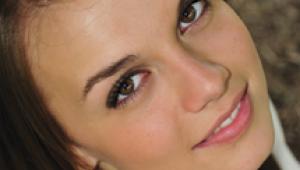
This
is a pretty traditional head and shoulder pose that has
had a little warmth and design added to it by using a
tapestry background that I bought at a fabric store for
about $20 and added an amber gel to the background light.
A little warmth is also added by amber gelling the hairlight.
(Bronica SQ-A; 150mm lens; Kodak VPS 220 film; diffuser;
f/5.6. Model: Melissa Whitney.)
Photos © 1998, Steve Bedell, All Rights Reserved
|
|
I’ve been doing photography
of high school seniors for over 20 years. When I first started, I wasn’t
that much older than they were, but, of course, they stay the same age
every year while I get a year older with each new batch. Seniors are
a big part of my business, and hopefully I’ve learned a thing
or two about the market over all these years. The two biggest things
I’ve learned are:
•Your marketing should be directed toward the girls.
•You must make substantial changes each year (poses, backgrounds,
props, etc.).
Let’s look at the marketing end of things briefly before we focus
on the photography. About 80 percent of the seniors I shoot are female.
Why? Because, generally speaking, the girls are the ones willing to
make an effort to come to my studio, spend more time, and spend more
money. Many of the guys are quite content to get in line at the school
and have their four minute session done by the contract photographer.
Think of it as the path of least resistance.
On the other hand, many of the girls are much more concerned about how
their photos will look and understand that the senior portrait is not
just a picture of their face, but a reflection of who they are at this
important milestone in their lives.
First of all, our typical session has three to five outfits, studio
and outdoor shooting areas, and about 25 different poses to choose from.
I’ll shoot close-ups and full lengths and everything in between.
A couple of shots may include the family dog or a “buddy”
picture. Depending on the time of year and my schedule, I have to shoot
all this in 60-90 minutes. I’ll shoot five or six sessions a day
like this during peak season (August in the Northeast). Done right,
it’s demanding and difficult work. It can also be very rewarding,
both financially and artistically.
|
| |
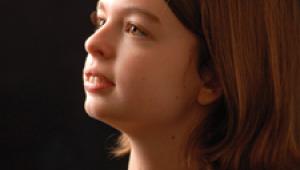
A
park bench, soft light from camera right, silver reflector,
and winning expression combine to make this shot a success.
(Bronica SQ-A; 150mm lens; Kodak PPF film; diffuser; 1/125
at f/5.6. Model: Katie Galanes.)
|
|
As in any photography session,
the first step to success is establishing a rapport with your subject.
Seventeen year olds are very quick to pick up on any false signals you
may be putting out, so don’t try to fool them at all. Be completely
honest and let them know that by working together you’re going to
produce the best photos of your subject they’ve ever seen. If you’re
a skilled photographer, this really shouldn’t be that difficult,
since at this point in their lives they’ve probably only had school
and department store photography for the past several years. Your subject
will pick up any “bad vibes” that may be emanating from you
and it will show in the photos. The reason they came to you was because
they felt you could do the best job on their portraits. If you aren’t
confident in your abilities, why should they be?
The first thing I do is go over the clothing options they brought with
them. I’ll usually ask them to bring more outfits than they’re
going to wear. I’ll give suggestions, but tell them to bring what
they like best. Gone are the days of drapes and bow ties. And usually
if they’ve got tattoos and piercings, they want to show them, at
least in a few poses.
While I’m checking out the clothing, I begin categorizing it. Outfit
one is studio, outfit two is outdoor, maybe we’ll split outfit three,
etc. If I’m doing five outfits, I’ll try to group the outfits
so I’m not constantly going from studio to outdoor and back again.
I’ll maybe do two inside, the next in and outdoor, then the last
two outdoor only.
I’ll further divide the outfits by color so it will save me time
changing backgrounds. If they’ve got two blue outfits and a brown
one that I’m shooting in the studio, I’ll go from one blue
to the next instead of sticking the brown in the middle. Then maybe one
shot will use the same background and at least save me one background
change. While we’re on the subject of backgrounds, here’s
a rule that I’m pretty strict about. Don’t use the same background
more than twice, and even then change the pose.
You may have surmised you need a few backgrounds. You do. I keep a traditional
background that covers the wall. I then have a cable that has four muslins
hanging from it that I can pull over just like a curtain.
|
| |
I
love barefoot poses. I asked Shannon Bostrom to sit on the
floor and this is close to what she did, I just refined
it a little. I usually see what the senior will do without
coaching instead of telling them to sit a particular way.
Many times it’s better than what I had planned. This
was done on Kodak VPS but I’ve since started shooting
the white background with the PPF because the higher contrast
helps keep the white pure without having a light on each
side of the background. (Bronica SQ-A; 150mm lens; no diffuser;
f/5.6.)
|
|
Most of my backgrounds are
plain, classical, or subtle. I avoid anything that may look like a department
store background (like lasers) or anything corny (like “hot”
or “cool”).
Same thing goes for props. I use very few props or have them bring their
own so they mean something to them. I keep some chairs and pillows available
and that’s about it.
As far as lighting, I use a “nailed down” four light system
that I change as little as possible. My hairlight is a small flash unit
that is clamped to the ceiling. I keep an amber gel on it to make hair
slightly warmer and meter it so it’s about the same intensity as
my main light with a seated subject. My fill is a big umbrella, my main
is a 3’ square softbox, one stop greater than the fill. The light
I change the most is the background light. I add and subtract light with
neutral density gels and change it with colored gels. I’ll sometimes
light from the side and I’ll up the power when using the white background
to keep it white. The lighting is a separate column, I just want to get
the point across that I try to keep it simple and keep variables to a
minimum.
Let’s start shooting in the studio.
I usually start with a pretty simple head and shoulder pose. They’ve
usually done something similar in “school pictures” so it’s
a good warm-up. It lets me see at once if they’re relaxed and easy
to pose. I ask them about school, work, future plans, family members,
movies, music, and whatever else the conversation might lead us to. It
tells me more about them and also relaxes them. I keep music on in the
studio always.
I shoot with a Bronica SQ-A in the studio and outdoors. I use Kodak VPS
220 inside and Kodak PPF 200 outside. I use the VPS inside because I like
the moderate contrast and it’s the standard for negative retouchers,
an important consideration with seniors. Outside, I use the PPF because
the 400 speed lets me shoot without a tripod and I like the contrast and
color boost, especially if I diffuse it. Most shots are taken with a 150mm
lens at f/5.6 or f/4. Diffusion is accomplished using a Pro-4 lens shade
with a warm/soft filter that I can snap in and out. I have tested the
new Kodak Portra films and was very impressed with them, so I’ll
be replacing VPS with the Portra160NC (Normal Color) for the studio and
the Portra 400VC (Vivid Color) for my outdoor shooting.
This shooting system allows me to move quickly from the studio to the
outdoors. I keep a quick release plate on the bottom of my speed grip.
I just switch film backs going in and out, pick up the camera, and go.
On some sessions I shoot sepia prints using the Kodak T-Max 400CN film
and a 35mm camera. I don’t just duplicate the color shots, but try
to have the sepia prints more natural looking and mostly outdoor poses.
The outdoor poses are by far the most popular with our seniors. I think
one of the reasons for this is the infinite variety. My studio is located
in the center of a small city. Many outdoor photographers have specially
landscaped outdoor shooting areas that are built with special attention
paid to where the light will be at different times of day. I had an area
like that in one of my previous locations. They work very well but can
sometimes contribute a “sameness” to the photos--something
to be avoided in senior photography. With the city as my backdrop, I have
an ever changing variety of locations and lighting conditions every day.
While it’s true that there are a couple of locations that I know
I’ll use because they are sure fire winners, I strive to make sure
each set of prints that leaves my studio has some unique images. I’m
fortunate to have a river and grassy area within walking distance and
also a few trees right next to the main street with the best light in
town. But I like to mix the traditional outdoor poses with more contemporary
looks that include brick walls, doorways, and architecture, and my seniors
like it, too.
All the above is basically a crash course in senior photography and many
of the individual elements worthy of their own discussion. But to be successful
in this venture requires you to go beyond basic posing and lighting. You
must interact with your subject and show them for the beautiful, self-assured,
young women that they are. You must go beyond cheesy smiles and develop
a trusting relationship to find the true expression that lies in their
eyes.
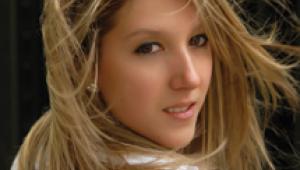
Here are a few examples of recent high school seniors I’ve photographed
during the summer of 1998. The self-assured look they all share must come
from the confidence they feel in you, the photographer.
If you’d like to learn more about high school senior photography
and are a full-time professional photographer, contact Senior Photographers
International, PO Box 07399, Ft. Myers, FL 33919; (941) 590-0560.
|
|