Site Links
|
 |
 |
 |
Wedding And Portraiture Unlimited Vision With Medium Format
By Monte Zucker January, 1998
| |
Photo
1.
Photos © 1999, Monte Zucker, All Rights Reserved
|
|
My Hasselblad gives me unlimited
vision. “Ideal” is another way of putting it. I never have
to think or compose any of my images to fit into a pre-prescribed format.
Horizontal? Vertical? Things I never have to consider. Cropping? Why
not compose on the ground glass before you make the picture? Why not
fill the space as you ideally would like to see it? All of these reasons
and more are why I feel that the medium format (square, to be more exact)
works so well for me.
Sure, I own a couple of 35s. They really work for me for convenience
sometimes, but my camera of choice is, undoubtedly, the Hassy. Let my
pictures speak for themselves. If they don’t, then I’ll
help you see what I see, know what I know.
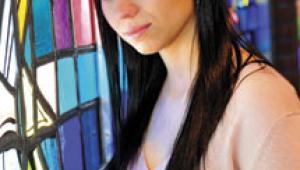
Let’s first take a look at Photo 1, the young lady in the blue
gown. What you are looking at is my vision of her at her best. Does
her bare shoulder and the draping of her dress around the shoulder increase
the interest of the portrait? Of course, the picture could have been
created as a vertical, but at what loss of interest and composition?
I love the image just as it is. I’ve used every square inch of
the format for specific reasons. Let me explain.
There’s more space in front of her because she’s looking
in that direction. I’ve cropped the portrait, so that her eyes
are 1/3 the distance from the top. I’ve even got the background
lighter in front of her face and darker behind her to keep the interest
on the highlighted side of her face. All visible on the ground glass
before the exposure was made.
The portrait was created by window light split-lighting her face. I
added a bare-bulb flash to my right, two f/stops less than the daylight
to help wrap the light around onto the right side of her face. Exposure
was for the daylight. The medium format allowed me to check out my daylight
to flash relationship with Polaroid. Only with a medium format camera
can I do that.
|
|
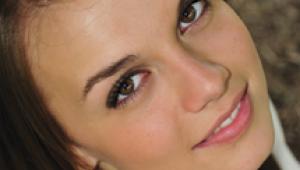
Similarly, in the outdoor portrait
of the bridal couple (Photo 2) I’ve carefully placed the heads with
more space in the direction that they’re looking. On the ground
glass I posed them, so that their heads would be close together and, believe
it or not, even made sure that their noses would be parallel. Their arms
leading down to the left hand corner of the print are all a part of the
full square composition. Could the picture have been cropped to a different
format? Probably. Better? I don’t think so. Square for me again.
The lighting, by the way, was achieved by placing the couple under an
overhang of the building, shielding the light from the top of their heads
and from my view of their faces. The light came from beyond the overhang.
A Westcott Monte Illuminator (silver/black reflector) placed camera left
pushed the light around onto the left side of their faces and kept the
light from flaring into my lens.
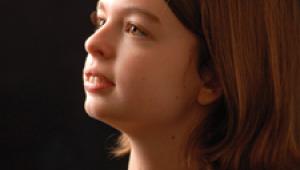
I used a 150mm lens for the first two portraits and Photo 3, the profile
of the bride. There’s absolutely nothing that I could crop out of
this picture. Make a composition like this fit into a rectangle? I think
that it would be destroyed. What about the retouching? Even with this
bride’s beautiful complexion, there are many areas where I would
want corrections. I just never feel that any portrait is complete before
it’s retouched.
|
|
The sepia tone of the portrait
is a result of using Kodak’s T-Max 400 CN film. Lighting, of course,
was by my complete Photogenic portrait studio and Westcott Mini Apollos.
There’s a total of five lights on this portrait. With all the pains
that I take to create fine portraiture, I can’t think of any reason
to use any less than a medium format camera.
As a matter of fact, years ago when medium format began to replace 4x5
cut film, I was very skeptical about the smaller sized film. Okay, I accepted
it--with pleasure. A lot less of a camera to carry around. But leave my
square format Hasselblad behind now? I don’t think so.
|
|
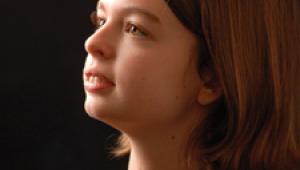
Photo 4, the studio portrait
of the family group, was undoubtedly made with 21/4 film. The fantastic
studio props are by Off the Wall. The setup was in the studio of Tim Roberts,
Boca Raton, Florida. I’m a consultant for Roberts, helping him with
many of his different photographic endeavors. This group was created by
Roberts, using his Hasselblad, too. Where/how would you crop it, other
than the way it was composed? No way.
Roberts and I again used Photo-genic/Westcott lighting. Two main lights
both came from camera left. The first light came in at a 90° angle
to the faces. The second came in at an angle much closer to the lens.
We were careful to pose each person, so that both lights would illuminate
their faces. The fill light, high and behind the camera, lit up the entire
scene.
I’m a firm believer in keeping things simple, especially when you
have two young children, each with their own personalities and desires
to escape the confines of the portrait environment. The square format
kept everything within bounds, and just look at the way we used the diagonal
composition of the steps, played against the verticals of the back wall.
Once again, everything fit perfectly into the square format. A 150mm lens
worked here, too. Thankfully, Roberts’ studio is huge. Otherwise,
we could have had used a 120mm lens (if we’d have had it).
|
|
Photo 5 is of a bride at the
entrance to Roberts’ studio. Just kidding--it’s really the
Cathedral Room in the Boca Resort and Club. Anyway, take a look at that
setting. Don’t you think that this bride wants to remember every
single detail of the room in which she got married? What would she want
to eliminate from this setting? Not much.
Once again the medium format camera is a winner. Switching lenses to a
wide angle lens allows all of this to happen. Keeping the bride up close
to the camera keeps her the center of interest, in spite of everything
that’s happening in the background. The square Hasselblad format
once more saves the memories.
This image was created by exposing for the existing light on the bride,
complemented with two Quantum flashes. One was in profile position--all
the way over to the right. It was set to automatically match the f/stop
on the camera. Quite an accomplishment at such a great distance and in
such a huge room, don’t you think?
A second flash was placed behind the bride to backlight her veil. That
flash was one f/stop greater than the other. Without it, her veil and
the back of her gown would have faded into the background.
The ribboned aisle, the series of windows, arches, and the candelabraes
above her all set the scene. I wouldn’t want to change a thing.
By placing her profile left of center and against a plain dark background,
Roberts positioned her perfectly in this square format.
Roberts has been a fast-learn. He was already a hugely successful photographer
in the Boca area before I began working for him. He told me that he had
attended several of my lectures, before I even approached him about possibly
becoming a consultant for him. Now, he’s keeping me (in my retirement)
busier than ever.
You can check my web site--www.montezucker.com--for
information on my classes. Of course, you’ll also find countless
pages of additional photographic and digital instruction there at no charge
to you.
Just about all of my images on film are done with a Hasselblad on Kodak
film. As you can see, it’s the medium format for me and most of
the people with whom I work. What we see is what we get. No need to change,
adjust, or crop composition. Besides, my lab, North American Photo, loves
to work with my 21/4 square negatives. Plenty of image size there for
retouching close-ups, and plenty of negative there for any size enlargements
that I want to produce.
Nope. No question. No limitations with this format. I see it all clearly
before I take the picture, and my vision is unlimited, to be sure.
|
 |
|
 |
|
|
 |
 |
 |
|