


- REVIEWS
Camera Reviews 
More Reviews Mobile Reviews Photography Reviews - GALLERIES
- VIDEOS
- BUYER'S GUIDES

Quick Tips
Shooting Spectacular Sunsets
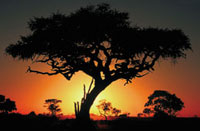
Have you ever been disappointed with your sunset photos? Do they lack color, drama, and impact? If so, here are my quick tips for turning sunset snapshots into great shots! Timing. You'll get the most spectacular colors just when the sun kisses the horizon and after it has finished its kiss. That's not to say that you can't get great shots before and after those magic moments. Therefore, be prepared--with plenty of film and lots of time--to capture the ever-changing colors in the sky, which can change from second to second. Composition. Ye old saying: "Dead center is deadly." In photo terms, this means: Don't put the sun in the dead center of the frame! Rather, place it off-center. This technique, effective for most subjects, draws the viewer into the scene by forcing him or her to look around the frame. |
|||
And speaking
of deadly, don't place the horizon in the dead center of the frame.
Place it low in the frame when the sky has lots of color, and high in
the frame when the foreground is interesting, as is often the case when
photographing sunsets over water.
Foreground Elements. A sky filled with spectacular colors is a great photographic subject. But place a dramatic foreground element in the scene, and you have a knockout photo. Trees and buildings are great sunset foreground elements, so are people and animals. Lenses. Photograph a sunset with a 24mm or 35mm lens and the sun will look like a pea in your picture. That may be okay, if the sky and foreground are interesting. Use a telephoto lens in the 300-600mm range and the sun will look like a huge ball in your picture. A dramatic effect, indeed. Accessories. A tripod will come in handy after the sun has set--when you want to get those low-light shots of a pastel-colored sky--pictures that required shooting at slow shutter speeds. |
|||
Red, yellow, and orange filters can help with dull sunsets, but I don't recommend them for naturally great sunsets. These filters tend to make the scene look too artificial. Gradual filters can help improve sunset photos. These filters are dark on the top and clear on the bottom (held in one position) and smooth out the contrast range between a bright sky and dark foreground. These filters are available in several different densities, allowing you to match the bright and dark areas of a scene for picture-perfect results. Film. I photograph sunsets with two films: Kodak Extra Color 100 for before the sun has officially set, and Kodak Elite Chrome 200 for those twilight shots. And I take more film than I think I need, several rolls of each. With ISO 100 and 200 films, I'm prepared to take pictures of the entire sunset sequence, only one of which, I've learned from years of experience, is the one I really like. |
|||
Exposure. I shoot slides. To ensure a good exposure, I take a reading of the brightest area of the scene and shoot at that setting. Then I take exposures at one-half stop and one stop under that setting (for a total of three exposures). The underexposed pictures have more saturated colors, and I sometimes prefer these shots over the "correctly" exposed ones. If you shoot negatives, I recommend setting your camera on automatic. Take your shot. Then set your ISO dial to twice the ISO setting (ISO 100>200, for example) and shoot again. If your pictures are too dark or too light, or lack brilliant colors, take 'em back to your photofinisher and ask for a redo. Because negatives have a wide exposure latitude, you should be able to get a print you like. |
|||
Have Fun. Please don't get too caught up in the technical aspects of sunset shooting. After all, you're there to have fun! So enjoy the moment. And if your shot does not turn out the way you saw it in your "mind's eye," remember that you can use Photoshop or other imaging programs to enhance the colors, contrast, and exposure of your scene. |



| ||
|
||












 FEATURED VIDEO


Get the Latest Photo Tips, News & Reviews from Shutterbug!







| Camera Reviews Other Reviews | |
Mobile Reviews Photography Reviews Columns | |
News | |
Features | |
How-To | |
Resources |
 © 2026 Shutterbug
AVTech Media Americas Inc., USA
All rights reserved