| |
Fill
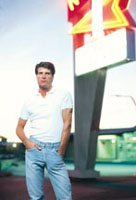
flash at sunset can be very dramatic. To create a surreal
look, I overexposed the foreground and added a little bit
of flash shot through a small softbox.
|
|
The first thing that every
photographer must be concerned with is light. Quality and quantity are
critically important. With a good studio flash system, neither are ever
in doubt, however out in the field you’ll have to deal with the
sun and whatever other ambient lighting is available. There are three
accessories that you must own to create good-looking light in the field--an
extension cord to get your flash off the camera, a small softbox or diffuser
for your flash, and a portable reflector card or folding reflector panel.
The extension cord is a must. On-camera flash looks harsh at best, and
downright flat as your distance from the subject increases. With any modern
SLR camera, be it 35mm or 21/4, you should be able to get an extension
cord that preserves all of the Off-The-Film (OTF) exposure capabilities
of your flash unit. Call me old-fashioned, but I just use a regular old
PC to household synch adapter hooked into a hardware store extension cord.
This gives me nearly unlimited cord length for a few bucks. I never did
trust that OTF stuff anyway, so I meter with the flash on manual and set
my exposure by hand.
A small softbox or reflector system is really important. Even an inexpensive
off brand flash unit can look like a $10,000 flash system when the light
is modified correctly. While a typical 50 ws on-camera flash doesn’t
have much punch when diffused (you’ll lose about three f/stops over
bare tube), with reasonably fast film you can still get a good f/stop
to work with. Another approach that is very portable and pretty efficient
is a reflector system like the Lumiquest. These reflector systems consist
of a vinyl backing card and usually a handful of different materials that
the flash can bounce off of. While photojournalists have long favored
an index card stuck to the back of their Vivitar 283s, the bounce system
usually relies on having a white or neutral ceiling to help with the bounce
chores--an impossibility in the field.
|
| |
Direct
sunlight can often be overly harsh, so I positioned four
silver reflectors around the model. Notice how well the
shadows, like those under his chin, are filled in.
|
|
The last accessory that you
must have is a good reflector card. Cheapskates like me fashion our own
out of white foamcore and some silver reflector material--a very wise
investment is a knock-down reflector system. Considering that a 42”
reflector system with a silver face on one side and a gold face on the
other is less than $75, it makes good sense to own one. If you’re
hell-bent on frugality, then you can do what I do. I take a 30x40”
piece of foamcore and cut it in half, making two 30x20” pieces.
I rejoin the two pieces with a wide strip of sturdy Gaffer tape on one
side only, creating a hinge. Then I cover the taped side of both sheets
with a single sheet of a silver material like Cinemills excellent M-270
Scrim material. This woven silver material allows some light to be bounced
back by the foamcore, the rest by the silver surface of the scrim. The
result is a very nice folding reflector card for around $20.
Once you’ve got your tools together, it’s time to shoot. An
experienced photographer already knows that direct sunlight can be quite
spectacular. That same photographer also has hundreds of rolls of film
of friends and family squinting into the harsh sun, their faces a mess
of hot spots and inky black shadows. One great approach to shooting in
daylight and really giving your subjects some nice light is to position
your subjects in shade. A several f/stop difference will create enough
underexposure in the foreground to add your own light source and make
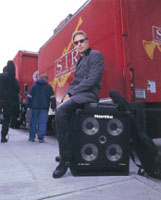
it the defining light. A good example of this is an assignment I recently
had to shoot--Will Lee, a musician on The Late Show with David Letterman,
for a print ad campaign. The client wanted him posed on the street with
a group of rental studio trucks in the background. Once we had all the
elements in place it was a matter of determining how to deal with the
lighting. It was a bright sunny day in Manhattan, but direct sunlight
would have blasted out all of the detail in the client’s product.
We positioned the product and Lee in the shade of a nearby building, and
I set the lens on my Mamiya RZ67 to expose for the sky in the background.
To light the foreground I chose a small flash unit bounced off of one
of my folding reflector cards in the foreground, and a small Vivitar flash
synched via a Wein Super Slave to add a highlight off the side of the
truck. The result was excellent foreground detail and a bright sky that
suggests daytime. Since I had enough daylight to get a decent f/stop without
any additional light, the fill flash didn’t need to be from a beefy
studio flash. A couple of 283s worked great.
Another shot brings up a different lighting chore--harsh midday sunlight.
For this fashion catalog shot of a model leaning on a red car in front
of a few New York brownstones, we had to deal with brilliant noontime
sunlight, without a cloud in the sky. Experiments with diffusing the daylight
with a large diffusion panel didn’t work, since the buildings in
the background would be receiving direct sun and thus be way overexposed.
While flash added, even off-camera flash, helped, we needed a bigger,
broader light source. Since studio flash and a few AC generators were
out of the question, I took four silver reflector cards and positioned
the client, the stylist, the makeup artist, and my assistant around the
model and instructed them to bounce as much daylight as they could directly
onto him. While a single reflector card looked very artificial, the four
cards bouncing sun from different angles softened everything up and looked
perfectly natural.
When shooting people in broad daylight, try and turn them away from the
sun if possible. In the spring and fall the daylight has a strong directional
quality, and setting your subject up for severe backlighting will allow
you to position your reflector as much as you would an umbrella in the
studio. For shooting in harsh summer light think about a gold reflector.
I love shooting my kids in midday sun and angling them to create some
shadow on one side of their face. I then bounce in some gold tinted daylight
from one of my homemade reflectors and the resulting pictures look deliciously
warm.
There are some effects that usually are associated with expensive location
gear, like those other wordly fill-flash portraits favored by magazine
photographers. You’ve seen them before, the subject lit by seemingly
perfect studio lighting, the background a deeply saturated, obviously
real location. I have created this look hundreds of times with my battery
powered Balcar flashes, but you can get a similar effect with a modest
shoe mount flash and a small softbox.
I have recently become quite fond of the Photoflex XS Silver-dome softbox.
This tiny 12x15” softbox is designed for small flashes, and its
silver interior makes it very efficient. A good example of what can be
done with a small flash and a softbox is illustrated in the picture of
the model posed in front of a drive-in hamburger sign. We wanted to get
a combination of the tacky neon of the sign, a bright sky indicating the
first tinges of a sunset, and the model seemingly lit by broad daylight.
To accomplish it we brought the model out some distance from the neon
sign, making him totally backlit and very dark. I overexposed the background
a few f/stops to create a colorful and punchy image, then lit the model
in the foreground with a simple Vivitar flash shooting into the Photoflex
Silverdome. I was able to get f/5.6 with 64 speed Kodachrome, and a 2
sec exposure took care of the background. While I shot a series of exposures
with shutter speeds as brief as 1/30 of a sec, the long exposure gave
the image a surreal look that worked.
While I have relied on assistants and clients to help hang on to the reflectors
and diffusers, a one-man show can function quite nicely with a few small
light stands and a hand full of Bogen Superclamps. While reflectors and
diffusers combined with the sun create a light that is easily previewed,
little flash units have no modeling lights, so their effect isn’t
visible until you look at the pictures. Pros preview the effect of their
flash’s output with Polaroid film, and I have Polaroid backs for
all of my cameras, even NPC Forscher Probacks for my manual focus Nikons
and my autofocus Canons. Since $600-$800 may be way over your budget for
a Polaroid back, you’ll have to learn to visualize the effects of
your flash without seeing the results in the viewfinder. It is for this
reason that I prefer to use a manual flash and a flash meter. By independently
metering the existing sunlight and the output of my flash, I can decide
how to expose to create the look I want.
Working with small battery powered flash units will never replace a full
blown pro lighting rig, but if you’re clever about it and can deal
with a medium or even fast film, you can pull it off. I’ve found
that 400 speed Fujicolor in a medium format camera can deliver really
nice 8x10 prints. I use this setup quite a bit to photograph my kids in
a formal/informal type of portrait shot at the local park. I’ll
bring my little Vivitar flash unit, the extension cord and a small softbox.
To make things easier I’ll bolt the whole rig to a heavy-duty Bachrach
flash bracket, removing the flash occasionally to create a more dramatic
light quality. Since I don’t bring light stands, I’ll just
have my wife hold the flash and move it around a bit to create some different
lighting results.
When shooting outdoors you usually have access to an ample amount of natural
light. Heavily overcast days usually result in very poor results, but
when enough of your flash is added, you can produce really dramatic portraits.
For overcast conditions when you don’t have a flash or don’t
plan on bringing one, a gold reflector can really punch things up. Even
thin wispy clouds can really cool off the color temperature of the daylight,
and a warm gold reflector can bring the life back to flesh tones. Since
heavy overcast results in a soft omnidirectional light, you’ll have
to bring the reflectors very, very close to the subject to create any
noticeable results. I have a couple of small 24” square gold cards
that I bring along, and I’ll place them no more than 18” away
from the subject and then shoot with a 100-135mm lens. This creates a
very tight but beautiful portrait.
Regardless of the situation, the clever creative photographer can produce
good results. While I usually throw as much technology as I can at the
lighting problem, a photographer with even a basic outfit can almost always
take great pictures. The key is to look at the quality of daylight, the
position of the sun, and the possibilities of adding light with reflectors
or small flash units. As with any technique, the only way to get good
enough to accurately “previsualize” this look in your head
is to expose lots of film, take notes when you shoot, and document your
results thoroughly. I guarantee that anyone with a camera, lens, a sheet
of foamcore, and a small cheap flash can reproduce the images that I’ve
shown here. All it takes is patience, creativity, and a dash of vision.
|