| |
 |
Tony
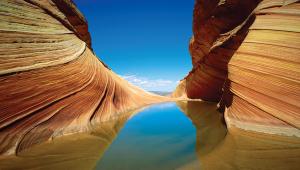
Sweet took the photo at left in Utah’s Canyonlands
National Park at sunrise, but what he really wanted was
the light to bring a glow to the scene, especially to
the foliage at the lower right. Twenty minutes of waiting
made it worthwhile. His lens was a 35-70mm zoom.
Photos © 1999, Tony Sweet, All Rights Reserved
|
|
“A lot of what we do
as nature photographers is spend time looking around for places to go
when the light is right,” Tony Sweet says. And, once those places
have been found, waiting around for the right light to put in an appearance.
I’ll go out and spend
the morning at a place I know is going to be a great sunrise spot. On
days when there’s bright sunlight and most hours aren’t
shootable hours, I’ll take that time to drive around, look for
spots that I think will be good for sunrise or sunset, and I’ll
make notes on those places.”
Sweet points out that while all light may be created equal, it’s
often location that dictates who gets the really good stuff. “A
lot depends on where you are,” he says. “On the East Coast
there’s a whole lot of smog, and that affects the quality of the
light. It acts like a great big diffuser or orange filter--or whatever
the color of the air is that day. In the desert southwest, or the deserts
of Morocco, or Africa, there’s always sand in the air, which acts
like a filter. That’s why the sand dunes in Namibia photograph
burgundy. Sand is bad for human beings, but great for photography.”
Most important, he adds, is to realize that the really great light is
fleeting. “Once you’ve got your spot, wait it out. Don’t
go away and hope to come back at the right moment. Chances are you’ll
miss it. Great light may be there for, let’s say, five or 10 minutes,
but there’s a certain window of maybe a fraction of a second or
a second at most, and if you’re visually acute enough to recognize
subtle changes in the light, you’ll see a split second of ‘This
is it!’ light. The truly great photos are taken in that split-second
window.”
How can you recognize that instant? “You train yourself to see
it,” Sweet says. “The more you do it, the better you get.
Look at a lot of pictures, and when you see that moment, you’ll
know it. You’ll know that’s what you saw in the pictures.
It takes concentration to see the difference between the good and the
great light. Believe me, magic happens in a split second, and you have
to be ready.”
--Barry Tanenbaum