| |
Make
sure the push button is placed on the housing where it can
be easily reached while holding the camera normally. A 1/4x20
nylon screw, easily cut to exact length with a hobby saw,
runs through the case and into the tripod socket, and is
fastened at the bottom with a wing nut or threaded knob.
A strip of cloth tape applied to the top of the case keeps
it from twisting on the body.
Photos © 1999, Tom Fuller, All Rights Reserved
|
|
While on-camera flash is certainly
convenient, and sometimes the only way to capture candid people shots,
its downside is the effect known as redeye. This demonic glow in the subject’s
eyes is the result of nearly point source and on-axis light entering the
pupils, already dilated by the low ambient light under which flash pictures
are usually taken, and reflecting off the retinas. The lens of the eye
then magnifies the many blood vessels to record an image that, while great
for ophthalmic study, is hardly suitable for wedding and party photography.
An increasing number of new cameras have built-in redeye reduction features,
with one approach sending out a series of closely spaced, low-power “pre-flashes”
that stimulate constriction of the pupils in anticipation of the main
flash burst. Another, upon which this month’s project is based,
rapidly flickers a tiny, high-intensity tungsten lamp just before the
shutter opens, again shrinking the pupils and greatly minimizing the chance
of redeye when the flash goes off. Despite its low-tech approach, our
inexpensive Redeye Reduction Light is quite effective and can be easily
built by anyone with basic workshop skills and simple hand tools.
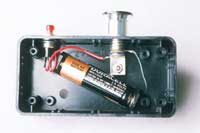
The project is basically a camera-mounted penlight with a spring-loaded
electrical switch that allows the photographer to quickly flick the lamp
on and off several times with a fingertip before pressing the shutter
release. Parts cannibalized from a pocket flashlight are enclosed in a
plastic housing to facilitate tripod socket mounting and to provide flat
surfaces upon which to place the push button. This version uses a flashlight
taking one AA battery, but the same design works with those requiring
two AA or AAA batteries. The flashlight must be bright, easy to take apart,
and equipped with a screw-base (not bayonet) bulb.
Disassemble the flashlight and save the reflector and lamp. Bore a hole
large enough for the lamp holder in the edge of the project case and,
as shown in the accompanying illustrations, cement or epoxy the reflector
over it. Mount the holder to the inside bottom of the case with a No.
4-40 machine screw and nut (Radio Shack 64-3011 and 64-3018) or similar
small fastener; adjust it so that the lamp is positioned within the reflector
exactly as it was in the original flashlight; and tighten the screw firmly.
Fasten the battery holder with double-sided foam tape.
The placement of the push button switch is critical and should be decided
upon carefully before drilling its mounting hole. The location of the
shutter release on the camera, the shape and mass of the body, your personal
gripping style, right or left-hand preference, etc., must all be considered
so that you can effortlessly “tickle” the button immediately
before taking the picture. I suggest finishing the Redeye Reduction Light
except for the switch, attaching it to the camera and empirically determining
the natural fall of your fingers in normal use. Once confident of this
position, which may well be different from that shown here, mount the
switch and wire the components together.
It takes a little practice to become adept at effectively “blinking”
the light before releasing the shutter. Too many may cause the subject
to be recorded with his or her eyes closed, whereas too few may not constrict
the pupils enough to minimize redeye. I have found that four, each about
1/8 sec long and spanning no more than 1 sec, is a good starting point.
By holding the button down, the light doubles as a focus assist for manual
focus cameras, letting you get sharp images in those reception halls where
there is barely enough light to safely walk among the tables. Remember
not to block the small reflector with your fingers.
Carry spare alkaline AA or AAA batteries, especially if you use the unit
as a focus assist light, as the lamp must be as bright as possible for
effective redeye reduction. Although rechargeable Nickel Cadmium (NiCd)
batteries are more economical, their lower voltage (1.2 to 1.25v) may
decrease light output beyond an acceptable level. Frequent users may want
to use a larger case and power the light with C-size or even D-size alkaline
batteries, or rig a way to run it from the flash power pack. A wide range
of lamps is available with E-5 or E-10 bases for the creative do-it-yourselfer.
I designed this project for use with manual focus cameras and non-TTL
automatic flash, and assumed the light will be off at the moment of exposure.
As the illumination may skew distance and/or exposure when used with newer
AF systems, many of which use infrared and other advanced detection systems
prior to the actual exposure, be sure to run a test roll before putting
the unit to work. And, while the Redeye Reduction Light helps, nothing
is 100 percent effective, so take a tip from the pros and cover yourself
by taking lots of flash pictures. Happy shooting
Parts List
Radio Shack numbers are listed,
but equivalent parts from other manufacturers may be used.
• One AA or AAA powered pocket flashlight
• One single or double AA or AAA battery holder (depending upon
flashlight design); 270-401, 270-408, or 270-398
• One E-5 or E-10 threaded-base lamp holder (depending upon flashlight
bulb); 272-358 or 272-360
• One plastic project case; 270-1802, 270-1803, or similar
• One miniature SPST momentary push button switch, normally open;
275-1547
• One nylon 1/4x20 screw, 3” long, with wing nut
• Small nut and bolt, double-sided foam tape, plastic model cement,
or epoxy
|