


- REVIEWS
Camera Reviews 
More Reviews Mobile Reviews Photography Reviews - GALLERIES
- VIDEOS
- BUYER'S GUIDES

Lighting With Mirrors
Economical, Convenient, And Effective
Soon after becoming really serious about your photography, something annoying begins to happen: you become increasingly critical of your results. You start comparing your photographs to those in magazines, and note that, esthetics aside, your technical quality often falls short. Many of your otherwise decent shots are ruined by blown-out highlights, inky black shadows, poor separation of subject from background, etc. Pursuing the dilemma, you eventually stumble upon a relevant article or book, thus discovering one of the most important success factors in photography: supplemental lighting. You learn that film has a limited contrast range: overexpose it and you can kiss highlight details good-bye; underexpose it and it's adios shadow detail. Unfortunately, many scenes and subjects, indoors and out, exceed this range, sometimes greatly. In those instances when there's no important details at one end of the range or the other (highlights or shadows), a compromise exposure biased toward the most significant end of the scale for the picture at hand will usually produce quite acceptable results. Contrast manipulation through various combinations of exposure and development is an option with black and white film for darkroom-enabled photographers, or via a custom lab. Color options in this regard are much more limited, especially with reversal (slide) film. Therefore, some means must be employed to bring a scene's contrast range within bounds of the film in use. |
|||
With overly contrasty color scenics, your options are confined to waiting for cloudy or cloudy-bright days; shooting before sunrise or after sunset; using weak diffusion filters; slightly overexposing and pull processing the film (know your film; some films color shift badly when pull processed). Otherwise, it's shoot for the mids and highs and let the shadows go. More confined shooting situations such as portraits (indoors and out), interiors, tabletop photography, and other close-in subjects allow the use of various lighting techniques and equipment to maintain a desired contrast range. In the studio, tungsten "hot" lights or electronic flash are the traditional tools of choice. For environmental portraiture outdoors, a combination of fill flash and/or fabric reflectors and translucent diffusion panels or scrims keep lighting ratios to a pleasing 4 to 1 or lower. |
|||
However, there are times and situations that require other solutions. When you're first starting out in photography, whether as a serious hobbyist or aspiring pro, a comprehensive studio lighting outfit may not be financially feasible. Or maybe you simply don't need a lot of lighting gear on a regular basis. And even when you have a respectable studio lighting kit, especially if you're into commercial photography, you'll occasionally find a need for more lights than you have. Further, unless you have a purpose-built studio that was wired accordingly, one light too many can trip a circuit breaker and leave you in the dark. Or maybe you're shooting out in the countryside, far removed from a source of electricity. What to do? Mirrors. The idea of using mirrors as lighting aids was demonstrated to me quite by coincidence early in my photographic career. I was shooting some fashion accessories with a pair of models in a park in San Diego. Even though I had an assistant with a variety of fabric reflectors to fill shadows, the models couldn't avoid squinting in the bright sunlight. Moving into the shade of some large trees solved the squinting problem, but resulted in unflattering, dull lighting for the models and accessories. The fabric reflectors were useless, as they had little to reflect. While sitting in the shade pondering the predicament, a truck stopped for a red light, perhaps 70' away. Fortuitously, the sun's angle was perfect for one of the truck's windows to blast one of the models square in the lookers with an intense beam of sunlight. This elicited a rather unladylike exclamation from the model, followed by equally unchivalrous laughter from myself and my assistant. The light turned green and the truck moved on, but the seed had been planted. I had picked up on the reason for the truck window's effectiveness at projecting sunlight, compared to the ineffective fabric reflectors: the window wasn't diffuse in nature. |
|||
My luck held out as I spotted a thrift store down the street. A few bucks later I was the proud owner of two decrepit wall mirrors, complete with peeling gold baroque frames. Nevertheless, they were extremely capable at projecting strong shafts of sunlight beneath the shading trees, there intercepted by the fabric reflectors to produce usable lighting of desirable intensity, color, quality, and direction. It was a lesson I would profit from and expand upon in the years to come. Those terminally ugly mirrors have long since been replaced with mirrors of a more businesslike appearance. Today, all of my large mirrors are acrylic; they're less expensive, lighter weight, and don't break. You can have acrylic mirrors cut to any desired size or shape at most glass/plastics shops. When not being used as reflectors, large mirrors come in handy placed in front of your tripod, as a posing reference for the models. |
|||
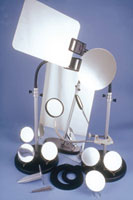
I frequently need to illustrate cameras for magazine reviews and articles, and almost always use at least one mirror, often several, to fill dark corners, illuminate camera interiors, bring out texture in coverings, or highlight a logo. The mirrors that I use for this purpose are $5 shaving mirrors, purchased in the notions department of my local supermarket. They are double sided (flat and concave) and swivel on their attached wire stands. If you occasionally need to take the edge off a mirror's specular nature, a light coating of hair spray will do the trick, diffusing and broadening the coverage. On location, the flat part of the stands can be gaffer-taped to walls or other objects, as necessity dictates. Another mirror used frequently is of the same type (round/flat/concave), but mounted on a length of "gooseneck," which in turn screws into a heavy-duty "C" clamp. It also attaches to a ground spike, which, in conjunction with a small, translucent diffuser, has lit many a flower shot for me. The unit illustrated is from Alpa's Macrostat system (long defunct), but a little ingenuity could cobble together a similar rig with minimal effort. |
|||
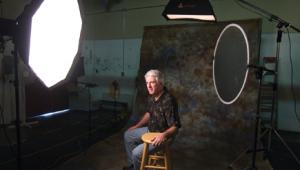
The two stand-mounted mirrors shown are among my most often-used outdoors on location. The heavy steel bases make them highly wind resistant, and the goosenecks allow aiming in any direction. The mirrors quick-release on and off the gooseneck, interchanging with other light modification attachments. Again, minimal shop skills could concoct a similar arrangement, with a light stand and a couple of bucks worth of electrical conduit of appropriate diameter, plus a "pony" clamp from the hardware store and an acrylic mirror. Another option, and the one I used for years before purchasing commercial units, was to epoxy a block of wood to the back of an acrylic mirror; set into the block was a 1/4"-20 nut, which attached to the tripod screw of a stand or tripod-mounted ball head. Not as versatile as the gooseneck arrangement, but quite serviceable. In the studio, I occasionally find that I can't orient a mirror properly to place light exactly where I need it because there's no source light located at the necessary angle of incidence. Rather than dragging out another light and setting it up, I clip mirrors to the inside of the barn door leaves of one of my studio flash units, directing this "intercepted" light to a mirror situated in effective bounce relation to the "blind" mirror. This technique works best with normal to wide angle reflectors on the studio flash heads. You can also use mirrors to bring sunlight indoors, through any window (open or closed) or doorway. It's a handy way to boost reflector fill for window portraits, or it can pump light into dingy industrial building interiors. Don't have a clear line of sight between the outside mirror and the area you want to photograph? Redirect the beam with another stand-mounted mirror. In closing, let me add a few tips. Outdoors, keep in mind that the Earth is rotating, accounting for the sun's apparent motion across the sky; therefore it helps to have an assistant maintain alignment of the projected beam while you concentrate on the photography. In the studio, you can usually use mirror-reflected light directly (not further bounced or diffused) on your subject, whether animate or inanimate. Outdoors, with a class G3 yellow dwarf star (the sun) as the light source, you must disperse the intense, mirror-transmitted beam with fabric reflectors or translucent diffusers. And never horse around with mirrors and models (including animals) outdoors; the reflected beam is blindingly bright and extremely discomforting if directed raw into someone's face. The IR is reflected, too, so beware of directing a raw beam (especially from concave mirrors at their point of focus) onto anything that's heat sensitive. Finally, don't concern yourself with how far you can bounce sunlight with a mirror outdoors; the light has traveled some 93,000,000 miles to get to your mirror, so another 20, 50, or 100' is no big deal! |


| ||
|
||







 FEATURED VIDEO


Get the Latest Photo Tips, News & Reviews from Shutterbug!







| Camera Reviews Other Reviews | |
Mobile Reviews Photography Reviews Columns | |
News | |
Features | |
How-To | |
Resources |
 © 2026 Shutterbug
AVTech Media Americas Inc., USA
All rights reserved