


- REVIEWS
Camera Reviews 
More Reviews Mobile Reviews Photography Reviews - GALLERIES
- VIDEOS
- BUYER'S GUIDES

Hot Lights Are Cool
How To Mix Tungsten And Flash Lighting For Great Results
There was an era long before my time when a pro photographer shot with big, heavy, hot tungsten lighting. In the 1930s, '40s, and '50s, hot lights were the state of the art. Giant 1k, 2k, and 5k tungsten fixtures from Hollywood suppliers flooded the studio with 5600k light. It wasn't the most efficient way, but it was all there was. In the '60s as the studio electronic flash became a reasonable way to pour light on a subject at the very instant of exposure, the hot lights started to vanish from the photo scene. By the time I was getting into photography in the early '80s, Speedos, Ascorlights, and Normans were pretty much all I saw. As they say, what goes around comes around. Hot lights have made a remarkable comeback as a real working tool for pro photographers. Try and make a living today with nothing but an array of hot lights and you'll probably starve, but when mixed with a potent studio flash system you can really get some great images. |
|||
Why would you want to use continuous lighting when you already own some snazzy flash units? Easy--by mixing the daylight-balanced, action-stopping qualities of a powerful studio flash with the warm, continuous qualities of tungsten or halogen lighting, you can get a nice combination of sharpness and "fluidity." The technique is simple--you light your image normally with your studio flash units, then illuminate only part of the image with hot lights. You turn the modeling lamps off on your flash units, so the only ambient light in the studio or at your particular location is provided by your tungsten units. By setting slow exposures and also synching with your flash units you can combine two images in the same exposure--the first image is the sharp image captured by the 1/1000 sec duration of your main flash units, the second is the longer exposure provided by the tungsten lights. If you are shooting people and can dial in a longish exposure, then you can get the classic "motion blur" shot. |
|||
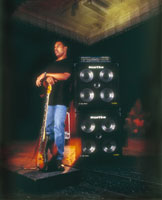
This image has nice sharp details but the edges of the person's outline--hair, clothes, etc.--are blurry and motion streaked. If you can get your exposure down to around 1 sec or longer, the subtle movements of your model will create the blue. If you hand hold, you'll add some movement of your own. I like to light the subject with flash, then light the background with tungsten only. It's a technique that has been made popular for the last 10 years, but done right it still looks pretty cool. If you're shooting products, then you can't count on the small movements of your subject to create a bit of motion blur. (Unless your products are alive.) There are a couple of neat ways to still create that blurred feeling. I like to use a long lens and hand hold while backlighting the subject with tungsten. This creates a nice sharp image where the edges of the product are nicely blurred with a soft, warm edge. Even if the product is staying totally still, you can always forgo the motion and just count on the mismatch of color temps for an interesting effect. A 5600k tungsten mixed with daylight-balanced film will produce an exceedingly red color balance. If the bulk of your image is lit with flash, HMI, or daylight, you can use tungsten for a nice warm accent. |
|||
Of course, tungsten lighting is still a viable choice as your main light source in the studio. There are a number of different ways to alter the light, whether it be a diffusion panel, gobo, scrim, or softbox. The blazing heat produced by most tungsten lighting makes it tough to just pop a tungsten light head into a standard softbox. A normal light box is designed to handle studio flash. While a typical studio flash head has a 200 or 250w tungsten modeling lamp, they are usually fan cooled and don't throw off the kind of intense heat that a 1000 or 2000w cine lamp does. When studio flash came into vogue in the '70s, the style of photography changed dramatically. Photographers were no longer trying to squeeze every lumen out of their light source, so efficient Fresnel lenses and polished aluminum reflectors were out, and diffusion panels, umbrellas, and softboxes were in. That's not to say that you
can't shoot soft with hot lights. I use a combination of hot lights and
flash almost all the time, and I frequently fire the hot lights through
a softbox. Don't try this with a typical light bank. You'll not only burn
up the softbox, but you'll kill the expensive tungsten bulb very quickly.
|
|||
Most tungsten lights rely on good old-fashioned convection cooling. Impede the flow of air around the bulb and you'll burn it out in a matter of minutes. Really severe cases of overheated light heads can get dangerous, with heat, smoke, and flames possible. How to diffuse a hot light with decent control? Simple--buy the right softbox. Check with the manufacturer for the capabilities of their particular softbox. I stumbled across a great light bank for hot light use, the Soffbox by Larson. It's a large square light box made of a very thin material that keeps the light in, but allows air to flow through. You mount the light head to a sturdy metal plate and assemble a nice metal frame, which supports the light box material. While I believe that Larson products are only sold direct, it's a terrific light box for the photographer who prefers tungsten lighting.
|
|||
The hardest thing about using tungsten lighting is finding it. Your standard pro camera store might have one or two bottom of the line Smith Victor photoflood fixtures lying around, but ask about the Smith Victor pro stuff and you'll get a blank stare. Shutterbug has actually been a tremendous resource for me. I've scoured the used gear ads looking for those magic "Fresnel" or "Tungsten Lighting" categories. Since most of the really good stuff was designed for the film industry, it can be tremendously costly to buy new. (Film crews rent everything, so purchase price is never a consideration.) A big 2k Fresnel light that was made in the '50s probably still has a few decades of service left in it. If you buy an old movie light you'll probably need to put a modern grounded cord on it, and perhaps replace the lamp sockets. Once you've got it up and running you'll probably be amazed at how much light these monsters throw out.
|
|||
If you've never really thought about tungsten lighting, except how to overpower it with your studio flash units when shooting on location, think again about working with mixed light sources. I've been tracking down and buying up tungsten lights for years, but there are plenty left at pretty fair prices, so it's not prohibitively expensive to get started. While many photographers like to meter out the actual color temperature of their light sources, I balance everything for the flash and let the tungsten lights blaze away. If you bracket a few stops in either direction, you'll always get something that looks great. |


| ||
|
||









 FEATURED VIDEO


Get the Latest Photo Tips, News & Reviews from Shutterbug!







| Camera Reviews Other Reviews | |
Mobile Reviews Photography Reviews Columns | |
News | |
Features | |
How-To | |
Resources |
 © 2026 Shutterbug
AVTech Media Americas Inc., USA
All rights reserved