


- REVIEWS
Camera Reviews 
More Reviews Mobile Reviews Photography Reviews - GALLERIES
- VIDEOS
- BUYER'S GUIDES

Turn Off Your Flash For Digital Images; Continuous Light Sources Make A Comeback
There's an old photographer's joke that goes: "If God invented light, then the devil invented fluorescent light." How times do change. With digital capture, fluorescent light can be your friend and I don't mean those long tubes hanging in lighting fixtures from the ceiling. I'm talking about a new breed of portrait lighting tools designed especially for digital photography. So what's the big deal and why is fluorescent a great source of lighting for digital imaging?
 |
|
|
The RGB spikes of output from high-color fluorescent light closely match the
receptive RGB spikes of a CCD imaging chip. A CCD is least sensitive in its
blue channel and tungsten light has the least output in the blue, and when combined
with the effect of infrared output (mostly heat) it can overcome the chip's
entire spectral response. What about CMOS? It's difficult to generalize
a head-to-head comparison between CMOS and CCD image sensors, but assuming competent
engineering and optimum settings for white balance, exposure, and light levels,
image quality from CCD sensors should be similar to image quality from CMOS
sensors, at least in terms of color accuracy.
Comparing fluorescent continuous light sources to tungsten lighting is a lot
easier. Fluorescent easily comes out the winner when compared to tungsten, which
is 93 percent heat and 7 percent red light. Techies who want to delve deeper
into light and color should visit Osram's Encyclopedia of Light (www.osram.com/service_corner/glossary/index.html).
What does this mean for digital photographers? It's simple: The light
you used to hate, you can now love. Making all of this easy for us and wrapping
these fluorescent lights in a useful package are a trio of digital lighting
kits from three different manufacturers that can change the way you make portraits.
 |
|
|
Itsy-Bitsy Spider
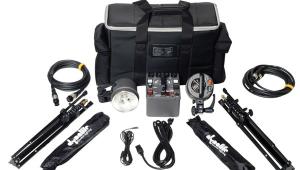
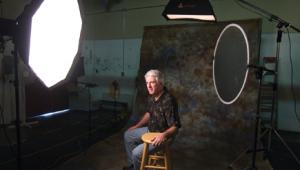
Westcott's Spiderlite TD5 is designed for still and video image-makers
and works with either halogen or fluorescent lamps. The halogen lamps produce
a consistent but hot 3200Þ Kelvin and the fluorescent lamps are rated
at 5100Þ Kelvin, although that varies as the lights warm up. After using
a color meter to set the exposure, I found my Canon EOS 20D produced better
results in Auto White Balance mode. Your chip may vary...
The all-metal Spiderlite TD5 has a built-in speed ring for attaching a light
bank and three separate switches that let you use multiple combinations of the
lamps. A handle allows quick and easy rotation. The fluorescent lamps provide
smooth, continuous light so that all of my exposures in this session were made
in (gasp!) Program mode. I used the digital SLR's Exposure Compensation
feature to increase exposure in 1/3 stop increments by looking at each image
file's histogram on the camera's preview screen to make sure exposure
was balanced.
 |
|
|
Check Your Ego At The Door
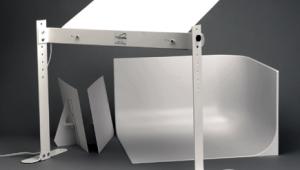
From the mind of Gary Regester comes the Lowel Ego, a tabletop fluorescent soft
light. Setup is a breeze: plug it in, place it on the table or light stand,
and turn it on. The Ego comes with two 27w screw-in compact daylight fluorescent
lamps that have a 5000-10,000 hour rating. Their Color Rendering Index (CRI)
provides a more natural and realistic color balance than standard (color-me-green)
fluorescent lamps. Lowel includes a hinge-folded white bounce card for reflected
fill. It can be used for portraits but is also useful for making tabletop shots
by eBayers, archivists, and desktop publishers. The Ego can also be used for
webcam desktop video conferencing.
When using the Ego light as a main light for portraits, be sure to place the
light as close as possible without getting it in the shot. Because of its small
size, the Ego light is probably best suited to headshots and that's a
good thing. I used to hate setting up lights for headshots; it took too much
time fiddling to get the light looking like I wanted. The Ego sets up quickly
and when used with a reflector, such as Westcott's Illuminator placed
close to the subject on the other side of their face, makes an ideal headshot
setup. I like doing headshots again and never thought that would happen!
 |
|
|
Sunpak Lights
I do a lot of shoots with new and inexperienced models. Big, complex light banks
attached to electronic flash units distract from the mood I try to establish,
so the Sunpak digitLITE 600, which is basically a cold "hot light,"
is a great setup for these kinds of portraits. The light is solidly built and
easy to move around if your light stand has casters, and creates the kind of
working environment that helps the model relax and be at her best. The digitLITE
600 uses cool fluorescent tubes that are balanced for daylight and do a good
job of emulating the real thing.
| |||||||||
|

| ||||||||









 FEATURED VIDEO


Get the Latest Photo Tips, News & Reviews from Shutterbug!







| Camera Reviews Other Reviews | |
Mobile Reviews Photography Reviews Columns | |
News | |
Features | |
How-To | |
Resources |
 © 2026 Shutterbug
AVTech Media Americas Inc., USA
All rights reserved