|
Few people realize that photographic
spot meters date back some 2/3 of a century. The very first was built
by Arthur Dalladay, editor of The British Journal of Photography, in about
1935; he described it in the BJP Almanac of 1937 on pages 127-138. This
meter still exists, in the possession of a subsequent editor of the Journal.
Within a decade or so, there appeared two commercial meters based on the
same principle. One was the “Ainger Hall” meter, manufactured
initially by the Bowen Instrument Company and then later (to special order
only) by one of its inventors, W.G.H. Turl. The other, with numerous refinements,
was the SEI (Salford Electrical Instruments) Photometer. By 1948 the SEI
Photometer was being distributed by Ilford Ltd. and (in the U.S.A.) by
The Zoomar Corporation.
All were comparison photometers, based on the Bunsen grease spot photometer.
These rely on the ability of the human eye to distinguish minute differences
in brightness between adjacent areas: in this case, a “comparison
spot” of adjustable intensity, and the chosen subject tone. They
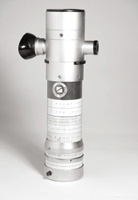
consist, in effect, of a telescope with the comparison spot on a photometric
cube in the middle of the field of view.
The light source in the SEI is a bulb with a frosted top, powered by a
11/2v battery. The bulb is underrun for maximum battery and bulb life.
It rarely if ever “blows,” but eventually, the light output
falls so low that it is impossible to get the calibration illuminance
high enough. A small photoelectric cell in the bulb chamber feeds a moving-coil
ammeter on the top of the Photometer, and a rheostat in the base is used
to control the bulb to set the meter to the one mark, “Standard
Brightness.” This means that if you can get a new, frosted bulb
and solder it into place in the bulb holder—and I’m working
on it—you should be able to calibrate the meter to work with it.
The Ainger Hall/Turl meter was much simpler, and had to be calibrated
to a candle flame in a darkened room.
The bottom 11/2” (38mm) of the 8” (20cm) instrument forms
a rotating unit which drives a pair of opposed continuous neutral density
wedges between the bulb and the photometric cube. This allows the brightness
of the comparison spot to be varied. Apertures are engraved on the rotating
base, together with a rotating collar to set the film speed. Mine is calibrated
in British Standard Logarithmic (B.S. Log) units from 10-50. This is the
same as A.S.A. (Log) and therefore can be converted to (original) A.S.A.
(arithmetic) readings. These correspond pretty closely to ISO speeds,
so the ISO arithmetic range is 0.75-8000, an impressive range even today.
For quick reference, D.S. Log to ISO equivalents are 14* = 50, 17* = 100,
20* = 200, 23* = 400, 27* = 1000, and 32* = 3200.
Two separate index marks are provided for the speeds, 20Þ (62/3
stops, 100:1) apart. The black index mark is used for determining exposures
for negatives (shadow readings), the white, for transparencies (highlight
readings). There is no index for reading gray cards or mid tones or any
other drivel, because the designer understood what he was doing and expected
users to have attained a similar level of technical understanding. The
instruction book does however give reflectances of several key tones,
including white snow, fresh white paint (80 percent), slightly weathered
white paint (65 percent), old weathered white paint (60 percent), diffuse
highlight on a “normal” face tone (Caucasian—remember
we are talking about 50 years ago: 30 percent), and diffuse highlight
on a “bronzed” face tone (20 percent).
Shutter speeds are printed on the body of the instrument, to be read off
against the aperture scale on the rotating base. Life is however complicated
by the fact that there are three measuring ranges, selected via a color-keyed
three-position switch that moves neutral density filters into the light
path.
Each range is 100:1. The red base scale is used for luminances of 0.01-1
foot-Lambert. (A foot-Lambert is one lumen per square foot; more modern
units of luminance include the nit or candela/square meter and apostilb
or 1/pi nits.) The white middle scale reads from 1-100 foot-Lamberts.
The highlight scale—nominally blue, but faded closer to green on
my meter—reads from 100-10,000 foot-Lamberts. The total measuring
range across the three scales is therefore 0.01-10,000 foot-Lamberts,
or one million to one.
Making Readings
To take a reading for shooting negatives, place the 1/2Þ photometric
spot over the darkest area in which you want texture and take a reading,
with the film speed set against the black index mark. For reversal film,
where exposures are keyed to highlights, you place it over the brightest
area in which you want texture, and use the white speed index mark.
Now press the button on the base, and turn the base until the spot disappears—which
it does, in quite a magical way, when the two tones (chosen tone and spot)
are identical. If the spot cannot be made light enough or dark enough,
change ranges as described earlier. The color of the spot is controlled
by another pair of filters, one for artificial light, one for daylight:
not a perfect solution, but quite adequate in practice.
As well as for conventional exposure determination, the instruction book
gives information on copying, using the SEI as an enlarging exposure meter,
using the foot-Lambert scale (use the screw on the tapered collar as an
index), and determining reflection factors. There were also accessories
for densitometry, though I have never seen them. As well as being a sublime
tool, it is a superlative gadget.
What, then, are the disadvantages of this paragon among spot meters, with
its enormous range, tiny measuring angle, easy close focusing, high precision,
and unparalleled build quality? Broadly, they fall into three groups:
commercial, convenience, and antiquity.
From a commercial viewpoint, the most obvious is that all those switchable
filters, sliders, rheostats, calibration meters, and the like mean that
it was terrifyingly expensive to make. This must have contributed to its
demise, as far as I know in the 1960s. Furthermore, it relies on a bulb
which is a consumable rather than a component.
Moving on to convenience, it’s slow to use, requiring two hands,
and while the view on the red scale is big and bright, and the view on
the white scale is adequate, the very heavy ND on the blue scale makes
things pretty murky. Another practical problem is that the image in the
viewfinder is upside down.
The scales on the meter are very clear and easily legible, but there are
a lot of them, and the shutter speeds are idiosyncratic, with many marked
only by lines. On the blue scale, for example, you have 1/100, line (1/125),
line (1/160), 1/200, line (1/250), 1/320, line (1/400), 1/500, line (1/650),
line (1/800), 1/1000, line (1/1250), 1/1500… The red scale is real
fun with such readings as 2h. 47”, 2h 13”, 1h. 45”…13’20”,
10’40”, 8’10”, and more.
It’s up to you to choose the nearest speed on your shutter, but
with 1/3 stop aperture settings from f/1 to f/32 and well over 100 shutter
speeds, running from the aforementioned 2 hours, 47 minutes to 1/500,000
sec, you have plenty of choice. Such precision takes quite some time to
read and interpret.
The third category of drawbacks relate simply to its age. The bulbs are
no longer available, though this may be surmountable as noted. The obsolete
speed scale is a nuisance, but you can easily use the “crib”
above, and it looks as if it should be possible to slip off the transparent
protective cover, fit a new ISO scale (the scale itself is on a strip
of paper), and then refit the cover.
For reasons I have never been able to fathom, even the original instruction
book tells you to remove the paper sleeve from the battery—it won’t
fit otherwise—before cleaning the contacts with emery cloth and
smearing them with petroleum jelly. The original U2 size is similar to
the modern D cell and I found that a Sanyo D cell worked, after I had
stripped off the wrapper and (still more carefully) the glue which would
otherwise have stuck the cell fast in the meter—though the locating
hole in the top of the battery compartment would allow you to poke it
out if necessary.
Finally, the incredibly complex assortment of mechanisms may be damaged:
I had to solder the finger back on the coil-wound calibration rheostat
in the base. To a considerable extent, though, the SEI is so beautifully
made that most parts can be made up and fitted by a sufficiently skilled
repairer.
Is it usable today? Yes, subject to the earlier concerns about parts and
repairs. Is it still the finest spot meter ever made? Quite possibly,
if you are not in a hurry: it must be the meter par excellence for fine
art landscape photographers, and reputedly, refurbished examples are still
sought after in Hollywood. Modern meters are a lot more convenient, and
unless you particularly need (for example) to be able to take readings
at 6” without accessories, they are probably a better bet. The mystique
of the SEI also ensures that prices of working meters stay high: rarely
under $200-$300, quite often twice as much. Then again, a $45 Casio quartz
watch is likely to keep better time than an antique Breguet mechanical
watch at 100 or 1000 times the price; but both are more than accurate
enough, and which would you rather own?
|