Site Links
|
 |
 |
 |
Create Your Own North Light Beautiful Daylight, 24 Hours A Day
By Steve Bedell September, 1999
| |
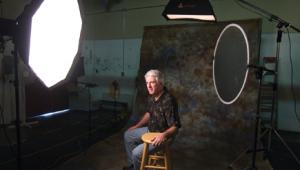
Photo 1.
Photos © 1999, Steve Bedell, All Rights Reserved
|
|
When I look at old photos,
I mean circa 1910, not my high school yearbook, I marvel at how beautiful
they are. Those old time photographers had things a lot tougher than
we do now, what with large format cameras, slow film speeds, and no
electronic flash. The single most outstanding quality of their photos
is the light. That’s because many of the old timers used only
daylight for their light source and were quite adept at it. When properly
used, it’s hard to find a more beautiful light.
When doing wedding photography, one of the first things I do is scope
out my shooting area, trying to locate a spot for nice window light
portraits. In my studio, as I’ve written about in a previous Shutterbug,
I sometimes use a window as my light source, placing backgrounds on
movable flats so that I can position them just where I want--it’s
much easier than moving the window. There are problems with this technique.
Sometimes the window faces the wrong direction. If you’ve got
a southern exposure and it’s a sunny day, you’ll either
have to forget about it or use some type of scrim. Even when you’ve
got a window that faces north, it may be too dark, you may have snow
kicking light up from underneath, or worse yet--it could be night. Then
what do you do?
Well, you could do what my friend Chris Beltrami did with his Barre,
Vermont studio. Make your own north light and make it available 24 hours
a day, 365 days a year. You can get beautiful, repeatable results. Tell
Mother Nature to take a hike, you’re packing your own light. If
you want to create your own daylight studio, here’s a look at
how Beltrami built his plus some tips on revisions he might make after
shooting with it for about a year.
First, let’s think about why we like north light so much. Every
light source has four characteristics--quality, quantity, color, and
direction. The defining characteristic of north light is its quality.
It’s big, soft, and diffused. Since it’s coming from the
north, it catches the direct sunlight and bounces it off the sky. Maybe
that’s where the term “skylight” came from. So if
we want to replicate “skylight,” we need to make sure our
source is big, soft, and diffused. What we need is a softbox about 10x12’,
with a depth of about 4’.
|
|
Beltrami has basically created
a big “wall bounce” flash and diffused it. Simple. Let’s
look at the photos as we go along to see how this has been accomplished.
Photo 1 shows the gist of it. He built a hallway about 4’ wide,
keeping the walls, floor, and ceiling white. The right side of the photo
shows the framing. He hung white sheer curtains from the top of the framing
to diffuse the light. While not visible in this photo, there is also a
built-in window frame that can be included in the photo if desired. Now
here’s the key to creating the beautiful, wraparound quality of
north light. Don’t put the light source too close to the background
wall. As you can see by the photo, Beltrami has positioned his light 12’
from the background wall. Put it too close and you’ll be fighting
a split light or light from behind.
You might think that you need gobs of power for this setup. Beltrami uses
a Photogenic Power-light 750, a moderately powerful flash unit with 750
ws of effective flash power. By putting the power setting at about 75
percent, he gets an f/11 reading using Kodak Portra 160NC. I thought he’d
need a 400 speed film to get that kind of depth, but it’s not necessary.
Of course, if you have lower powered lights, using the faster film is
always an option. If you like larger f/stops for individuals and smaller
ones for groups, consider setting your lights so that with the 100-160
speed films you’re at f/5.6 or f/6.3 and then f/11 with 400 speed
films for groups. I much prefer changing films to changing lights, I always
forget to change the power settings back again.
Getting back to the photos and layout, Photo 2 gives you some idea of
the size and quality of the light. Notice how it “wraps around”
the columns with a very smooth transition from highlight to shadow area.
Notice the size, too. The ceiling is 9’ tall and the light source
is 12’ back from the far wall. You may see the window frame faintly
in the photo.
|
|
Photo 3 shows the entire width
of the studio. There are times when you may want to control the light
more precisely than the window light, especially when gelling lights on
the background. If your studio is big enough to allow you the luxury to
do it, you may want to have separate shooting areas. Note also the white
floors and how no fill or reflector is used for the window light setup.
After shooting with this setup for about a year, there are really only
a couple of changes Beltrami would suggest. The first--no tile floor to
catch the wheels of your tripod dolly. The second concerns the light direction.
The current “wall of light” is at a 90° angle from the
subjects. Even with the light placed 12’ back, you still must guard
against split light. Split light is when one side of the face receives
light and the other is in the shadow, usually “split” by the
nose. To resolve this, he thinks he may modify it by angling the wall
so the light direction is perhaps about 60° or so from the subjects
instead of 90. All in all though, he’s thrilled with the light and
the concept. There are no lights to fiddle with, just hook up your radio
control, set the f/stop and get going. If there’s a blizzard outside,
too bad. You’re packing your own “daylight.” If you
would like more information, contact Beltrami at (802) 476-4762. He and
his wife Pat are both stellar photographers and among the world’s
nicest people.
|
 |
|
 |
|
|
 |
 |
 |
|