Bogen Flies High On Wings Of Smithsonian New Air And Space Museum Is Now Shown In The Right Light--For All To See
Jack Neubart, May, 2004

| |
Construction
of the Steven F. Udvar-Hazy Center, which opened on December
15, 2003.
Photos © Mark Avino/NASM Photo, All Rights Reserved
|
|
Well-grounded in the photo
biz as one of its premier suppliers of photo gear, New Jersey-based
Bogen Imaging Inc. (www.bogenimaging.us),
formerly Bogen Photo Corp., lent its support to—and you might
say, shed considerable light on—a project that is expected to
soar in the eyes of the American public. This project involves producing
a fully immersive record of the aircraft housed in the latest addition
to the Smithsonian Institution’s National Air and Space Museum,
namely the Steven F. Udvar-Hazy Center. The Udvar-Hazy Center, which
opened its doors to the public on December 15, 2003, is located at Washington
Dulles International Airport in Northern Virginia. A few of us were
privileged to get an advance sneak peek. I, for one, left there with
a much greater appreciation for aviation history.
The Udvar-Hazy Center (www.nasm.si.edu/udvarhazycenter)
is, at its heart, a gigantic airline hangar. But outward appearances
can be deceiving, for housed within its walls is a congregation of both
vintage and modern airplanes, along with space artifacts. Encompassed
in the collection are a French Concorde (which we glimpsed) and the
US space shuttle Enterprise (due to arrive days after our visit), with
a vast variety of craft that flew in both war and peacetime.
|
| |
The
Vought F4U-1D being hung on the north end of the Steven
F. Udvar-Hazy Center aviation hangar.
|
|
Bogen’s involvement in
this project began months before. Dennis Biela (www.lightspeedmedia.biz
and www.wayaheadgroup.com)
and David Palermo (www.worldvr.com),
both with LightSpeed Media, were hired to document the new wing before
it was opened to the general public. These two had a daunting task in
front of them, made all the more so by limited government budgets. So
Bogen stepped in with a generous loan of equipment, adding to Nikon’s
contribution to this endeavor. (We should add that they’re using
Nikon D1X digital SLRs.)
The focus of Bogen’s involvement centers on Apple’s QuickTime
VR (Virtual Reality). As Apple (www.apple.com/quicktime/qtvr)
explains it: “At the intersection of commercial photography and
new media technology, QuickTime VR moves the photographic image from the
flat, 2D world into a more immersive experience, complete with 3D imagery
and interactive components. Interactive content design and immersive imaging
allow the viewer to explore and examine detailed virtual worlds using
a computer and mouse, (without) cumbersome goggles, headsets, or gloves.”
At the heart of QuickTime VR is the still image captured digitally, except
not one but a series of images that, when combined on a computer, form
this immersive quasi-reality. (Log on to the National Air and Space Museum’s
special website, www.nasm.si.edu/interact/qtvr/uhc,
and check out QuickTime VR for yourself. You’ll also find lots more
data on this project.)
|
| |
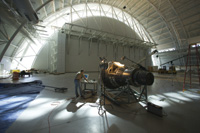
With
Elinchrom Power Packs by his side and a Manfrotto QuickTime
VR head in the cockpit, David Palermo is able to get the
precision he needs to document an important piece of history,
one of the original Mercury Capsules.
|
|
Elinchrom And QuickTime
VR
In a telephone interview, Marc Schotland, Manfrotto Product Manager at
Bogen, noted that this company’s relationship with the National
Air and Space Museum goes back a while. In the past, Bogen provided the
National Air and Space Museum with photo gear for a book on Star Wars,
as a tribute to the movie. On that earlier project, they’d worked
with staff photographer Eric Long—on stills. Long also documented
portions of this project as well.
It became clear to Biela and Palermo that consistent lighting was one
key component to QuickTime VR, since the various images needed to be the
same in terms of exposure, contrast, and color balance, considering that
numerous shots were required of the same subject, taken from different
angles. Given that one of them had prior experience with Elinchrom, it
was only natural to go to the source, Bogen, Elinchrom’s US distributor.
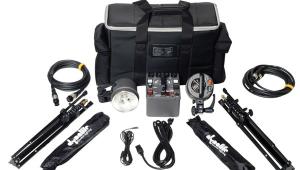
Their studio lighting of choice for each QuickTime series was the Elinchrom
Micro AS Power Pack system, whereas other aspects of this project would
involve Elinchrom Monoblocs (these monolights would be used to provide
overall fill from a vantage point on an upper walkway).
|
| |
The
first row of planes to be hung at the Steven F. Udvar-Hazy
Center.
|
|
Biela pointed out that when
shooting VR, “I have to think in 360Þ, not only about what’s
in front of the camera. When we light, I have to light both sides at the
same time. I can’t have the light and shadows shifting during the
shot. So it’s important to get the lighting right. And it’s
what’s behind you that’s always the killer, trying to get
the shot to look good when the camera’s facing 180Þ away.
So hiding the lights also becomes a big thing.”
These photographers proved themselves to be very resourceful indeed. Each
lighting situation is approached individually. As Biela described it:
“It depends on the aircraft. Things like the Concorde were a nightmare,
because it’s so long. Other airplanes are really easy: We can set
up the strobes right on the outside; flood the cockpit with light, because
it’s open, and not worry about anything.”
On The Lighter Side
Biela noted that other lights may come into play. While we were there,
he proceeded to illustrate how he used what he calls his “Home Depot
special” fluorescent bulb fixtures, which alleviated any concern
with heat inside an aircraft. “We hide them inside the cockpit,
behind the seats, and in different spots so we can light the interior.
We also employ linear fluorescent lights, and they work well down in the
foot well, or underneath the seat. Or I’ll use a lot of holiday
tree lights in cockpits, winding the lights around to get just enough
light to show up. Since we always shoot raw, I adjust color balance in
the computer.” While the 3700K fluorescents in the cockpit lend
some warmth to the shot, other lights may add a nice contrasting cool
tone, especially in shadow areas.
Given the different light sources, color management was critical to the
project. Toward that end they made use of GretagMacbeth’s Eye-One
color calibrator to create the monitor profiles, with Apple ColorSync
completing the job of color management.
As Palermo pointed out, “The first thing we had to think about was
color management, making sure that we had a certain consistency on our
project. We shoot a color wedge chart and a gray scale at the beginning
of each shoot, so we have a master image as our point of reference.”
It may take a half-hour to 45 minutes to complete a series of VR exposures.
The software involved includes Nikon Capture, Photoshop CS, and VR Worx
from VR Toolbox (www.VRToolbox.com).
For the cubic VR interiors specifically, they use REALVIZ Stitcher (www.real
viz.com). “We always shoot in raw mode, because we can do so
much more with the material,” Palermo added.
|
| |
Museum
staff carefully unload the Curtiss P-40E Warhawk in the
Steven F. Udvar-Hazy aviation hangar.
|
|
10Þ Of Separation
Bogen also provided Gitzo carbon-fiber tripods, Lastolite reflectors and
diffusers, Gossen meters, and most important perhaps, Manfrotto 300N and
303SPH QuickTime VR heads—all on loan. Schotland explained that
the 303SPH allows them to do a full 360Þ cubic VR (consisting of
vertical and horizontal shots). “That head,” he pointed out,
“is used only on the interiors of the planes. On the exterior, they’re
using a combination of our QuickTime VR heads and also our standard tripod.”
Some interiors instead made use of a motorized head—each head suited
to the situation.
Biela and Palermo are also producing more conventional 3D images—the
ones that do require the special glasses (www.3-D.com
for more info). QuickTime VR movies, free of such encumbrances, do come
with their own set of needs, especially where these aircraft are concerned.
Each QuickTime VR—interior and exterior—had a couple of things
in common. First was a rotating view of the artifact, 10Þ at a time.
The technique evolved. Initially small craft would have to be physically
revolved about an axis. VR heads made this unnecessary, since all movement
was now on their shoulders, aided by a laser pointer to mark of 10Þ
detents.
Second came shooting against a blue screen (actually a huge blue plastic
sheet), so that they can later drop in various backgrounds. In fact, blue-screen
photography was used even with interior shots, so that various sky and
scenic views could be dropped in to give the appearance of an aircraft
in flight.
Whichever method is used, the resultant QuickTime VRs leave quite an impression
on the viewer. Interactive kiosks throughout the building will give visitors
this immersive experience. There will also be a series of interactive
CDs available for educational purposes and on sale to the general public.
For more information on this project and for visitor information log onto:
www.nasm.si.edu/udvarhazycenter.
|
|