


- REVIEWS
Camera Reviews 
More Reviews Mobile Reviews Photography Reviews - GALLERIES
- VIDEOS
- BUYER'S GUIDES

Light On The Land
Capturing The Elusive Moment
"What are you photographing?" I was so lost in the scene in my viewfinder that it took a few moments before I realized she was talking to me. "All the textures and colors in the field," I answered pointing in the same direction my camera faced. "That is very nice," she agreed and raised her camera to her eye and began working the zoom lens looking for her own composition. "What are you photographing?" This time it was a man's voice and before I could look away from the scene a second time I heard the woman behind me begin to explain, "All the shapes and textures out in the field. See how there must be 20 different shades of yellow€" The man spoke again, this time to his companions, "It's not a moose." And with a shrug of his shoulders he walked away. We all see the world in different ways and one of the major factors that influences how we see the world is our own prejudice of what we are looking for. No matter how beautiful an autumn scene, waterfall, or flower may be, it will be overlooked if we are single-mindedly searching for that moose. I believe the converse of this is also true. If a beautiful scene such as a waterfall captivates us, it is easy to lose sight of little imperfections such as a branch with dead leaves hanging down from above or a gum wrapper left by an inconsiderate visitor. It is also easy to pay no attention to the light surrounding it, which is well and good if we're simply enjoying the moment. If we plan to photograph this waterfall, however, then the little details, especially the available light, become vital. Painting With Light Our brains automatically compensate for the color of light. Here's a quick test to prove this. Look at a plain piece of white paper under a fluorescent light, an incandescent light, and in the sunshine. It will look white under all three lighting sources. However, if this piece of paper is photographed under each light, the photos will show it to be green, yellow-orange, or white respectively. In the midday sun our eyes can see both leaves bathed in bright sunlight and a salamander hiding in the shadows. Film, on the other hand, is incapable of recording this high contrast scene. While slide film can record about three stops of light and negative film about seven, our eyes can distinguish over eight times that range! Our pupils enlarge and constrict in response to the intensity of light in much the same way we change the f/stops when making an exposure. Cameras have the added control of differing shutter speeds. Light Changes Subtle changes in the light often lead to dramatic changes in the landscape. And the light is always changing, be it from minute to minute, hour to hour, or day to day. Mindful observance is the first step in learning to see the light that is so easily overlooked. Light on the landscape is always changing and in turn the landscape is always changing as well. I hope that guy eventually found a moose. But more importantly, if he was intending to photograph it, I hope he found it in great light. Light Moods Fog: Early morning fog tends to be low in contrast ("flat") and bluish in color, but then a flowering redbud tree jumps out of the forest as the sun begins to burn through the early morning fog. As the fog continues to lift and the sun becomes brighter, contrast will continue to increase until it becomes too harsh to look good on film. For the moments while the sun and fog battle for permanence, the lighting will be fabulous. |
|||
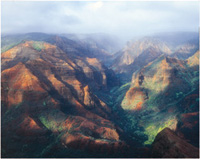
Sunrise/sunset: My favorite part of sunrise and sunset is not so much the brilliant display of colors in the east or west respectively, but rather the color and direction of light that bathes the landscape to the north and south. A drab rocky shoreline begins to glow in hues of red and orange as the sun breaks over the horizon, but soon returns to browns and grays as the sun rises higher into the sky. The early morning and late evening light that is both directional and warm in color never lasts long enough to capture all the beautiful scenes it creates. Breaks in the clouds: Heavy cloud cover makes the landscape look flat and lifeless and overcast skies photograph as bland, white without detail. While these days are great for close-ups, they're not very good for grand vistas. At least until the sun peaks through an opening in the clouds and transforms reflections in a nearby lake from "nice" to "stunning." Moments later the scene returns to "nice" as the sun slips back behind the clouds. Areas lit by sunshine become brighter relative to their surroundings and shout for attention. With a lot of patience and a little luck it is possible to photograph landscapes with specific points of interest in direct light with all else falling into shadows. |
|||
Breaks in the clouds. Heavy cloud cover makes the landscape look flat and lifeless and overcast skies photograph as bland, white without detail. While these days are great for close-ups, they're not very good for grand vistas. At least until the sun peaks through an opening in the clouds and transforms reflections in a nearby lake from "nice" to "stunning." Moments later the scene returns to "nice" as the sin slips back behind the clouds. Areas lit by sunshine become brighter relative to their surroundings and shout for attention. With a lot of patience and a little luck it is possible to photograph landscapes with specific points of interest in direct light with all else falling into shadows. |
|||
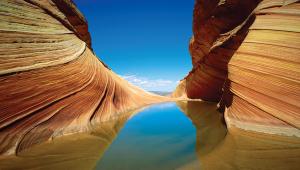
Filtered light: A stream cascades peacefully under the yellows and golds of early autumn. The water sparkles while the trees and shrubs glow. Time seems to stand still, but only for a few seconds because the sun reappears from behind the passing cumulus cloud and again shines down its harsh midday light. My favorite light for photographing intimate landscapes such as waterfalls, streams, or trees is the filtered sunlight that is produced by cumulus clouds passing overhead. The fleeting moments between harsh sunlight and complete shadow are magical. Light shining through trees often creates beautiful patterns. Different parts of the forest are lit at different times and the light changes quite rapidly. Because of the extreme contrast that often occurs in this situation, the best time to use this light is shortly after sunrise or before sunset when the light is less harsh and often warm in color. |
|||
Backlight:
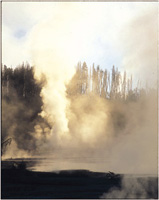
Backlighting can be found anytime the light is directional, but not all
that many subjects benefit from it. Leaves, flowers, cactus spines, steam
and other translucent subjects usually look great backlit. Backlighting
works best near sunrise and sunset when the sun is close to the horizon
and warm in color. |



| ||
|
||












 FEATURED VIDEO


Get the Latest Photo Tips, News & Reviews from Shutterbug!







| Camera Reviews Other Reviews | |
Mobile Reviews Photography Reviews Columns | |
News | |
Features | |
How-To | |
Resources |
 © 2026 Shutterbug
AVTech Media Americas Inc., USA
All rights reserved