


- REVIEWS
Camera Reviews 
More Reviews Mobile Reviews Photography Reviews - GALLERIES
- VIDEOS
- BUYER'S GUIDES

A Traditional Photographer Merges Film And Digital Techniques; The Art And Craft Of Richard Lohmann
One look at the work of Richard Lohmann and you know you are viewing the work of a very skilled photographic practitioner. But what really has Lohmann excited these days are evolutions in digital technology. A combination of advanced film processing techniques and new ink technology has convinced Lohmann that he can now produce images comparable in quality to platinum prints produced from 8x10 negatives, but have a different, and unique, character. I was fascinated by the concept and thought exploring the idea further with him would prove worthwhile.
 |
A Professor of Photography at the College of San Mateo, Lohmann earned his
B.A. in Photography and Conceptual Design in 1980. After graduation he worked
for the Imogen Cunningham Trust making platinum prints made from her glass-plate
negatives. He later earned his M.A. in Photography in '84 from San Francisco
State University.
Lohmann began making hand-coated platinum prints in '77 as a response
to the mood and character he saw in the vintage platinum prints of P.H. Emerson
and Frederick H. Evans. He loved the work of early platinum revivalists like
George Tice and Tom Millea, and was drawn to the ambiguous reference to time
created by the print's warm tones. The print color suggested that the
image might have been made in another time, perhaps in another era. Additionally,
he felt that the tonal softness helped create a mood of quiet reflection. Because
then, and now, he wants to create something that is, in the words of Brian Eno,
"extremely calm and soothing, something that invites you in, rather than
pushes itself upon you."
He made his first platinum print 27 years ago, but today he's exploring
how digital imaging can aid in his expressive efforts. Today he works with a
"hybrid" of digital and traditional techniques, producing prints
that share the same warmth and texture as his platinum prints, but produce a
wider dynamic range of tones.
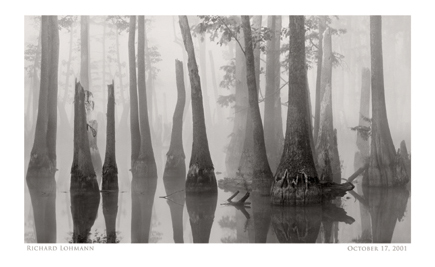 |
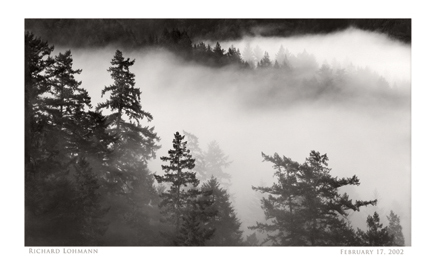
Lohmann is currently working on a project titled "Atmosphere."
In his words, "I have stopped seeing my photographs as descriptions of
place but as visual metaphors, where the whole is equal to more than the sum
of its parts. To dissuade viewers from literal interpretation, I have titled
each image simply with the date the photograph was created. My goal is to create
images where `the trees are no longer trees.'"
To view more of Lohmann's work, visit www.richardlohmann.com.
| |||||||||
|

| ||||||||














 FEATURED VIDEO


Get the Latest Photo Tips, News & Reviews from Shutterbug!







| Camera Reviews Other Reviews | |
Mobile Reviews Photography Reviews Columns | |
News | |
Features | |
How-To | |
Resources |
 © 2026 Shutterbug
AVTech Media Americas Inc., USA
All rights reserved