Picture This Pan It
Shutterbug Staff, August, 2003

Picture This!
| Our assignment
for this month was panning and we got a slew of images from readers showing
that they had really mastered the technique. Panning is accomplished by
setting your camera to a slow shutter speed and then following a subject
as it moves past. It’s another way that photography allows us to
see the world in a way that is impossible for the unaided eye. We received
images of everything from sports action to birds on the wing, and a few
that caught us by surprise. So the next time you want to try a fun technique
slow down that shutter and give panning a try!
|

Buckaroo:
The motion and action of the rodeo are caught in one shot by D.W. (Dave)
Clements. He made this photo using a Canon EOS-1D and a Canon f/2.8
70-200mm lens. Exposure was f/2.8 at 1/250 sec.
©
2003, D. W. Clements, All Rights Reserved

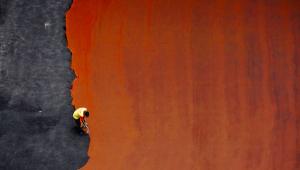
Panning Pan: We’re
suckers for a visual pun and Tony Mason of Oregon Photo Tours (http://oregonphototours.tripod.com)
supplied it. As he wrote: “I placed my tripod-attached Olympus
OM4 on a local city park playground’s merry-go-round…and
then set up another tripod in the center with a frying pan attached
to it.” He then spun the merry-go-round and made an exposure of
2 seconds on Fujichrome Sensia II 100 film.
© 2003, Tony Mason, All Rights Reserved

Fun Ride: Ray Eurich
made this great shot of his grandchild Brittney on the Tilt-a-Whirl,
which he says is one of her favorites. He used a Pentax Super Program
camera with a Tokina 35-70mm lens and made the shot on Kodak Gold 100
at 1/30 sec at f/11.
© 2003, Ray Eurich, All Rights Reserved

Tone And Motion:
We were struck by the beauty of this shot and how the tones all fall
together with the subject. Shelley Alger Fong made this with a Canon
Elan 7 camera with a 100-400mm IS lens. No exposure information was
supplied.
© 2003, Shelley Alger Fong, All Rights Reserved

Victory Lap: John
E. Rees said auto racing fans would know this driver by the size of
the checkered flag, which he says the driver carries with him because
he wins so regularly. We’re not sure who that might be but we
liked the way the light catches the flag and plays off the cars. Rees
made the shot with an Olympus 3030 at f/8 and 1/30 sec.
© 2002, John E. Rees, All Rights Reserved
|

Shoot
That Puck: Les Whitford captured the quick motion of a hockey game and
this Salmon Arm Silverbacks player. He worked with a Canon EOS D60 with
a Canon EF 100-400mm L lens. Exposure was 1/20 sec at f/4.5 with the ISO
set at 200.
© 2003, Les Whitford, All Rights Reserved

Motocross: Joe Duty made this dynamic image of a racer using his Nikon
D1X with a Nikon 17-35mm lens at f/22 at 1/30 sec. It goes to prove that
the faster the action the faster the shutter speed you can use for panning.
© 2003, Joe Duty, All Rights Reserved

Dog Chases Ball: This fun shot of Debbie Smith-Gordo’s dog Murphy
was made with a Pentax ZX-7 with an exposure of f/11 at 1/90 sec. Debbie
told us that she made this shot for a class assignment, and that she got
an A in the class. Now we see why.
© 2003, Debbie Smith-Gordo, All Rights Reserved

Motion Transformation: Sometimes a slow shutter speed can warp form through
time. This skateboarder was caught in mid-flight by Jack Mansfield with
a Canon Elan IIe and a Canon 75-300mm lens. The shutter speed on Kodak
Gold 100 film was 1/10 sec.
© 2003, Jack Mansfield, All Rights Reserved

In Full Flight:
John C. Wilson told us that he shot three rolls of film of seagulls in
a small cove in Grand Manan Island in New Brunswick, Canada, and this
was his main keeper. He worked with a Canon EOS 620 and a 100-300mm lens
and exposed at 1/15 sec on Fujichrome 100.
© 2003, John C. Wilson, All Rights Reserved
|

© 2002, Joe Farace, All Rights Reserved
|
Picture This! -
Our Next Assignment
Colorful
Cars
Our next Picture This! assignment
is “Colorful Cars.” Photographing automobiles, especially
at car shows, can be a challenge, because there’s crowds of people
and the cars are often parked closely to one another. The secret, if there
is any, is to get close and use lots of depth of field by selecting the
smallest possible apertures. Tip: Wide angle lenses help. They provide
a greater range of sharpness and let you get closer, cropping the car
tightly, eliminating extraneous details.
This photo was made with a
Canon EOS-1N and 28-90mm zoom at f/8 with Kodak Elite Chrome Extra Color,
Joe Farace’s favorite film for photographing cars. The extra contrast
and enhanced saturation are perfect for this photo that basically features
three colors (not counting black) of white, yellow, and blue. There were
800 cars and many thousands of people at this car show, but using a low
angle simplified the background and made for what, Farace thinks, is a
stronger composition.
Please Read This
It is important that you read and follow these guidelines. We need to
follow this procedure because of the large volume of images we receive.
1) Images sent to us cannot be returned. You retain complete copyright
over the
images, but do grant us permission to print your image(s) in the magazine
and on our
web site, www.shutterbug.net
2) Because images are not returned please send a quality print or duplicate
transparency. We will not accept or view images on CD, ZIP, or any other
electronic media.
3) Images will be selected on the basis of content and technical quality.
Please mark your outer envelope with the topic of the month (for example,
“Wide View”).
4) Enclose a short caption with the image stating camera, lens, film and
exposure, plus location. If you are submitting an image with a recognizable
person we must have a model release or signed permission from that person
to reproduce their image in the magazine and on the web site.
Send your image
and information to:
Picture This! Shutterbug Magazine,
5211 S. Washington Ave.,
Titusville, FL 32780.
Deadline for submission: September 15, 2003.
Images will appear in our December 2003 issue.
Our next topic: Found Still Life
Deadline: October 15, 2003.
Publication Date: January, 2004
|
|