


- REVIEWS
Camera Reviews 
More Reviews Mobile Reviews Photography Reviews - GALLERIES
- VIDEOS
- BUYER'S GUIDES

Canon EOS 40D Digital SLR
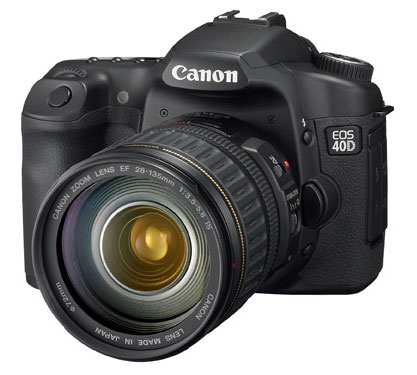
The most easily visible upgrade on the EOS 40D Digital SLR is the camera's larger three-inch LCD screen (compared with the EOS 30D's 2.5-inch monitor). In order to increase viewing ease in outdoor conditions such as bright sunlight, Canon raised the brightness level of the EOS 40D camera's 230,000-pixel LCD screen, broadened the color gamut and narrowed the viewing angle from 170 degrees to a still wide 140-degree perspective in all directions. An added advantage of the larger-sized display is the ability to use a larger font size for text, making it easier to read setting and menu options on the screen. The camera's menu is organized in the same tabbed format as the EOS-1D Mark III Digital SLR. The upgraded viewfinder increases optical magnification from 0.90x to 0.95x, expands the viewing angle from 251 degrees to 264 degrees and raises the eye point from 20mm to 22mm.
The EOS 40D SLR has a magnesium alloy exterior that is said to be even more ruggedly dependable than its predecessors with upgraded dust and weather resistant construction, particularly around the camera's connection ports, battery compartment and single-slot compact flash memory card door. Should the user inadvertently open the compact flash card door while the camera is writing to the card, a warning will pop up on the LCD screen and an open door "alarm" will sound, but the image(s) will continue writing to the memory card without interruption. The EOS 40D SLR also retains many of the outstanding features of the EOS 30D model, such as its fast 0.15-second initial start-up, its extremely durable shutter (rated up to 100,000 cycles), its top shutter speed of 1/8000 sec and 1/250 maximum X-sync flash shutter speed setting.
Although it is based on the image sensor used in the EOS Digital Rebel XTi, the EOS 40D Digital SLR's 10.1-megapixel CMOS APS-C size image sensor has been significantly improved thanks to the use of larger microlenses over each pixel to reduce noise and expand sensitivity up to ISO 3200. The EOS 40D retains the model 30D camera's 1.6x focal length conversion factor (compared to full-frame digital image sensors or 35mm film) and is compatible with the full line-up of Canon EF lenses as well as the Company's expanding selection of high-quality, affordable EF-S lenses created specifically for Canon Digital SLRs with APS-C size image sensors.
Adding to the improved virtuosity of the images captured by the EOS 40D SLR
is the camera's 14-bit Analog-to-Digital (A/D) conversion process. Able
to recognize 16,384 colors per channel (four times the number of colors recognized
by the EOS 30D SLR's 12-bit conversion capability), the EOS 40D camera
is able to produce images with finer and more accurate gradations of tones and
colors. The EOS 40D also incorporates the optional Highlight Tone Priority and
High-ISO Noise Reduction functions first introduced earlier this year with the
EOS-1D Mark III Professional Digital SLR.
In addition to retaining the RAW image capture capabilities of its predecessors,
the EOS 40D SLR now offers a more manageable "sRAW" recording format.
In sRAW mode, the number of pixels is reduced to one-fourth that of a standard
RAW image and the file size is cut in half, while retaining all of the flexibility
and creative possibilities associated with full-size, conventional RAW images.
While the EOS 40D SLR maintains the nine-point wide area AF coverage first introduced
on the EOS 20D camera, Canon has made significant improvements to its speed,
precision and functionality, minimizing subject recognition problems in the
process. The EOS 40D camera's completely redesigned nine-point AF sensor
provides cross-type AF measurement at all nine focusing points for maximum apertures
up to f/5.6, and for the first time in any EOS camera, the central AF point
offers enhanced precision for both vertical and horizontal subject contrast
when using EF or EF-S lenses featuring maximum apertures of f/2.8 or faster.
AF calculation speed with the EOS 40D camera is 30 percent faster than the EOS
30D model.
The Canon EOS 40D Digital SLR retains the same 35-zone metering sensor as its predecessor. Available patterns include Evaluative metering, which is linked to all AF points and is set automatically in the Basic Zone modes, Centerweighted average metering, Partial metering and Spot metering, covering approximately 9 percent or 3.8 percent of the viewfinder at center, respectively. The camera's E-TTL II autoflash and 12 exposure control modes (11 AE modes plus manual) are also unchanged from the EOS 30D SLR model. However, as a result of consumer input, Canon has added three Custom exposure modes. As an added convenience, particularly for wireless flash operations, users can adjust the flash settings of the Canon Speedlite 580EX II directly from the camera.
The Canon EOS 40D camera offers ISO speeds from ISO 100 to ISO 1600 in 1/3-stop increments. Users can also opt for a high-speed setting of ISO 3200. For the first time in any EOS camera, the 40D model offers Auto ISO capability in Creative Zone exposure modes. This valuable new feature adjusts the ISO speed to the optimal setting based on low light or shaky shooting conditions. Additionally, the EOS 40D provides full-time display of the active ISO speed setting, both in the viewfinder as well as on the top LCD data panel.
The Canon EOS 40D Digital SLR is also the first camera in its class to offer two interchangeable focusing screens in addition to the standard precision matte screen. Users can opt for a grid-type focus screen that makes it easier to verify horizontal or vertical alignment while determining image composition, as well as the Super-Precision Matte focusing screen that makes it easier to grasp the "sweet spot" of manual focusing when using a lens with a maximum aperture of f/2.8 or faster.
Enhanced Live View
Previously the province of the EOS-1D Mark III DSLR (one of Canon's top-tier
professional cameras), the Live View function now gives EOS 40D camera users
an expanded and exceedingly convenient and comfortable set of shooting options.
By permitting the framing and capturing of subjects using the camera's
LCD screen instead of the viewfinder, the shooter gains a 100 percent field
view to more easily achieve the desired composition. A new Custom Function on
the EOS 40D allows autofocus during Live View by pressing the camera's
AF-ON button. At that point, the reflex mirror goes down and AF is carried out
in the normal way. Letting go of the AF-ON button resumes Live View functions.
Also, in the Live View shooting mode the user can magnify the image by five
or ten times in order to ensure that the shot is optimally focused. Live View
is at its best during tripod shooting -- particularly for close-up photography
where precise focusing is imperative. As a side benefit, the Live View shooting
mode helps to reduce vibration by lifting the reflex mirror out of the optical
path well in advance of the exposure, improving image quality at slow shutter
speeds. A new electronic 1st-curtain shutter function in Live View mode reduces
release time lag and operational noise even further to avoid spooking wildlife
or disturbing people nearby with unwanted camera sounds. Additionally, as the
release time lag is miniscule, even instantaneous movements like a bird taking
flight can be readily captured.
EOS Integrated Cleaning System
First introduced on the EOS Digital Rebel XTi camera, the EOS Integrated Cleaning
System is a prime example of trickle-up technology and is now becoming a standard
feature on all new EOS Digital SLRs. The camera's Self-Cleaning Sensor
Unit uses ultrasonic vibrations to literally shake dust particles off of the
low-pass filter in front of the sensor each time the camera is powered up or
shut down. Users also have the option of engaging the "clean now"
function at will or bypassing it altogether. Additionally, the EOS 40D SLR's
manual sensor cleaning function raises the mirror and allows users to clean
dust that has stuck to the low-pass filter. Dust that has been shaken or blown
loose is then trapped by adhesive at the base of the sensor unit housing, preventing
the problematic particles from reattaching themselves to the filter when the
camera moves. The second part of the cleaning system is a software solution
that maps the location of any spots that may remain on the sensor. The mapped
information is saved as Dust Delete Data and attached to the image file. Subsequently,
the offending dust information is subtracted from the final image during post
processing with a compatible personal computer, using the supplied Digital Photo
Professional software.
Improved Software
Among the most valuable features of the Canon EOS 40D Digital SLR is its compatibility
with Canon's Picture Style Editor (PSE) 1.0 software. With PSE, shooters
can actually design the look of their photographs by inputting their own preferred
style, color and tone curves. The EOS 40D Digital SLR also ships with the latest
versions of Canon's powerful software applications, including Digital Photo
Professional 3.1 and EOS Utility 2.1, which now support the camera's Remote
Live View and Dust Delete Data functions, as well as incorporating a broad range
of additional improvements designed to improve image quality and speed up workflow.
Also included are ZoomBrowser EX 5.8 and ImageBrowser 5.8 for easy browsing,
viewing, printing and archiving with compatible computer operating systems,
including Microsoft Windows Vista and Windows XP, as well as Mac OS X.
Accessories
New system accessories for the EOS 40D SLR include the redesigned high-capacity
Battery Grip BG-E2N, which facilitates high-volume shooting and easier vertical
shooting. Compatible with up to two BP-511A battery packs or a set of six AA-size
batteries, the battery grip approximately doubles the number of shots that can
be taken, compared with the battery power of the EOS 40D SLR alone. The BG-E2N
grip features new sealing material around the battery compartment to better
resist water and dust. The new model replaces the original BG-E2 grip and is
compatible with the EOS 20D, 30D and 40D models.
Designed exclusively for the EOS 40D SLR, the new Wireless File Transmitter WFT-E3A*/** permits wireless transfer and back-up, as well as remote control of the camera in Live View mode. It can also be connected to various GPS receivers or Hi-Speed USB 2.0 external storage devices such as convenient flash drives or high-capacity hard drives with much larger storage capacity than the memory cards in the camera for instant back-up as images are captured. Compact and affordable, the WFT-E3A wireless transmitter also doubles as a vertical grip and requires its own BP-511A battery pack in addition to the battery installed in the camera body.
EF-S 18-55mm f/3.5-5.6 IS Lens
The Canon EF-S 18-55mm f/3.5-5.6 IS standard zoom lens adds a flexible lens
to the EOS 40D SLR shooter's imaging arsenal. While it features the wide-angle
to mid-range zoom flexibility of its non-IS predecessor, this new EF-S 18-55mm
f/3.5-5.6 IS lens offers the significant advantage of a true lens-shift image
stabilization system that yields up to a full four stops of image-shake correction.
The Canon's lens shift IS system includes the ability to optimize the lens performance for specific shooting situations such as low-light, long-zoom or movement while shooting (or virtually any combination of the three). What's more, the shooter can see the image stabilization effect in the viewfinder. As the image already appears steady, more accurate framing and composition is possible, the AF point can be placed more precisely, and the photographer can concentrate on the optimal shot more comfortably.
Compact and lightweight, the optional EF-S 18-55mm f/3.5-5.6 IS zoom lens is manufactured by Canon specifically for the EOS 40D SLR and any other EOS SLR that takes EF-S lenses including the EOS 30D, EOS 20D, EOS 20Da, EOS Digital Rebel XTi, EOS Digital Rebel XT and the original EOS Digital Rebel camera. An ideal complement to the EOS 40D SLR, the EF-S 18-55mm f/3.5-5.6 IS lens is scheduled to be in stores in October at an estimated selling price of $199.99.i
The Canon EOS 40D Digital SLR is scheduled for early September delivery and will be sold in a body-only configuration at an estimated selling price of $1,299.00i. It will additionally be offered in a kit version with Canon's EF 28-135mm f/3.5-5.6 IS USM zoom lens at an estimated selling price of $1,499.00.
| ||
|
||














 FEATURED VIDEO


Get the Latest Photo Tips, News & Reviews from Shutterbug!







| Camera Reviews Other Reviews | |
Mobile Reviews Photography Reviews Columns | |
News | |
Features | |
How-To | |
Resources |
 © 2026 Shutterbug
AVTech Media Americas Inc., USA
All rights reserved