


- REVIEWS
Camera Reviews 
More Reviews Mobile Reviews Photography Reviews - GALLERIES
- VIDEOS
- BUYER'S GUIDES

Humibox Dry Cabinets
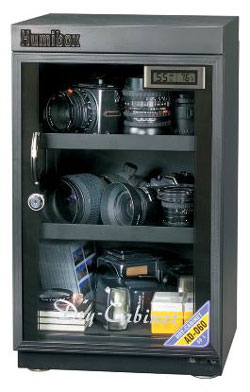
A Dry Cabinet is a storage cabinet that protects objects from problems caused by humidity. It has a built-in automatic dehumidifier that controls humidity on demand.
According to the manufacturer, fungus can grow on the surfaces inside your
lens, provided that there is enough moisture. Over time, the fungus can etch
into the surface of the glass, causing permanent damage to the lens performance.
The etched spots in the lens glass alter the lens surface and characteristics,
thus reducing performance significantly and contrast in particular. A fungal
attack which hasn't altered the lens shape or etched into the glass, but only
eaten away at the very thin outer lens anti-flare coating, is less damaging
to the lens performance. Once the lens coating and surface are etched and damaged,
removing the mold won't return the lens to its original performance levels.
Fungus can be removed during a lens CLA (clean/lube/adjust), but the damaged
and etched lens elements are costly to replace. Not every fungus spore will
be removed even with the most thorough cleaning. Even if you sterilized the
lens elements (not recommended), fungus spores would still be sucked into the
lens during focusing and use.
Many people are warned against using leather lens carrying cases or bags as
a potent source of fungal infection. But there are enough fungus spores in the
air (often hundreds per cubic meter) that lenses are easily infected in general
use. So since you can't get rid of fungus spores, you simply have to store your
lens in a condition where fungus can't live or grow.
Varying levels of relative humidity can have an effect on lenses and other gear. It is generally recommended that still cameras, video cameras, lenses, microscopes, telescopes, negatives, tapes, videos, slides, microfilms, CDs, DVDs and art work be stored at 40-55% relative humidity.
Precise metal materials, electronics, pottery and porcelains, semiconductors, PC boards, various precise instruments, metallic musical instruments, clothes, leather, gold and silver and various treasured collections are best kept at 30-40% relative humidity.
Humibox uses T.E.Cooling refrigerated crystal which is a semiconductor crystal for absorbing the moisture of the cabinet's interior air. Whenever the humidity of the cabinet is higher than the set RH% value, the cooling refrigerated crystal will start to refrigerate and condense the moisture until the humidity of the cabinet is down to the set RH% value. Once crystal stops working, it begins to defrost as well as evaporate the moisture out of the cabinet.
| ||
|
||















 FEATURED VIDEO


Get the Latest Photo Tips, News & Reviews from Shutterbug!







| Camera Reviews Other Reviews | |
Mobile Reviews Photography Reviews Columns | |
News | |
Features | |
How-To | |
Resources |
 © 2026 Shutterbug
AVTech Media Americas Inc., USA
All rights reserved