


- REVIEWS
Camera Reviews 
More Reviews Mobile Reviews Photography Reviews - GALLERIES
- VIDEOS
- BUYER'S GUIDES
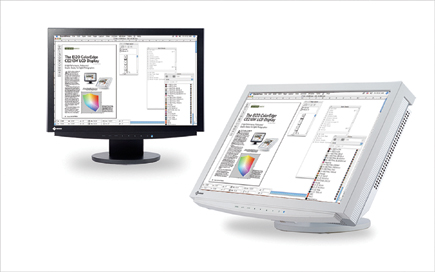
The EIZO ColorEdge CE210W LCD Display; A High-Performance, Professional Graphic Display For Digital Photographers
As with CRT monitors, LCD displays for computer use exist because of a larger market for television sets. Without that larger market displays for computers would be prohibitively expensive, if available at all. So, an LCD display made and sold for computer use might be appropriately considered a stepchild of the TV industry. A professional graphic display intended to meet the exacting demands of graphic users, pre-press, and digital photographers is an even more distant relative, but defined largely by its ancestry nevertheless.
 |
|
|
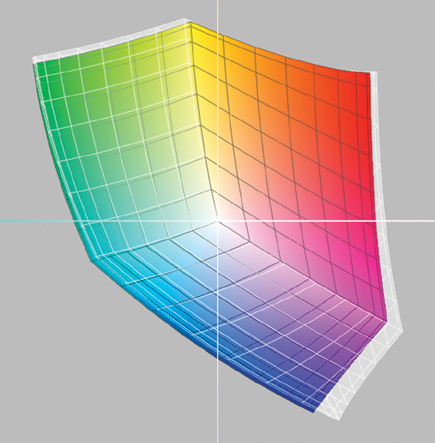
Although CRTs and LCDs serve the same purposes, even though technically they are unrelated in how LCDs function, there is a new dimension and difference between CRTs and LCDs that affects how they are applied to their different kinds of use. CRTs were not very bright relative to normal room light, so all CRTs were configured to function close to their maximum brightness capacity for all applications, whether used in TVs, as a computer monitor or a specialized professional graphic monitor. With LCDs that has changed because the LCD-TFT screen that forms the image and the usual cold cathode light source are separate and essentially independent parts of the display, allowing for a much higher brightness and subsequent contrast potential.
 |
|
|
The result is that LCD displays made for general computer use primarily in
home/office environments can reproduce text and web graphics with very high
brightness and contrast to match normally bright office and home interior lighting.
This very high brightness and contrast that is advantageous with text and some
graphics in bright environments is not an ideal configuration for the effective
display and editing of digital photographic images. They usually reproduce burned
out highlight detail and too dark shadows that can obscure detail.
Although the latest premium models of general home/office computer LCD displays
provide adjustment to levels of brightness, contrast, and color balance, the
default settings out of the box often require substantial adjustment and fine-tuning
to achieve an ideal balance for displaying pro graphic and digital photography
applications. And, LCD models specifically designed for pro graphics and digital
photography should be both factory configured with default settings consistent
with that specialized use, as well as provide performance attributes and features
that are complementary to pro graphic and digital photography use.
 |
|
|
EIZO ColorEdge CE210W Features
The EIZO ColorEdge CE210W is an HD wide format 21" LCD (and the larger
24" but similar CE240W) designed to be used for a wide range of professional
creative graphic applications, including exacting requirements for color management
and precisely controlled color reproduction performance. The EIZO CE210W provides
a native resolution of 1680x1050, an adjustable contrast ratio up to 1000:1,
and a maximum brightness of 450 cd/m2, with a 178Þ viewing angle. The
features that most distinguish this EIZO model as a professional creative graphic
display include factory adjustment of gamma, with a default to the most popular
industry standard of 2.2 using the display's own 10-bit LUT (Look Up Table)
that measures every shade of the RGB spectrum, setting each precisely. In addition,
the 10-bit LUT supports a user-selectable gamma (other than 2.2) from 1.8 to
2.6.
The on-board display color processing is accomplished with the EIZO CE210W's
own 14-bit ASIC (Application Specific Integrated Circuit), which provides color
information and reproduction of smooth, accurate gray scale and color rendering
in even the darkest values, which is necessary to display color images without
blurring. This performance extends to video and 3D motion graphic reproduction,
with a fast 8 ms midtone response time. The display's color management
is also facilitated by EIZO's own ColorNavigator CE software, supplied
with each display, that facilitates 10-bit hardware calibration via one of three
popular professional monitor/display measurement devices, including GretagMacbeth's
Eye-One, X-Rite's MonacoOPTIX and MonacoOPTIX PRO, and ColorVision's
Spyder2 and Spyder2PRO.
 |
|
|
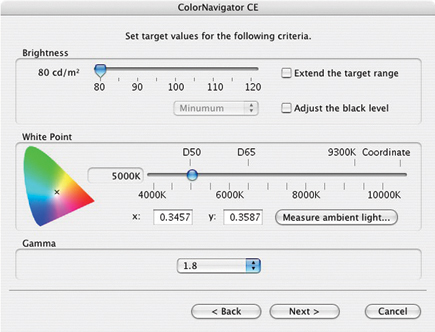
Calibrating and profiling the EIZO CE210W is enabled using the ColorNavigator
CE software application by a direct hardware interface through a USB connection
between the host computer and the display. The ColorNavigator CE software provides
precise target settings for brightness in 5 cd/m2 increments from 80-400 cd/m2
(and black level), white point color temperature in 100K increments from 4000-10,000K,
as well as gamma in 0.1 increments from 1.0-2.6 (digital). Calibrating and profiling
after the targets are chosen is then accomplished by following very simple on-screen
instructions and using one of the supported monitor/display sensor measuring
devices.
| |||||||||
|

| ||||||||























 FEATURED VIDEO


Get the Latest Photo Tips, News & Reviews from Shutterbug!







| Camera Reviews Other Reviews | |
Mobile Reviews Photography Reviews Columns | |
News | |
Features | |
How-To | |
Resources |
 © 2025 Shutterbug
AVTech Media Americas Inc., USA
All rights reserved