


- REVIEWS
Camera Reviews 
More Reviews Mobile Reviews Photography Reviews - GALLERIES
- VIDEOS
- BUYER'S GUIDES
The Nikon D2x; Nikon’s Flagship Pro Digital SLR
When Nikon announced the D2X last year at photokina there was a good deal of anticipation about it, and a good wait that followed until it finally arrived. In the meantime, Canon countered with their EOS-1Ds Mark II, which in many ways shaped the competitive landscape. With a street price of $4999.95, Nikon's flagship digital SLR is $3000 less than the $8000 (body only) Mark II, albeit with a smaller CMOS sensor. Has the D2X met and surpassed expectations? In my mind it has been well worth the wait, being a camera that is solidly within the Nikon tradition that in many respects feels like a digital F6, Nikon's recently introduced top of the line film SLR.
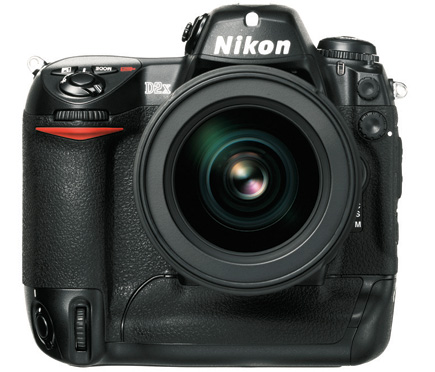
For F5 and F100 users, there will be an instant familiarity with the controls.
Nikon did an excellent job of making the transition from their professional
film cameras to the D2X as seamless as possible. Many of the controls fall under
the fingers at the same location on this camera as on the F5. The "on-off"
switch, mode button, exposure compensation button, metering systems, diopter
adjustment, AE-L and AF-L, AF-ON, shutter/aperture wheels, spot wheel, the S,
CH, CL, and Timer, and vertical shutter release are all in the same locations
on the camera as on the F5. A nice new feature on the D2X is "M-up"
selection, which locks the mirror to avoid any blur occurring from mirror slap.
One of the most attractive aspects of the new camera is the large 2.5"
LCD monitor. Its "roomy" view is a great advantage in checking out
composition. As with all LCD monitors, the exposure is best evaluated by viewing
the histogram, not by viewing the image on the monitor. In addition, the top
control panel is large and easy to read, including flash data. The rear control
panel, just beneath the monitor, has controls to quickly adjust ISO, image quality/size,
and white balance without going into the menu. That's as it should be
for a pro camera, where field responsiveness is paramount. Many other features
are accessed with the electronic menu that includes a multitude of options,
including custom functions.
 |
|
|
The sensor on the D2X is what's come to be called "APS-sized,"
which yields a 1.5 conversion factor with 35mm SLR lenses, but does not affect
aperture, at least when it comes to exposure. For example, an 80-200mm f/2.8
lens becomes a 120-300mm f/2.8 lens. That sounds pretty good. I know that the
great bird photographer and author, Artie Morris, likes the 1.5 factor as his
500mm f/4 lens becomes a 750mm f/4 lens!
The situation is quite different for landscape and nature photographers, who
tend to lean more toward wide angle lenses. A workhorse lens for landscape shooters
is a 20mm f/2.8 lens. A 20mm becomes a 30mm and completely loses the ultra-wide
angle effect. This could be an issue for some, especially those invested in
"normal" wide Nikkor or Nikon-mount lenses. For me, the solution
is to invest in one more lens, the Nikon 12-24mm, which gives one a true 18mm
lens. I have never gone any wider than 20mm for most of my photographic career,
so with the addition of one lens, problem solved. Also, the finder view is 100
percent, so you see in the finder exactly what you'll get in the final
image.
 |
|
|
My forte is nature and landscape photography, so I am always concerned with
a camera's built-in protection against the elements. During my tests,
I didn't "baby" this machine, and worked with it out on a
windy beach, in a heavy wet fog, freezing cold, and in a light drizzle. No problem.
Don't get me wrong, I wasn't inviting trouble, as I did cover the
D2X when I thought the weather was getting a bit out of hand, like I would the
F5. Happily, the D2X seems well protected and solidly built.
Many of my images are shot for stock, and previous pro digital cameras (especially
the last crop of 6-megapixel models) didn't really deliver the large file
sizes required. The D2X, with a high-resolution 12.4 effective megapixel CMOS
DX Sensor with fast four-channel output for 4288x2848 pixel images passed that
test with flying colors and the files will be readily accepted by the two major
stock agencies, Getty and Corbis. While some photographers, such as those doing
sports or reportage, might not need the hefty 39MB sizes for their work, those
seeking to do large prints or who shoot for stock or reproduction will have
all the firepower they need when using the full resolution settings on this
camera.
 |
 |
|
|
||
Speaking of files, you can shoot raw (Nikon NEF) and one of various JPEG compression
ratios simultaneously, which allows you to ship off previews to editors or agencies
without having to convert all the raw files first, a great aid in speeding what's
come to be called workflow. It's also great for making images ready for
the web for those who blog or need to fill pages the night after a shoot.
The "native" ISO is 100, but can be shot up to 400 with absolutely
no noise. The highest "normal" speed you can set is ISO 800, and
you can get to 1600 and even 3200 if desired via the menu. Beginning at ISO
800, there is a noticeable drop in brightness, increase in noise, and the shadows
get very blocked up. You can also turn on the "noise reduction"
command for higher ISOs.
 |
|
|
White balance options are available for bright sunlight, overcast, dark overcast, fog, sunrise, and sunset. When shooting in raw, the white balance can be set during the raw conversion. Actually, you can try all of the white balance options to see which works best for you. When shooting in JPEG, one needs to set the white balance before shooting. This can be done by selecting an available option or by using an ExpoDisc device to preset the white balance. I use a great deal of color correction and color altering/enhancing glass filters and prefer them, as they are faster and save computer time in the processing stage.
Field Test
While the D2X has a list of impressive features, all are pretty meaningless
if the camera doesn't perform in the field. Following are some of the
settings that I used and why.
First off, I always use mirror lockup on non-moving subjects in order to avoid
any camera shake produced by some shutter speeds.
My image quality is set to raw+ and JPEG basic. This is done because I don't
want to process every raw image in order to edit. The JPEGs can all be placed
in a folder and viewed immediately by dragging the folder into a program like
iView Media. The NEF and JPEG image have the same number, so after seeing what
image I want to edit in the JPEG window, I process the corresponding NEF image.
 |
|
|
My white balance is set to the bright sunlight setting, because the camera
"expects" to see bright sunlight and compensates the least of all
the other white balance options. Then I try various white balance options during
the raw processing phase.
My ISO is set to the lowest number for greatest sharpness and clarity. On the
D2X, the lowest is ISO 100. Image Sharpening is turned off, as I prefer to do
all sharpening in Photoshop.
My Tone Compensation is set to A (Auto). This is the camera default and automatically
optimizes contrast by choosing the appropriate curve for each image. The Color
Space is set to Adobe RGB as the widest color space available on the D2X. The
Color mode is set to III for landscape/nature.
| |||||||||
|

| ||||||||


 FEATURED VIDEO


Get the Latest Photo Tips, News & Reviews from Shutterbug!







| Camera Reviews Other Reviews | |
Mobile Reviews Photography Reviews Columns | |
News | |
Features | |
How-To | |
Resources |
 © 2026 Shutterbug
AVTech Media Americas Inc., USA
All rights reserved