


- REVIEWS
Camera Reviews 
More Reviews Mobile Reviews Photography Reviews - GALLERIES
- VIDEOS
- BUYER'S GUIDES
Pro Digital Cameras
The High End Digital Market
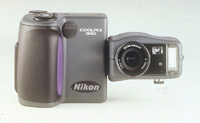
During a recent trade show, I was walking across the exhibition floor with Joe Hall, sales and marketing manager for Jobo Fototechnic, Inc., when we heard a speaker say: "You can make a 5-foot print from this 2MB file. And it will be goorgeous," the voice trailed after us. "I'm sure you can," chuckled Hall. "In fact, you can make a 10-foot print, and it won't bog down the printer at all." The exchange brought me back to an earlier conversation with Ronn Brown, Calumet Photographic, commercial/portrait marketing manager. "There's a new era of mediocrity in this industry that is going to slow down the evolution of professional photographers moving into digital imaging," warned Brown. "With companies making promises that can't be substantiated or introducing vapor-ware that make everything currently on the market appear obsolete, the decision-making process is becoming increasingly difficult." And while the technology is complex, confusing marketing ploys further complicate matters by rearing their ugly heads. Take for example the 65-foot, man-eating tyrannosaur rex hovering over Times Square during the past holiday season. Taken by Joe McNally with a CoolPix 990 (prosumer type point-and-shoot)--the original 2048x1536 uninterpolated 3MB file (10MB interpolated or de-mosaiced file) was scaled up to 237MB using Altamira's Genuine Fractals (GF) technology. And that is exactly the sort of thing that is causing confusion in this industry. Why buy a $10,000-$25,000 professional digital camera, when you can create a 65-foot image with equipment that will not break the bank. "It's almost like history is repeating itself," said Doug Sperling, Calumet Digital Solution (CDS), technical training manager. He was referring to a century ago, when the large format 8x10 view cameras were the popular instruments for professional photographers. Then Kodak introduced the Brownie, which was originally intended as a child's camera, and completely revolutionized the industry. "We are at the Brownie stage now. When people choose to use it, and how they choose to use it, remains to be seen," he added. "The industry is starting to evolve, and we have to evolve with it. We've had to shift our focus to support a heavier concentrate of consumer products. Our customer base is, and has been, based on sales and support for high-end professionals. Many of them are looking to add prosumer equipment to their arsenal to remain competitive in full-service studio services such as grip-and-grins and other events." "The thing that segments the consumer from the pro is not there anymore, but the bottom line is, you still have to be a good photographer," added Ed Meyers, technical trainer and support at CDS. "For that reason the professional photographer will always use high-end equipment." |
|||
Apples And Oranges In the digital arena, there is a distinct difference between shooting moving and still objects. Still photography has the advantage in the digital arena, because it allows the capture device to capture or scan the medium three times (or four)--once (or more) for each color channel (RGB) providing uninterpolated (true) color resolution and large file sizes. Usually, comparing specs on scanning or multi-shot digital devices is based on numbers (file size), but there are three other important variables, namely the quality of the optics, the quality of the image sensor (which we will get into later), and the functionality of the proprietary software. Other important considerations that affect functionality rather than quality are speed and the device's compatibility with the studio's existing lighting, camera, and computer equipment. However, both of these technologies (scan and multi-shot) are limited to inanimate/still photography. Shooting moving objects with digital equipment for color output provides an entirely different set of problems because of the inherent nature of digital imaging sensors--they are monochromatic. Therefore, capturing digital images in color adds a dimension beyond the sensors to the process, which has been approached with a variety of innovative solutions. Before we get to that however, let's back up for a moment and examine the differences between imaging sensors. The two primary types of imaging chips on the market today are CCD (Charged Couple Device) and CMOS (Complimentary Metal Oxide Semiconductors). Both are based on photons displacing electrons as light hits the diodes. Like horsepower for cars and megahertz for computers, file size is usually the first criteria to use when determining quality capabilities. But file size can be confusing, and doesn't always tell the whole story--most one-shot digital cameras have a raw uninterpolated file size, and then a finished file size that's inflated by a factor of three after interpolating to fill in the missing colors. To determine a camera's file size capabilities: multiply the number of (x) pixels by the number of (y) pixels by the number of color channels (in a one-shot camera using a CCD with a mosaic of filters, that's only one color channel), by the number of bytes per datum. Then divide the answer by 1,048,576 (the number of bytes in a megabyte), and you will have the cameras potential true uninterpolated file size. If, for example, you were using a BetterLight 6000, the pixel configuration is 8000x6000 or 8000 pixels in one direction and 6000 pixels in the other direction. Multiply that by three color channels (RGB), and by one byte per datum (because 8 bits or less per channel equals one byte per datum--24-bit RGB in this scenario), while 2 bytes per datum would be for more than 8 bits per channel (up to 16 bits per channel). So the equation would look something like this: 8000x6000x3x1 =144,000,000 bytes divided by 1,048,576, which equals 137.3MB. It's hard to compare cameras by pixels when you've got two vendors claiming the same pixel resolution --within a very different price range. Once you know how to calculate a camera's file size, it becomes a lot easier to compare apples to apples and oranges to oranges. |
|||
SNR (Signal To Noise Ratio) "Quality is really a function of signal to noise, and the lens' optical quality," said Richard Chang, technical representative at MegaVision. "Noise is like a film's base fog. It does count as density, but it is non-resolving density and it cannot be used to render transition of tone. It's called noise because it is grainy. We generally think that's a bad thing in a picture." For whatever reason, advertisers rarely offer pixel size in their product information--despite the fact that it has a direct effect on quality. (It is also a crucial element that separates the low-end prosumer camera from the professional camera.) While both may offer 4 or 6 megapixels, the pixels are not the same size. "Pixel size is fundamentally an aperture," said Chang. "An aperture of f/2.8 gathers more light in a given amount of time than f/8. On the same note, a 12 micron Philips gathers more light than a 5.7 micron Foveon." This represents four times the surface area of the Foveon chip, so, it would seem that there is a two-stop advantage for camera's employing the Philips chip. Not so, offered Richard Lyon, Chief Scientist at Foveon, Inc. "Foveon uses three highly-evolved CMOS chips--specified at 10 stops dynamic range, equivalent to what you're calling 1000:1 SNR," explained Lyon. "The total surface area of the three Foveon chips is three times the single pixel area and samples all three colors at every point, which gives the images freedom from moir patterns as well as more noise tolerance by not having to undergo any interpolation. "The difference between the Philips and the Foveon is only 1/3 of a stop in effective ISO rating--40 for the Foveon and 50 for the Phillips CCD. Both sensors contain enough dynamic range to allow for 'pushing' the chip for a higher effective ISO with slight quality loss, as the image gets closer to the noise floor. This loss may not be visible until extreme print enlargement." |
|||
Pixel Size Does Count Pixel size also has an effect on full-well capacity of a pixel. Full-well capacity is the term used to indicate the number of electrons a pixel-well will hold before it saturates (spills over into the next well--known as blooming) or must be flushed. In the newer chips, hardware blooming control flushes all the electrons down a vertical or lateral drain before it can spill over and cause problems. Not all pixels efficiently hold electrons and different manufacturers generate different capacities in their fabrication process. "It's a little like horsepower to a car manufacturer," added Chang. "It is relative to efficiency, and ultimately performance. Full-well capacity is not the end all, though, because fine pictures can be made with smaller well capacities (the Loral 2K for instance)." So what do you go by? "I'll almost always take more capacity when counting electrons, if I can get it," advised Chang. Pixel size generally is market specific. Based on the picture qualities needed to successfully compete, a camera maker will spec a chip with the proper spatial resolution/file size, image area, and ability to read-out the chip quickly, which dictates how fast you can shoot without too much noise generation. Then there's also the ability of the fabrication to supply sufficient quantities, and of course very important to both the consumer and professional market--price. Another significant difference between high-end cameras and prosumer/consumer is that professional cameras do not compress. Consumer and prosumer cameras compress, because of the cost of the storage media. "There really isn't a compelling reason to compress if you don't have to," said Chang. "Compressing a single pass capture will almost always be a compromise. Plus, the capture of a compressed image means a density remap has already been applied to the image. At MegaVision, we don't apply the remap until later. This allows picking and choosing the remap for best effect, rather than being stuck with a single remap (developing)." "Foveon follows a similar strategy with its FoveonLab and Foveon-Auto processing programs," said Lyon. "In that way the raw data is never compressed." |
|||
Now€Back To Rex Be assured that we are not trying to minimize the Times Square dino effort. In fact, McNally's image composed of a single Nikon CoolPix 990 digital file is most likely the largest single digital image in the world to date. The final image was a whopping 65x43', printed on five panels of Noir Mesh media that combined to measure 75x46' and weighed 350 lbs, all from McNally's little 10MB file that was scaled up to 237MB using Altamira's Genuine Frac-tals technology. Does this magical potion negate the math that proves where quality is concerned file size is king? Not really. Genuine Fractals is an Adobe Photoshop plug-in designed to let graphic designers, photographers, and others in the imaging field work with medium-size files and still produce high-resolution output. The software works by encoding RGB images as SNR files, either by lossless encoding, which produces an encoded file of approximately 2:1 compression and renders the image exactly when opened at 100 percent; or near lossless encoding, which produces a file of typically around 5:1 compression, yet still enables you to render an image well beyond 100 percent with excellent quality. So why worry about file size at all? "Because you can't add information that is not already there," Glenn Martin, industry writer/photographer and lead dog at Digital Outback told me. "If you want, you can enlarge a 35mm color negative and put it on the side of a building, and it will look great from two miles away. It's the same thing. GF will not add shadow information that is not already there, or increase the dynamic range," he added. "I use GF, and think it's a great product, but I wouldn't advocate that professional graphics people do original image capture under 15MB for large format output, because you're just not capturing enough information." Armed with this information, let's take a serious look at what the high-end pro-digital camera manufacturers are up to. You'll notice that while there is some relatively new equipment on the market, many vendors are upgrading software and adding new adapters to make their lines of equipment as versatile as possible, as well as adding options to take equipment on the road. We won't be covering professional digital SLRs, such as the Canon D30, Nikon D1, and the Kodak DCS series (although the same concepts apply). Rather, we'll be focusing primarily on very high-end digital camera backs designed for very large file sizes, primarily for still photography in studio environments. |
|||
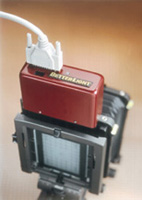
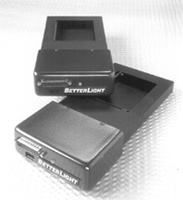
Better Light And Dicomed Better Light also added some thoughtful improvements to its software when it introduced ViewFinder 5.0, at the end of last year. "We went from a standard and somewhat limiting software to the best RGB capture software on the market," said Collette. "ViewFinder 5.0 offers a larger, more compact, and comprehensive preview area--with no more little windows all over the screen, and a much faster initial pre-scan." |
|||
The ISO is variable, within 1/10 f/stop, and 5.0 offers real-time updating of raw file information, including full dynamic range and raw bit depth. Color management takes place before digitization--and you can control the files to open in your application of choice. A new focusing tool allows you to optimize focusing, because the software allows you to focus individually on each color channel. On another note, Collette, who is also the original developer of the technology used in Dicomed scan backs, recently announced that Better Light will be providing ongoing support, repair service, and replacement parts for all digital scanning camera back models manufactured by Dicomed Inc. Dicomed began experiencing
financial difficulties in early 1999 that ultimately resulted in the closing
of most of the company's operations. Better Light will be offering the
new ViewFinder 5.0 interface to Dicomed owners, providing the equipment
had a factory-installed firmware upgrade. |
|||
Foveon Inc. Developed in conjunction with Swedish camera manufacturer Victor Hasselblad AB, the Foveon II uses the same prism-based capture system (capturing each color channel simultaneously on three chips) as its predecessor. The Foveon II uses a 2048x2048x3 sensor assembly (three CMOS sensors with a color separation prism for 12 million total pixel sensors), and stores a little over one byte per color measurement, for a 17MB raw file. The Foveon II also features a fast IEEE 1394 (FireWire) interface for delivering both live color video preview and high-resolution captured images to the user's Windows-based computer screen. The live video preview offers the photographer the opportunity to accurately frame and compose before the image is taken. Once capture is complete, images can be examined at 100 percent using Foveon's image review loupe to ensure that the image is in focus and no artifacts have occurred. Foveon's proprietary software, FoveonAuto automatically processes images to either TIFF or JPEG format while the photographer is still shooting. The software is also designed to make contrast, exposure, and color adjustments based on settings entered by the photographer. The MSRP is $23,900 with volume discounts available. Fuji Photo Film U.S.A. |
|||
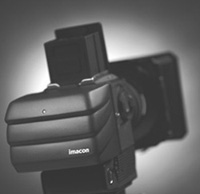
Imacon Inc. The MSRP for this camera is $19,995. |
|||
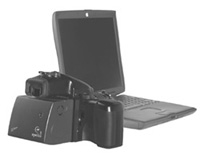
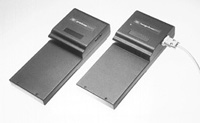
Jenoptik Laser, Optik Systeme In the eyelike MF's scan mode, the sensor captures 16 single exposures. This rather clever but difficult multi-shot approach puts the red and blue into each of 16 positions in the 4x4 block of half-pixel positions; the two greens in each block simply provide duplicated data, which can be averaged in for a better picture. It provides 25.1 megapixels in a 48-bit RGB, 142MB file--in about half a minute. Like several of its competitors, the eyelike MF is designed to work with most medium and large format camera systems. In fact, you can buy several adapters and use the MF with your choice of equipment for the given application. For mobility, the company also recently added a mobile kit (eyelike to go) to its line. The "eyelike to go" is a small box the size of a videotape that holds a rechargeable battery and combines the advantages of fiber-optic systems with FireWire technology. For location work, it's a matter of using the FireWire connection with a PowerMacintosh, Power-Book, or Cube--rather than the PCI board connected to the PowerMac in the studio. Eyelike's proprietary software features include full-frame, live image with zoom for use with one-shot mode, as well as scan. The system also offers color profiles designed for a variety of illumination situations, ICC profile embedding, and intelligent color management. |
|||
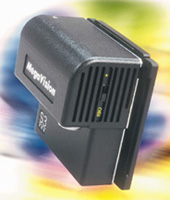
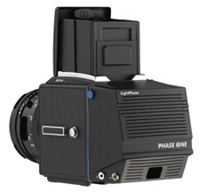
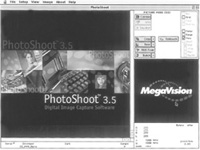
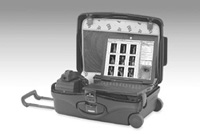
Jobo Fototechnic Inc. Jobo entered the digital arena just a little over a year ago, when they introduced two digital backs that made a splash in the imaging industry. Today Jobo has several models available with single, multi, and scanning capabilities. For capturing moving or still photography, the proFile 4000 functions as both a single or multi-shot 4 megapixel back; the proFile 6000s is a single-shot 6 megapixel back; and the proFile 6000 offers both single or multi-shot 6 megapixel capture. Both the 4000 and the 6000s can be upgraded to the proFile 6000. Via an adapter, proFile backs are available for several popular medium format cameras, including the Fuji GX680, Mamiya 645 PRO and RZ67 PRO II, and Hasselblad 553ELX and 503CW. Prices for the proFile digital backs range from $4,199.95 to $27,990 with adapters priced at $995. Jobo also offers two digital scanning backs for large format (4x5) cameras. With possibly the highest resolution on the market, the proScan 10500 generates 394MB (24-bit RGB) 13,100x10,500 files for $24,990. Its slightly smaller sibling, the imageScan 8000 offers 10,500x8000 pixel resolution and generates 240MB (24-bit RGB files). Suggested list price for the 8000 is $19,995. Kodak Professional The back operates in untethered environments and is compatible with the Hasselblad 555ELD and the Mamiya RZ film cameras, although according to Kodak, "it will eventually have interfaces for a wide range of medium and large format camera systems." The back is targeted at commercial location, tabletop, and high-end portraiture applications and comes bundled with Kodak Professional DCS Capture Studio Software Version 1.5 for capturing and editing the digital images. The back also sports an LCD screen with full 90 movement for one-handed waist-level operation. The DCS Pro Back can also perform 1:1 zoom and pan functions with video review capability for high angle or other difficult camera placements. The DCS Pro Back offers an ISO equivalent of 100, and can capture an image every 2 sec, and store up to eight images prior to writing to either internal PC cards or a host computer via a FireWire connection. Cost of the Kodak Pro Back is $19,995. Leaf America The new Leaf Cantare XY offers multi-shot and single-shot capabilities with its color 3072x2048 pixel CCD array. While the Leaf Volare captures complete color information via its three shots (one for each RGB channel), and captures 18 million pixels without any interpolation, the Leaf Cantare captures all three colors in a single exposure and the six million original pixels are interpolated into an 18 million pixel HDR file. The new Leaf Cantare XY employs their three-color mosaic CCD technology with the Leaf XY Weave technology, providing a choice of one, two, and three shot modes. While the use of one-shot mode (for movement), and multi (three and four) shots to provide additional color information for still photography makes sense, adding a two-shot feature seemed confusing. While the (patent pending) two-shot mode is designed to double the resolution of the image, why not triple it, using the three-shot mode, especially since the added exposure already makes it impossible to capture moving images. Also new, the Leaf C-Most digital back, sports a 6.6 megapixel CMOS sensor. According to Leaf, the back is designed for optimum user friendliness for photographers making the move to digital, with an 11 f/stop dynamic range and 14 bits of color for each color channel. The back shoots at a fast 3 fps and provides 10 fps video frame rate with its built-in electronic shutter. The back works as a stand-alone, or with Sinar View Cameras; Hasselblad EL Series, 503CW, 205FCC; Mamiya RB67, RZ67, 645Pro; Fuji GX 680II, III; Contax 645 AF; and Bronica ETRS. The C-Most should be available by mid-summer. MegaVision Inc. System software includes Mega-Vision's new PhotoShoot Lite image capture and processing software for Windows 2000, as well as ColorVision monitor/ printer calibration hardware and software as the workstation's ICC-compliant color management component. PhotoShoot Lite allows the photographer to shoot directly to disk, or rapid capture to buffer, with or without a saved back-up. The software also offers batch processing, automatic cropping, tone curve control, 8 to 16-bit CMYK export, and includes Mega-Vision's unique Color Coded Light Metering feature. Previously introduced by MegaVision is the S3 Pro digital--one of the first professional digital cameras to offers a flexible ISO setting range with 100, 200, and 400 selections. The S3 is based on the Philips 3072x2048 chip, which offers a low SNR, high dynamic range, and hardware blooming control designed to work well in available light situations. Because the S3 was specifically designed for the portrait, wedding, and fashion markets, where portability is the name of the game, MegaVision also offers the BatPac. This portable storage device offers a CD-ROM operating system, rather than a spinning disk, which allows startup in as little as 2 sec. MegaVision also recently released a new multi-shot back, the T32. This new back offers 3072x2048 pixels in 18-32MB (8-16 bits per color) file sizes. All large format cameras, including Cambo, Sinar, and Toyo support the back. Suggested retail price for the back is $22,900. Phase One The new software Version 2 for Macintosh, Windows 98 and 2000 offers enhancements to increase productivity such as a fast full resolution preview/focus tool, an instant preview of the built-in unsharp function, and extended file format supporting free naming of capture files. With the extended file format, the file will also contain the exposure time, ISO setting, and curves recorded during the original image capture. The new software also shortens review and capture times. For added flexibility, selectable ISO values and curves, as well as an adjustable gray balance has been integrated. The company's two flagship products are the PowerPhase FX Scanning back and the PowerPhase Light Phase. The former, designed for flat art can capture up to a 1GB (64-bit CMYK) file, as well as 380MB (8-bit RGB) and 760MB (48-bit RGB) files. The FX boasts the largest capture area of any digital camera at 8.4x10cm (3.3x4"). The reason the capture area is so large is because it is based on moving the whole chip, in effect tiling a capture within the image circle of a lens and taking multiple shots. The ISO is as high as 1600 and the backs 200-foot long IEEE1394 cable allows for scan times up to 240MB per minute. It is designed for use with most 4x5 view cameras. The LightPhase is a one-shot camera back designed for use with most professional medium format cameras. The LightPhase offers 3000x2000 pixel resolution (6MB uninterpolated) and is capable of generating RGB file sizes of 18MB in 8 bits per color and 36MB in 16 bits. The camera offers a 48-bit internal data path with 14-bit analog to digital converter for optimum shadow and highlight details. The company purports that this provides a better contrast range than is possible with film. Light sensitivity is an ISO equivalent of 50 with exposure time possible up to 2 sec. The camera back also provides an 11 f/stop range. Capture speeds are available up to 1.5 sec--limited only by the user's computer hardware. For shooting flexibility the LightPhase can be controlled by either the camera or the computer. The back comes with a 33-foot flexible IEEE 1394 cable for studio operation and an optional portable battery pack with storage data available for on location work (without direct computer access). The Light Phase retails for $22,900. Phase One plans to join the ultra-high resolution digital camera club by adding a 16-megapixel back to its line this summer. The new LightPhase H20 will employ Eastman Kodak's 4020x4020 pixel CCD imaging sensor and be capable of outputting a 48MB, 24-bit RGB file in 48-bit format. Sinar Bron Imaging The Sinarback is a digital studio back that features both one-shot and four-shot capabilities in a single back. For anyone looking to start small and upgrade later, Sinar offers the Sinarback Light, a one-shot camera back upgradeable to four-shot capability. Both backs are available with either the Philips 2048x2048 or 3072x2048 pixel CCD. The back delivers 14-bit capture with a 12 stop dynamic range. Sinar also offers photographers the option of adding a Macroscan adapter to the Sinarback (22+ and 23) for increased file size and an effective CCD imaging area of more than 18 million pixels. Because the Macroscan is not a line scanner, it is functional with any kind of lighting (flash, tungsten, HMI, or continuous). I'd like to thank Richard Chang of MegaVision, Claude Jodoin of i2i Studio, Glenn Martin of Digital Outback, Michael Colette of Better Light Inc., Richard Lyon of Foveon, and Gary McGinnis of REALity Bytes for contributing to this article. Manufacturers/Distributors |
| ||
|
||






















 FEATURED VIDEO


Get the Latest Photo Tips, News & Reviews from Shutterbug!







| Camera Reviews Other Reviews | |
Mobile Reviews Photography Reviews Columns | |
News | |
Features | |
How-To | |
Resources |
 © 2025 Shutterbug
AVTech Media Americas Inc., USA
All rights reserved