


- REVIEWS
Camera Reviews 
More Reviews Mobile Reviews Photography Reviews - GALLERIES
- VIDEOS
- BUYER'S GUIDES
Nikon’s D200; A 10.2-Megapixel Digital SLR Built For Comfort, And Speed
The latest Nikon entry in the digital SLR market is the D200, a 10.2-megapixel digital SLR that combines a strong, pro-caliber build with 5 fps speed, all for a competitive $1699 list price (body only). The Nikon DX format CCD retains the 1.5x magnification factor of previous Nikon sensors, plus borrows many of the metering and some of the image-processing capabilities of the pro D2X. Similar to the D2 line is the 11-area AF and 3D Color Matrix Metering II as well. Indeed, perhaps reading more into the naming than Nikon may have intended, the D200 is a D2-type pro camera aimed, and priced, at the higher end of the avid amateur market. Being between the amateur and pro offerings, the D200 shares many features and functions with its pro siblings, including image quality that's hard to beat.
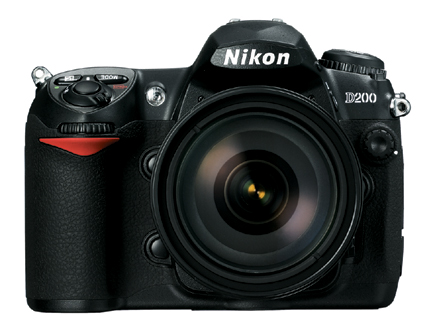 |
The camera is not lightweight, and rightfully avoids the "plasticky"
feel of more amateur-oriented models. The large (2.5") LCD makes selecting
the many options easy, although those used most often in the field are evoked
by buttons on the camera body, including ISO, white balance, quality settings,
and various AF and AE options. The D200 accepts CompactFlash and Microdrive
cards only, and allows you to shoot in various JPEG modes, in NEF (Nikon's
raw file format) or with NEF+JPEG in three levels. Unlike some rivals it does
not have a dual card slot.
Increasingly, digital SLRs should be judged by what's under the hood,
as many of the body dynamics are becoming fairly standardized, at least in specific
camera classes. And what's inside should drive image quality, shooting
speed, and responsiveness, and of course should also open the door to greater
creative potential. Many digital SLRs are now featuring more and more image
enhancement options, of interest mostly to those who shoot JPEGs. But setting
those enhancement features (or Optimization, as Nikon calls them) also assigns
the attributes to the raw file, although the raw version can be swapped out
for other attributes easily enough later.
High NR Filter |
|
 |
|
|
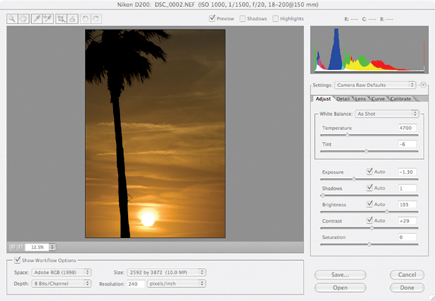
It should be noted that Nikon continues to charge extra for their Capture (now Version 4.4, $99) software, which gets the most out of their NEF files. Their included PictureProject software allows for conversion of NEFs to JPEGs or TIFFs, but does not offer advanced raw processing. The Adobe Raw 3.3 upgrade that handles these D200 NEFs hit the Adobe website right as this camera came to market, which speaks to perhaps increased cooperation between the two companies. I found that either route to process raw worked fine, although Capture does afford more camera/software interoperability.
NR vs No NR |
|
 NR OFF |
|
 |
|
NR ON |
|
|
Start Up And Shooting Response
The issue of time lag on start up and shutter release is moot for many digital
SLRs, and the D200 is no exception. It is virtually imperceptible. What has
improved is what is called "blackout time," the time that the viewfinder
scene blanks out between exposures. This can be seen when shooting at the highest
framing rate, which for the D200 is 5 fps. While the framing rate is more than
most will need, what is more impressive is the "burst" rate, the
number of frames you can shoot consecutively without pausing for the image processor
to take over. Given that you use a high-speed card, such as the Lexar Professional
Write Accelerated (WA) card we used for testing, that burst rate can be as high
as 37 JPEG or 22 NEF images in one shutter release in Continuous shooting mode.
Part of that responsiveness is due to the camera's new 11-area AF system,
which can be converted to a seven-wide AF system. Both setups are based on their
Multi-CAM 1000 AF Sensor Module. The setup is quite flexible, allowing for Nikon's
Dynamic AF, Closest Subject Priority Dynamic AF (our choice), and Group Dynamic
AF. Dynamic AF is where you select an AF target within the finder; if the subject
moves the focus follows. Closest Subject Priority is where the AF system automatically
selects the subject closest to the camera. As with all Nikon AF setups, especially
with the Nikkor 18-200mm VR DX lens we used for this test, autofocus reacts
swiftly and silently to every subject, even in low light. Note that the Nikon
pro models sport a Multi-CAM 2000 Module and have Focus Tracking with Lock On.
Bracketing In Continuous |
||
 |
 |
|
 |
||
|
||
Body Build And Functionality
The D200 body has a magnesium-alloy chassis and body cover with a claimed enhanced
sealing system, which helps keep out dust and moisture. The double-bladed shutter
is said to be tested to over 100,000 cycles, plus the shutter unit has a refined
mirror balance mechanism, said to virtually eliminate any mirror bounce. The
decidedly right-handed body contour has rubberized grip and coating, giving
one a firm feeling in hand. While it is fairly lightweight, it certainly has
more heft than the amateur models, which is to be expected.
First-time Nikon digital SLR users will be presented with a cacophony of buttons,
toggles, and dials, but their functions, and functionality, is learned quickly
enough. We applaud digital SLRs that put most of the important operating functions
on the body, rather than having to plow through menus and menu options, and
the D200 shines in this regard. Every important and even minor change you might
want to make in the field is easily at hand, including focusing modes and options,
metering patterns, ISO settings, white balance, file format and size, drive
speeds, AE and AF locks, etc. are handy and well marked. You delve into the
menu for Image Optimization (changing image attributes), Noise Reduction (NR),
and the clever Nikon multi-exposure and image overlay functions.
Raw Conversion |
|
 |
|
 |
|
|
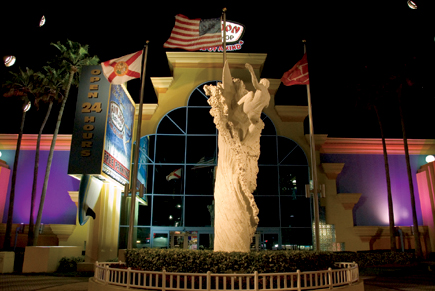
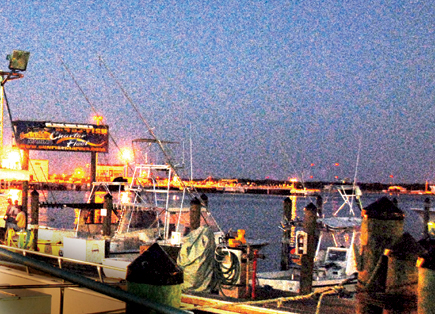
I used the internal menu often when shooting in low light at a high ISO, such
as 1600; that's where the two-level NR filter resides. Tests show that
NR works very well and encouraged me to shoot a lot at higher speeds, more than
usual just to see how NR would work. And happily the filtration did not take
an inordinate amount of time and never got in the way of the next shot, even
when recording in NEF+JPEG file format mode.
| |||||||||
|

| ||||||||


 FEATURED VIDEO


Get the Latest Photo Tips, News & Reviews from Shutterbug!







| Camera Reviews Other Reviews | |
Mobile Reviews Photography Reviews Columns | |
News | |
Features | |
How-To | |
Resources |
 © 2026 Shutterbug
AVTech Media Americas Inc., USA
All rights reserved