


- REVIEWS
Camera Reviews 
More Reviews Mobile Reviews Photography Reviews - GALLERIES
- VIDEOS
- BUYER'S GUIDES

Shutterbug’s Exclusive photokina Coverage; Medium Format: High-Res Backs Raise The Ante
As ever, medium format—hereafter MF—ranged from the sublime to the ridiculous. For sublime, it’s hard to beat the new 50-megapixel Hasselblad or the 37.5-megapixel Leica S2, or possibly the Rollei/Sinar/Leaf Hy6, built by Franke & Heidecke (with their new option of a 6x6cm rollfilm back). As for ridiculous, well, I know I’ll get hate mail from Holga owners, but multicolored and stereo Holgas are pretty silly, even if they are fun. In between, there was quite a lot from Mamiya as well as the new
dual-format (6x6/6x7cm) rollfilm folder from Voigtländer/Fuji, and a red Luxus-style Seagull Twin-Lens Reflex (TLR).
 |
|
|
Actually, the Hasselblad H3DII-50 itself is quite quickly discussed. As the man on the stand said, it’s pretty much the same camera as before, with a new 50-megapixel sensor (48x36mm) and “50” written on the side. This wonderfully casual analysis ignores the fact that it’s the most sophisticated, integrated, and powerful cube-style SLR on the market. It also ignores Hasselblad’s price reductions: now that they have the 50-megapixel flagship, they have reduced the price of the base 31-megapixel model so that it starts to look halfway affordable, though you’re still looking at the price of a new small car.
 |
|
|
Hasselblad also introduced an aspherical zoom lens optimized for the M3D series, 35-90mm f/4-5.6, and an ingenious 1.5x tele-converter-cum-tilt/shift adapter, the HTS 1.5. The image circle is magnified along with the image, allowing for the tilt and shift, and with a digital back the aberrations introduced (or at least, magnified) by the HTS 1.5 can to a large extent be “faked out” in software. It lists at $5395 and should be available by the time you read this.
Of course, to a professional, spending several tens of thousands of dollars on a camera system can make a lot more sense than it does to an amateur. When I think back to when I started in advertising in the 1970s, and of what we used to spend on Polaroids, film, processing, and couriers to and from the lab, I can see how even a $50,000 outfit can pay for itself surprisingly quick.
 |
|
|
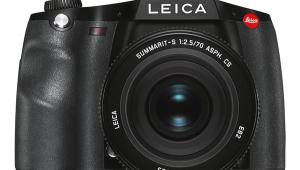
Hasselblad’s “cube style” is in antithesis to the “big 35mm style” adopted by Leica for their S2, a veritable thunderbolt of an unexpected camera. The S2 looks like a chubby 35mm SLR or D-SLR but is built around a 45x30mm Kodak-made 37.5-megapixel CCD sensor with a 6 micron pixel size. As everyone knows nowadays, pixel quality and size is at least as important as pixel count, and quality depends partly on pixel size (the bigger the size, the less you have to amplify the signal) and partly on software: Leica’s “Maestro” software for the S2 was specially written in conjunction with Fujitsu
Weather-sealed and with a whole new line of autofocus lenses, the S2 qualifies as “medium format digital” on sensor and pixel size as well as on megapixel count, but it’s going to be very interesting to see who buys it. There’s no doubt that it’s a very different-handling camera to the (equally brilliant) Hasselblad, and I have to say that the control layout on the S2 seems a lot more intuitive to me. If I were shooting only in the studio, or with a bevy of assistants, I think I’d go for the Hasselblad; on location, or on my own, it would have to be the S2. I can see the S2 becoming the digital camera of choice for those who want the best possible quality outside the studio, for example among National Geographic photographers (though this is pure speculation on my part) and it should attract well-to-do amateurs as well. When I tried a prototype, I was extremely impressed by the ease of switching between autofocus and manual, the almost (for me) instinctive control layout, and the brightness of the screen. The last is of course aided by the relatively fast (for MF) f/2.5 lenses.
I was much happier using the camera without the “booster” (base battery pack), simply because I like smaller, lighter cameras and will put up with reduced battery life in return. I was slightly puzzled by the provision of two different media slots (SD and CF) in the same body, but the more I think about it, the more sense it makes—not least if you run out of one type of card!
Of course the camera and lenses were only prototypes—the camera is unlikely to go on sale before spring or even summer 2009—but I am really, really looking forward to reviewing them when they do become available. An especially interesting feature is dual shuttering, both leaf (in lens) and focal plane, to allow flash synchronization at all speeds.
 |
|
|
The Franke & Heidecke (F&H) Hy6 cube-style camera—variously customized and labeled as Rollei (originally an F&H trademark), Sinar, and Leaf—was seen in prototype form at photokina 2006. It hardly qualifies as new, therefore, but all three versions are now in production and for film diehards the long-awaited 6x6cm film back is now available as well as the switchable (landscape and portrait) 645.
F&H also introduced an updated 120mm f/4 six-glass Makro-Apogon focusing to 0.8m (reproduction ration 1:4.5) and an AF non-macro version of the same lens focusing to 1.15m. Other accessories for the system include an eye-level, high-eyepoint finder that automatically switches the viewfinder displays to unreversed viewing and an electrical remote release. All these are compatible with all versions of the camera.
 |
|
|
 |
|
|
Finally, to celebrate the 80th anniversary of the Rollei TLR, 1929-2009, F&H introduced gold versions of all three TLRs—standard, wide, and tele. These are not cheap in normal form and you’ll need deep pockets indeed to buy one of the 80 sets they produced of all three in a walnut chest, with accessories.
 |
|
|
In another realm entirely, Seitz (Roundshot) revised both their rotating panoramic cameras and their ultra-fast scanning-back non-rotating camera and there is now a Chinese digital panoramic camera from e-filming, but as with so many Chinese companies at photokina it was next to impossible to extract any useful information from them unless you spoke Cantonese, which I don’t.
| |||||||||
|

| ||||||||





 FEATURED VIDEO


Get the Latest Photo Tips, News & Reviews from Shutterbug!







| Camera Reviews Other Reviews | |
Mobile Reviews Photography Reviews Columns | |
News | |
Features | |
How-To | |
Resources |
 © 2026 Shutterbug
AVTech Media Americas Inc., USA
All rights reserved