


- REVIEWS
Camera Reviews 
More Reviews Mobile Reviews Photography Reviews - GALLERIES
- VIDEOS
- BUYER'S GUIDES

photokina Special Coverage; Medium Format: “The Reports Of Its Death...”
 Despite innumerable premature reports of its death, medium format refuses to lie down. Instead, it polarizes increasingly into large-sensor digital (up to about 2x the size of full-frame 35mm) and highly specialized roll film--though the two biggest announcements of the show were actually traditional dual-platform (film/digital) SLRs.
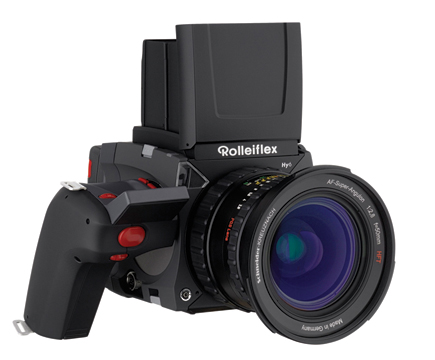
Rollei deserves first mention for the film-plus-digital Hy6 SLR. This was described by a Rollei spokesman as "the most important camera for the company in the last 20 years." Handle it, and you have to agree. It replaces the 6000 series, with which it shares a lens mount, and despite being even more packed with high technology it is smaller, lighter, handier, and a good deal more intuitive in use with a brilliant "switch/menu" system where the most common options (such as autoexposure, shutter-priority, aperture-priority, and manual) are set on a rotary switch with an additional "red dot" position. Set the red dot and it calls up a whole menu of other options--which you need never see unless you want them, and which you can't accidentally get into by pressing the wrong buttons, only to find you can't get out again.
 |
|
|
The list of technical features is overwhelming, including a counterbalanced linear motor for the mirror lift and such exotic options as continuous shooting with pre-lift on mirror. The ergonomics are brilliant, too, with a variable-angle handgrip to suit different shooting positions, and recessed controls so that the camera can be put down "naturally" on its side, handle uppermost, without risk of accidentally changing any settings or of course damaging the switchgear. It is the first Rollei SLR since the long-gone SL66 which inspired in me the once-familiar "love at first sight" that always used to accompany the introduction of new Rollei products.
Although it is a full 6x6cm SLR, the only backs initially available are digital and 645 film with a reversible insert for "landscape" and "portrait"; the 6x6 back will appear later in 2007. Backs are not compatible with the 6000 series, but are (once again) smaller, lighter, and handier. We have been promised one of the first production models in early 2007; the camera should be shipping in the first quarter. No price had been set at the show.
Slightly confusing, I first saw it on the Sinar stand, where I was assured it would not appear as a Rollei; but then, even the Rollei says on the side, "Powered by Sinar, built by Franke & Heidecke." Allegedly, a Leaf version is also planned.
All this is a consequence of the enormously confusing network of inter-ownership of the different companies. In 2004, Rollei split into Rollei GmbH (essentially trademark owners) and Rollei Production which actually made high-end equipment. In September 2005, Rollei Production became Franke & Heidecke, but a great deal of the same finance seems to be behind Franke & Heidecke, Jenoptik, Sinar, and Leica: Jenoptik used to own 51 percent of Sinar, but sold this to Leica. One is reminded of the old limerick which ends, "They argued all night/As to who had the right/To do what, and with which, and to whom."
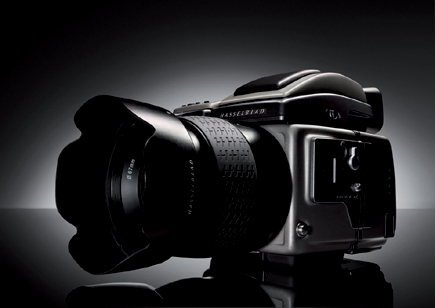
Although the Rollei is conceived as a film-plus-digital camera with "open architecture" for a variety of backs, Hasselblad's H3D is effectively pure digital. It accepts film backs, but is really designed only for use with its own 22- and 39-megapixel 36x48mm sensors.
The latter redefines "medium format" as applied to digital cameras. The great advantage of a bigger physical size for a sensor is a much "cleaner" image: sharper and (above all) less noisy. It also makes it easier to use selective focus, which requires very large apertures indeed with the smaller sensors in 35mm-style cameras.
 |
|
|
In a sense, the H3D is only an upgrade of the H2D, and indeed, an H2D can be factory-converted to an H3D, giving numerous advantages such as a bigger, brighter viewfinder and the option of using the new Apochromatic 28mm lens, the widest rectilinear-drawing lens available on a big sensor. But the hardware, as well as the software, must be upgraded.
The new 28mm is very interesting in that it is sold only for use with the H3D, and comes with software to improve the image quality. This combination of optical correction and software correction is increasingly common and is one of the reasons for the 6-bit coding on new Leica M-series lenses, as reported elsewhere in our photokina coverage.
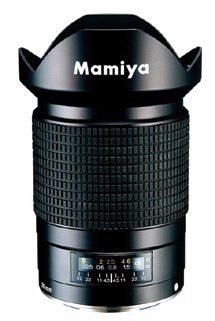
Actually, this wasn't the only medium format 28mm: Mamiya also introduced an AF 28mm f/4.5 alongside an AF 75-150mm f/4.5, both suitable for film as well as digital, so those who feared that the new Mamiya Digital Imaging Co. Ltd. was just a shell, or maybe digital-only, are happily proved wrong. Mamiya's long-awaited medium format SLR was also finally shipping, though there still seems to be no date for the release of the ZD back.
 |
|
|
This raises the question of the medium format pixel race. It is widely agreed that 35mm equates to something between 10 megapixels (fast film, handheld, undemanding subject) and 30 megapixels or even more (slow, sharp film, camera on tripod, lots of very fine subject detail), with a broad consensus that 18-20 megapixels is probably about right. (Editor's Note: We came to the same conclusion in 1987, believe it or not, when the first digital cameras were previewed and comparisons were made with 35mm film. At that point, however, 18 megapixels seemed very much a pipe dream.)
Thus, although 22 megapixels is a comparatively modest advantage over the best that 35mm can do, it delivers the quality more easily and more reliably, while 39 megapixels is around twice as good as the best 35mm and rather better than the best 645 and 6x6cm can do; it probably breaks even at 6x7cm. The whole thing is rather like the old arguments between 35mm and medium format film users. Yes, with super fine-grained films, a tripod, and the best lenses, 35mm can produce results that are hard to tell from roll film; but bigger film sizes and bigger sensors give better quality quicker and with less effort, often with better tonality into the bargain.
The net result, according to a Hasselblad representative, is that "we have to resell the idea of medium format." He meant, of course, the advantages of bigger sensors vs. cramming more megapixels onto small sensors.
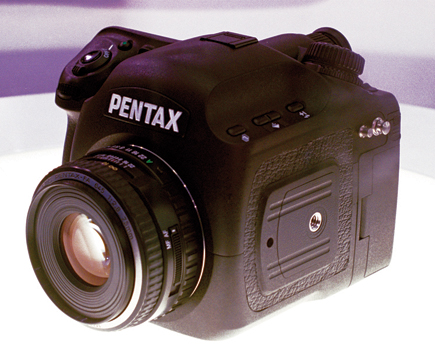
The medium format megapixel race also explains why Pentax's "concept" version of the 645 looked rather lonely as it sat in its sealed transparent case, waiting for the 30-megapixel sensor that will make it a serious contender in digital "medium format." As it stood, reputedly in 18-megapixel prototype form, it just didn't have enough megapixels. I'd be surprised to see a digital Pentax 645 shipping before mid-2007, and it might well take longer.
 |
|
|
Moving on to specialized film cameras, the new Tele-Rollei should be shipping by the time you read this, while ALPA's extremely beautiful TC (Travel Camera) is a smaller, lighter version of their classic 12 series. It is designed for travel, usually with film, but finds increasing popularity with digital users who put it on a tripod like a large format camera. We have been promised both a Tele-Rollei and a TC for test.
| |||||||||
|

| ||||||||





 FEATURED VIDEO


Get the Latest Photo Tips, News & Reviews from Shutterbug!







| Camera Reviews Other Reviews | |
Mobile Reviews Photography Reviews Columns | |
News | |
Features | |
How-To | |
Resources |
 © 2026 Shutterbug
AVTech Media Americas Inc., USA
All rights reserved