


- REVIEWS
Camera Reviews 
More Reviews Mobile Reviews Photography Reviews - GALLERIES
- VIDEOS
- BUYER'S GUIDES

Great Buys In Medium Format Cameras; In The Wake Of The Digital Revolution, You Can Snag Your Dream 2 1/4 Film Camera At A Fantastic Price
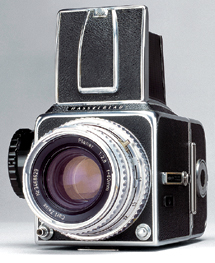 Just the other day a buddy of mine bought the Hasselblad he'd always wanted but couldn't afford at the unheard price of $475. It was a 20-year-old Hasselblad 500C/M, the functional equivalent of the current 500C/W. He purchased it from a private seller for $475 in near-mint condition, complete with 12-exposure back, waist-level finder, and 80mm f/2.8 Carl Zeiss Planar lens. A quick check on eBay revealed that this price was better than average, but not exceptional. Indeed, for an additional $200 or so my friend could have bought a similar outfit complete with a one-year warranty from one of many dealers. Instead he bought it with a return privilege, examined the camera carefully, and was prepared to take his chances.
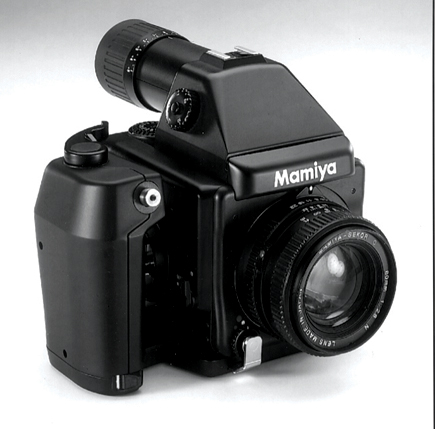
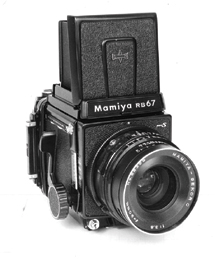
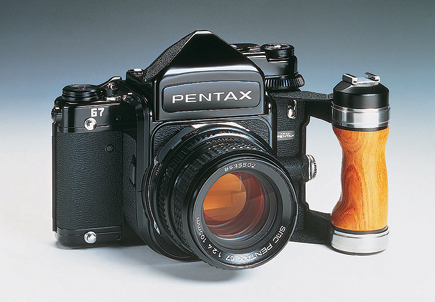
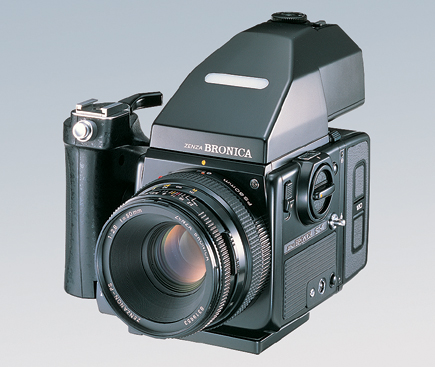
Now if you can get that kind of a deal on a Hasselblad, which many regard as the ultimate in professional medium format SLRs, just imagine what a pro-caliber Mamiya RZ67 or M645 Pro might run you these days. Or how about a Pentax 6x7 or 645? And with Bronica now out of the 21/4 SLR business entirely, you can literally nab one of these babies for a pittance. Stepping back a bit, what happened to cause all this? Did the bottom simply drop out of the medium format film camera market? And if so, will prices continue to drop? We will answer these and other fascinating questions in due course, but first some demographics.
 |
|
|
The basic cause of the precipitous drop in used medium format camera prices, and the less dramatic erosion in the prices of many new medium format cameras is demographic in nature. Most 21/4 cameras, especially SLRs, are used by professional wedding and portrait photographers, and as these businesses have shifted toward digital capture and workflow, many switched to high-end, 35mm-system-based digital SLRs, mainly Nikons and Canons, rather than taking the more expensive route of adding digital backs to their existing medium format systems. The end result of this trend is classic supply and demand--the prices of used medium format cameras have dropped as the supply has dramatically increased and the demand has slackened off.
This is definitely good news for serious amateur photographers who want to take a crack at medium format at affordable prices and reap its operational and psychological advantages. These plusses include superb image quality, large viewfinders, interchangeable film backs, and that indescribable feeling you get when "making images for the ages" with a real pro camera. In my opinion, it's unlikely that the prices of fine-quality medium format cameras will sink much lower than they are now, and it's quite possible that they'll rise somewhat and then level off. There's even an outside chance that the prices of medium format cameras will rebound if some electronics genius comes up with, say, a high-resolution digital back for under $3000.
 |
|
|
However, before you gleefully jump into the current buyer's market for used medium format gear there are a number of crucial caveats to consider. The first and most important one is whether you want to play the medium format film game at all. Without doubt, you can produce images of exquisite quality with a 6x4.5cm, 6x6cm (21/4" square), or 6x7cm camera, and that may be reason enough to acquire one. However, you'll have to purchase 120 or 220 roll film at a photo specialty store, and you probably won't be able to get it processed or printed at your local minilab. Custom labs catering to pros will process black and white, color negative, and transparency film in rollfilm sizes, and also make contact sheets and custom enlargements. However, these services are typically much more expensive than getting machine prints from 35mm print film.
To sidestep these added costs many medium format shooters scan their negatives and transparencies with a high-end film scanner such as those from Microtek, Minolta, or Epson, which start at about $400. A good high-res scan of a 21/4 film image will let you preserve the medium format image-quality advantage all right, but the resulting image files are huge, and may not be convenient to work with, or even necessary unless you're making prints larger than 11x14. Ultimately, the charm of medium format lies in taking the time to produce something of lasting quality, and it's hard to justify the additional effort simply on the basis of cost and convenience.
 |
|
|
If you remain undeterred and are staunchly determined to take advantage of the genuinely great buys out there, here are some additional caveats to consider before plunking down your hard-earned cash on a medium format camera:
1. Condition is everything. While some medium format cameras have led easy lives as the seldom used prized possessions of aficionados, many have seen hard use in the not-so-gentle hands of working pros. The best ways to avoid getting stuck with a worn-out hulk are to buy a new, new old stock, or salesman's demonstrator camera, or to opt for one in mint or near-mint condition. With a pro camera, you can usually tell a book by its cover--well-worn cameras usually have obvious dings, dents, and scratches. Yes, medium format cameras in pristine condition cost more than those in average shape, but as a rule this breed is very costly to repair, and it's far better to pay a little extra up front in order to eliminate problems later on.
 |
|
|
2. Stick to the basics. If you peruse the medium format selling prices on eBay, online, and in magazine ads, you'll notice that lensless camera bodies with or without finders and film backs are offered at the lowest prices, and that the next cheapest category is complete cameras with normal lenses and plain (meterless or waist-level) finders. If you are already into the Hasselblad system, for example, you can snag a clean extra 500C/M, body only, for a measly $300, and probably get one with standard waist-level finder and 12-exposure back for $100 or so more than that. However, if you're a medium format newbie, the most economical alternative is to get a basic shooting outfit--body, film back, waist-level or prism finder, and normal lens.
3. Extra lenses are expensive! As a rule, prices for wide angle, telephoto, macro, and other lenses for medium format cameras have gone down far less (if at all) than the cost of basic shooting outfits. You can get some good deals, especially if you buy extra lenses as part of a "system outfit," but don't expect to acquire lenses individually at bargain basement prices. In general, prices for used "bread and butter" wide angles and telephotos such as 50mm, 100mm, and 150mm lenses have decreased somewhat, but not the prices of more exotic optics like ultra-wide, super telephoto, and macro tele lenses.
 |
|
|
4. Take the system approach. The prices for used finders, film backs, and other medium format accessories in excellent condition have likewise held up better than cameras prices, so try to acquire these items as part of an outfit at the time of purchase.
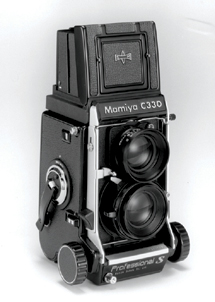
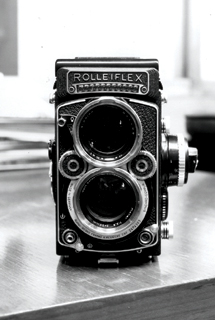
Which medium format camera is for you? To a greater extent than other camera types, medium format cameras have very distinctive personalities and handling characteristics, and that is why choosing one is a very personal decision. Among 21/4 SLRs, the 6x4.5cm models from Mamiya, Pentax, and Bronica (and the current Hasselblad H1) score on 35mm-like handling and the ability to shoot 30-32 exposures per roll on 220 film. Traditional 21/4 square (6x6cm) models from Hasselblad, Bronica, Rollei, and Kiev represent a good compromise for handheld and tripod-mounted studio use, work well with waist-level or eye-level finders, and the format can be conveniently cropped for vertical or horizontal prints.
 |
|
|
So-called ideal format 6x7cm SLRs are useable handheld, but really shine in the studio or atop a tripod. Offering the biggest finder image and the largest negative, they deliver extremely high image quality.
| |||||||||
|

| ||||||||





 FEATURED VIDEO


Get the Latest Photo Tips, News & Reviews from Shutterbug!







| Camera Reviews Other Reviews | |
Mobile Reviews Photography Reviews Columns | |
News | |
Features | |
How-To | |
Resources |
 © 2026 Shutterbug
AVTech Media Americas Inc., USA
All rights reserved