


- REVIEWS
Camera Reviews 
More Reviews Mobile Reviews Photography Reviews - GALLERIES
- VIDEOS
- BUYER'S GUIDES
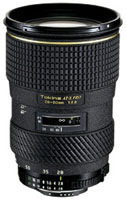
New Tokina AT-X 28-80mm f/2.8SD AF PRO
Dedicated to sophisticated design and engineering, Tokina makes lenses with an excellent reputation; the best of these bear the AT-X designation, denoting "Advanced Technology-Xtra." These models--bearing a gold stripe indicating premium grade optics--include the most advanced technology, superior mechanisms, and lens coatings. The newly redesigned AT-X 280AF PRO is a fine example. Retaining the best features of its 28-70mm f/2.6-2.8 predecessor, the 28-80mm f/2.8 model offers several added benefits: an extra 10mm, internal focusing, a constant maximum aperture, an upgraded optical formula, and a refined AF/MF switching mechanism. The previous 28-70mm model included an element of low dispersion glass, but the addition of two aspherical elements helps assure even better image quality at the short focal lengths of the new model. Such elements--with a non-spherical surface--cause all light rays to converge at a common point. This design feature offers several benefits: correcting linear distortion and spherical aberration (curvature of field) for more consistent edge to edge sharpness even at wide apertures, reducing halo and comatic flare, and minimizing size/weight as fewer elements are required to achieve high optical quality. Several mechanical features have also been improved. The "focus clutch" mechanism--used to shift between manual and autofocus--now operates at any focused distance, so the shift can be made instantly. A new distance scale under glass allows the photographer to determine focused distance not only in manual focus, but also in autofocus operation. Finally, the "feel" of the manual focus ring has been improved, with greater friction to satisfy the most demanding traditionalist. |
|||
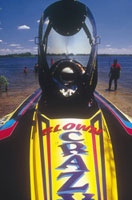
During the summer, I used this zoom lens often for a variety of subjects including the colorful craft at a drag boat race, pleasure boats and its occupants on a lake, architecture, portraits of people at several festivals, the action at a hot air balloon race, and flower gardens. In all cases, the lens performed in an exemplary manner as detailed in a later section. Design Characteristics. Even on first examination, this zoom certainly appears to be a professional tool. It's built of aluminum alloy instead of "space-age plastics" to withstand pro level abuse. This does increase weight but also increases the pride of ownership. The lens bayonets onto the body with an authoritative click, assuring a tight fit. As befits the PRO designation, long-term reliability seems probable. The external matte, crinkled finish is hardened Alumite for increased durability and a top quality appearance. Other features are worth noting as well: |
|||
|
|||
Autofocus Evaluation. The focus clutch mechanism is still rare on most lenses but its method of operation is worth noting. For autofocus (AF) push the focusing ring forward until it reaches the line marked "AF." On the older 28-70mm zoom, the focusing distance scale was covered by the ring, but this does not occur with the new lens. As with most recent AT-X lenses, the ring does not rotate during AF operation. Because there is less load on the focus motor, autofocus is smoother, faster, and quieter. Though not silent, operation is fairly quiet with a high-pitched sound. With this latest AT-X lens, there is no need to set the focus for infinity before shifting between manual and autofocus. For manual focus, pull the ring back (toward the camera) anytime, until it snaps into place at the line marked "MF." In the Nikon and Canon AF mount versions, the lens can be set for manual focusing without setting the AF/MF control on the camera body to MF, increasing overall speed of operation. (With Minolta and Pentax cameras, the AF/MF switch on the camera body must also be flipped to change focus mode.) Contrary to some comments on Internet photography web sites, focus cannot be touched up manually when the lens is set for AF. With an EOS-1N, autofocus response was extremely reliable with portrait and landscape subjects. Focus was instantly achieved on the desired area, such as a person's eyes. Even in low light around sunrise and sunset at the lake, reliable AF operation was maintained; this was understandable, as the wide maximum aperture of this PRO lens transmits plenty of light to the AF sensors. Continuous tracking focus performance with soldiers marching at a fast pace was highly acceptable, surprisingly good for a lens with a conventional autofocus motor. However this may be academic because a zoom of this focal length range is unlikely to be used for action photography such as motor racing or sports. Optical Evaluation. As expected with pro lenses, the Tokina AT-X 28-80mm f/2.8 AF PRO produced excellent image quality at all focal lengths, focused distances and apertures. The super-low dispersion element countered aberrations at the longer focal lengths, while the two aspherical elements assured superior image quality across the entire frame at shorter lengths. The AT-X 28-70mm f/2.6-2.8 AF PRO zoom received a five-star ("Super") rating from Germany's highly respected foto magazine and this AT-X 28-80mm f/2.8 AF PRO lens is a superior lens. Flare is very well controlled with internal measures. Clarity, resolution, sharpness, and definition of fine detail range from excellent to superlative. Under a 10x loupe, all of my slides are razor sharp. Even at the widest aperture, center sharpness is extremely high. By f/4 edge sharpness is excellent. From f/5.6 to f/11, edge sharpness matches central sharpness at all focal lengths, an impressive achievement. Even in extreme close focusing, resolution is very high. This wide to short tele-zoom is capable of producing image quality adequate for a fine 16x20 print, or a double-page spread in a magazine, at all but the widest aperture at all focal lengths. At f/2.8, you should still be pleased with 11x14 prints. Aside from sharpness, contrast is high, important especially in flat, cloudy-day lighting for snappy images. As with any zoom, the hood is least effective at longer focal lengths so change your shooting position slightly if flare is apparent on the viewing screen. For the absolute sharpest images at any focal length, stop down to f/11 and the results will satisfy even the most critical photo buyer. Conclusion. While the moderately priced Tokina lenses--like the AF 28-105mm f/3.5-4.5 zoom--tend to be the hot sellers in this brand, serious photo enthusiasts should definitely check out the professional caliber AT-X 28-80mm f/2.8 AF PRO. Its superb performance, rugged construction, and wide maximum aperture definitely warrant the extra cost for those who demand the finest quality and want a "fast" problem-solving lens as well. As the only 28-80mm f/2.8 AF zoom (at the time of this writing) it's more versatile than the 28-70mm models, with the extra 10mm making it useful as a portrait lens. In comparison to some of the camera makers' pro zooms, this AT-X PRO lens will seem surprisingly affordable. Can you still get a lens of rugged construction and fine imaging capabilities? I cannot vouch for every Tokina lens, but the answer is a definite "yes" for the AT-X 28-80mm f/2.8 AF PRO model. It merits a place in the "best value" category of lenses likely to satisfy the discriminating photo enthusiast and the working professional. If you're looking for a "fast" zoom for serious photography, this model is worthy of your consideration. For more information contact THK Photo Products, 2360 Mira Mar Ave., Long Beach, CA 90815; (562) 494-9575 fax: (562) 494-3375. www.thk.com. |
|||
Technical Specifications |



| ||
|
||


 FEATURED VIDEO


Get the Latest Photo Tips, News & Reviews from Shutterbug!







| Camera Reviews Other Reviews | |
Mobile Reviews Photography Reviews Columns | |
News | |
Features | |
How-To | |
Resources |
 © 2026 Shutterbug
AVTech Media Americas Inc., USA
All rights reserved