Site Links
|
 |
 |
 |
The Sigma 300 to 800mm f5.6 Zoom Winning The Hearts And Lens Mounts Of Dedicated Wildlife Photographers
By Stan Trzoniec October, 2003
| |
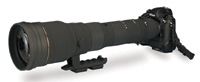
When
attached to a camera, the new
Sigma 300-800mm zoom is quite an
impressive piece of equipment. This lens now gives any
photographer the opportunity of using six different focal
lengths (and anything in between) in one finely engineered
lens.
|
|
As soon as I opened the box
I was in hyper-drive. There before me was one very impressive piece
of optical gear. Made by Sigma, this new telephoto lens includes useful
focal lengths from the ever-popular 300mm to a mind-boggling 800mm.
For photographers on the go this just could be the ultimate “one
lens” package especially with the new restrictions on both the
airlines and world travel today.
As an outdoor writer and photographer I put this lens to good use almost
immediately. It came just in time for a trip to Cape May, New Jersey,
for the annual birding festival and later for a travel piece on a town
in central Massachusetts. Sometimes you really can’t visualize
a lens like this but after a short time of putting it to the test I
found that I could actually see the various angles of view generated
by this optical product right there before my eyes. I’m a big
fan of fixed focal length lenses, so being able to vary the focal length
without changing is a blessing indeed.
|
| |
This
was the night of the eclipse but this is the best shot we
got before the clouds came in. With a Nikon D1X, a 1.4 extender,
and a heavy-duty Gitzo tripod, we are looking at 1680mm.
Wow!
Photos © 2003, Stan Trzoniec, All Rights Reserved
|
|
No Small Lens
Right off the bat I’m going to tell you this is a monster lens by
most standards so for the faint of heart a lens bearer might be in order
when trekking in new territory. For this I found it easy to place the
lens in its own supplied nylon case complete with camera, huff it on my
shoulder and carry the tripod in my hand. Once at my destination and placed
on my Gitzo #1548 all capped off with a Wimberley head, I found the Sigma
well balanced and was very agile in the way it swung on the mount and
followed everything I pointed at with its internal lens motor. This Sigma
checks in at almost 13 lbs and has an overall length (with the hood) of
25”.
Features For Photographers
Feature wise, this lens is loaded. It has all the bells and whistles modern
technology can supply, along with some very innovative additions that
make it a good choice for anyone looking to take the work out of constantly
moving the camera back and forth when faced with an interesting subject.
At 300mm the angle of view is 6.9Þ; at 800mm it’s an incredible
2.6Þ.
|
| |
This
is the start of a sequence that indicates the power and
sharpness of each millimeter. Digital camera magnifications
(usually around 1.5x) are shown in the parenthesis. This
beginning photo is 300mm (450mm).
|
|
But wait, it gets better. When
out in the field I took both my F5 and D1X cameras. On the F5, the 300-800mm
with the Sigma 1.4x extender is now a 420-1120mm f/8 lens. Factor in a
digital camera and you wind up with a stock 450-1200mm lens, with the
optional extender you now have a 630-1680mm lens.
Naturally you can also add the 2x extender for some really wild results
but the downside of all of this is that you are now dealing with an f/8
lens (with the 1.4x) and an f/11 lens with the 2x. Since the autofocus
will not work above f/5.6, manual focus is the order of the day here.
|
| |
At
500mm (750mm) we start to see the details of both the osprey
and its nest more clearly.
|
|
Lens Construction
Construction wise, the lens incorporates all of the features that fall
into the top of the line Sigma lens category. First off it’s an
“EX” lens which means that this Sigma is EX-finished denoting
a special exterior finish that is both very durable and handsome in appearance.
Without you, the reader, personally holding the lens, it almost feels
like a coating of velvet has been applied to all exterior surfaces of
the lens barrel and hood. Fit and finish was never under debate and both
the zoom and focus ring are coated with a ribbed, non slip rubber coating.
For accents, there is a gold ring about the front lens element and all
markings and numbers are large and enhanced with brilliant white filler.
The lens has 18 elements of glass arranged in 16 groups. For additional
correction of chromatic aberrations this is an APO lens. Sigma has included
two ELD (Extraordinary Low Dispersion) elements at the front part of the
lens group. Additionally this product is rated as an IF (Internal Focus)
so it does not change its length regardless of what focal length you are
at. Along with a constant aperture of f/5.6, Sigma has also incorporated
its version of a Hyper-Sonic Motor (HSM) for instant follow focus on moving
subjects.
|
| |
Finally
at 800mm (1200mm) this Sigma 300-800mm lens holds the detail
for a frame-filling photograph. Under all conditions and
subjects the author found this lens easy and fun to work
with.
|
|
Quick Response
In Cape May in particular I found this lens combination to be fast, quiet,
and very positive on the uptake, locking in on its intended subject without
any hesitation. On another day with the wind blowing I had no trouble
keeping pace with some egrets at a rookery in Avalon, New Jersey, as they
swayed back and forth in the trees as a front rolled by. And if by chance
I used the wrong sensor on the camera or I overshot the subject I could
touchup the sharpness by simply turning the focus ring up front.
I found two design features on this lens that other manufactures might
want to emulate. One is that this lens has a rotating filter draw at the
rear of the body so you can actually turn a polarizer (one is supplied
with the lens) within its mount without taking it out and trying to figure
out the best angle as you replace it. Simply install your filter into
the mount—keeping in mind that it can’t be more than 5mm thick
or it will impede the operation of this internal holder—place it
back into the lens and, taking note of the rotating ring just in front
of the filter slot, just turn it until you get the desired effect.
|
| |
Backlighting
is always a good choice on bright, translucent objects and
the afternoon sun along with the Sigma lens played a big
part in this photograph of a common spring weed during the
first weeks of spring.
|
|
The other neat thing is the
way the Sigma lens hood was designed. On all of my other super telephotos,
trying to either install or remove the hood can be a frustrating experience
simply because of the narrow front mounting ring and somewhat awkward
thumbscrew. On the Sigma, they’ve machined in a bayonet type of
mounting which is a big improvement in not only convenience but in speed
and security. The hood is reversible for travel, has a thumbscrew to snug
everything up, matches the finish of the host lens, is flocked inside
to minimize reflections, and comes with a full leather hood cover.
Other features abound. Since the operation of the Nikon cameras I was
using depended on the diaphragm secured at the smallest lens setting (in
this case f/32) for correct exposure, there is a lock to keep all of this
worry free. The tripod collar rotates and the tripod shoe has finger grooves
to make carrying the lens more comfortable.
The only thing I’d like to see is that all of the manufacturers
of long, heavy lenses machine this foot with ARCA specifications so you
can use the lens right away. I installed a pair of “universal”
lens adapters on the Sigma that worked fine on the rather long Wimberley
platform. If you opt to carry the lens sans case over your shoulder a
strap is also included and attaches readily to special mounts on the lens
barrel and tripod foot. For those who use them, distance scales are in
both feet and meters and protected by a clear plastic shield.
In The Field
Out in the field I had a blast with this lens especially on moving subjects.
If the subject was small, I would zoom back to 300mm, find my target,
and then return to 800mm for the shot. The operation of the zoom ring
was flawless yet firm to the touch and without any balking as it went
through its entire rotation. While some may resist this lens because of
its f/5.6 aperture, I found no problems (other than using the camera on
manual with an extender) whatsoever in the field. Images were bright and
no matter what zoom setting I used there was no darkness in the finder.
As an added plus, the lens focuses down to 20 ft, which is really impressive
especially at 800mm.
Since I had the chance to use this lens on both a film and digital camera
I was anxious to get back to the light table and computer after each outing.
Images shot on Fuji Provia 100F or 400F showed without reservations the
lens’ ability to hold tight, crisp resolution no matter the focal
length. Naturally, beginners to this type of photography must use a sturdy
tripod, plan their shots, and use a high shutter speed to get the max
from a product like this. Digital images shot on a TIFF 7.5MB file were
indeed remarkable. As far as a “sweet spot” goes, I recommend
either f/8 or f/11, but photographs shot wide-open at 800mm were exceptional
and, along with separating the subject from the background, could easily
put a new dimension into your pictures.
This brand-new zoom should be a boon to those who like all of the popular
focal lengths from 300-800mm but don’t want the hassle of carrying
more than one heavy telephoto lens around at a time. Besides that, on
the economic side, even if I only purchased the 300, 400, 500, and 600mm
top of the line AFS lenses, I’d be in the hole for over $27,000!
Considering all this, our Sigma lens represents added value whether it
be optical, mechanical, or monetary and, in the short time that I was
privileged to use it, I found new and exciting ways to open my photographic
horizons.
For more information, contact Sigma Corporation by calling (631) 585-1144
or by visiting their website at www.
sigma-photo.com.
Technical Specifications
Focal Length: 300-800mm zoom lens
Maximum Aperture: f/5.6
Lens Construction: 18 elements in 16 groups with two
ELD elements
Picture Angle: 6.9Þ at 300mm; 2.6Þ at 800mm
Focal Length Scale: From 300-800mm
Shooting Distance Scale: Graduated in both feet and meters
Focusing: Silent Hyper-Sonic Motor with manual touch
control
Aperture Scale: f/5.6-f/32
Minimum Aperture Lock: Provided
Diaphragm: Nine blades, fully automatic
Filter Attachment Size: 46mm drop in
Supplied Accessories: Nylon case with strap, rear lens
cap, front lens shade, front leather lens cover, 46mm polarizer
Overall Size: 61/2x251/4” (with front lens shade
attached)
Weight: Approximately 13 lbs
Lens Mounts Available: Sigma, Nikon, and Canon
MSRP: $5849
|
 |
|
 |
|
|
 |
 |
 |
|