


- REVIEWS
Camera Reviews 
More Reviews Mobile Reviews Photography Reviews - GALLERIES
- VIDEOS
- BUYER'S GUIDES

The Leica Lens Saga; An Interview With Peter Karbe
Editor’s Note: Our intent in bringing you this interview is to give you a look inside the technical development of new products and laud the achievements of engineers, scientists, and designers who contribute to advances in photography and imaging. We look forward to publishing a series of these interviews from many different aspects of the photographic world in the future.
While all lens manufacturers, including Leica, now employ the latest ray tracing and computerized optimization programs to speed up the lens designing process, ultimately it is the non-quantifiable human elements that make Leica lenses world-renowned. With the recent announcement of the Noctilux-M 50mm f/0.95 ASPH and the Summilux-M 21mm and 24mm f/1.4 ASPH, the fastest lenses in their respective focal lengths, this was an opportune time to get the story straight from the man who spearheaded these optical achievements.
 |
|
|
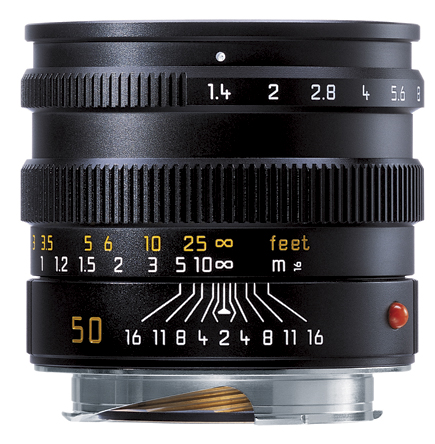
One of the first spectacular results of Leica’s unique design philosophy is the Leica Summilux-M 50mm f/1.4 ASPH. To gather all the details behind the decade-long gestation process that resulted in this remarkable lens, we interviewed Peter Karbe, director of optics development, Leica Camera AG.
Shutterbug: When did you first get the idea of developing the Summilux-M 50mm f/1.4 ASPH, and what were your main objectives in doing so?
Peter Karbe: The idea of developing this lens was born during the first production of the current Summilux 35 ASPH (1993). The previous Summilux 50mm f/1.4, designed by Dr. Mandler, had been produced for 30 years and was widely esteemed as a very good high-speed normal lens. Nevertheless, from the technical standpoint of optical design we were well aware of its weak points: low contrast over the imaging field due to oblique spherical aberration, curvature of field and chromatic aberration (on- and off-axis). The main objectives for the new optical design were therefore the reduction of these aberrations. A very challenging constraint on the overall design was to achieve all these laudable objectives without increasing the size of the lens.
 |
|
|
SB: Which existing 50mm f/1.4 lenses had imaging characteristics you wished to integrate into your new design, what were they, and how did you seek to combine these characteristics in a synergistic way?
PK: In former times Leitz Wetzlar tried to construct improved high-speed 50mm lenses by incorporating aspherical elements into the design (e.g., the Noctilux 50mm f/1.2). However, Leitz abandoned this concept due to the extreme difficulty and cost entailed in producing glass aspherical elements by traditional grinding methods at that time. The new Summilux 35mm f/1.4 ASPH was the first lens we produced using a molded aspherical lens element. And significantly it was also the first aspherical lens delivering the highest level of optical performance that we were able to produce economically at a profit.
Understandably, I tried to adopt the successful optical design concept of the Summilux 35mm f/1.4 ASPH for the new Summilux 50mm f/1.4. However, it was not possible to adopt the concept in total. Due to the structure of the first optical group of the 35mm Summilux (the first surface has a concave shape) the ray bundle would be enlarged (widened). This would enlarge the dimensions of the 50mm lens, an unacceptable result because of the aforementioned size constraint. As a result, the Summilux 50mm f/1.4 ASPH combines aspects of the Double Gauss (DG)-Type and the Summilux 35mm ASPH. Specifically, its front group looks like a DG-Type and rear group looks like the one in the Summilux 35mm f/1.4 ASPH.
| |||||||||
|

| ||||||||










 FEATURED VIDEO


Get the Latest Photo Tips, News & Reviews from Shutterbug!







| Camera Reviews Other Reviews | |
Mobile Reviews Photography Reviews Columns | |
News | |
Features | |
How-To | |
Resources |
 © 2026 Shutterbug
AVTech Media Americas Inc., USA
All rights reserved