


- REVIEWS
Camera Reviews 
More Reviews Mobile Reviews Photography Reviews - GALLERIES
- VIDEOS
- BUYER'S GUIDES

PC-E Nikkor 24mm f/3.5D ED; A Pro Perspective Control Lens
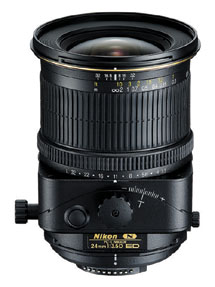
Created chiefly for the high-end Nikon D300 and D3, the new 24mm PC (Perspective Control) lens from Nikon can also be used on other Nikon D-SLR cameras, such as the relatively new D60 on which I tested it, albeit with some loss of full automation and functionality. Being a manual focus lens it can also mount on most Nikon film SLRs as well; being a PC lens it is unique in both operation and function, which is mainly to control perspective and enhance depth of field options with its tilt and shift functions. It is quite a bit larger (3.2x4.3" diameter/length) and heavier (25.7 oz) than you might be used to for a 24mm fixed focal length lens, but one look at it tells you why. Forward from the lens mount sits a tilt and shift mechanism with various knobs and locks that allow you to tilt the lens 8.5° to and fro and shift 11.5mm plus and minus. The lens will revolve so you can work vertical or horizontal as well, although this only works with the D300 and D3 of modern D-SLRs, with some others blocking that rotation.
|
PC-E Nikkor
24mm f/3.5D ED Lens |
|
 |
|
|
The lens is constructed for pro use with three aspherical elements, three ED glass elements, a "Nano Crystal Coat," a Nikon Super Integrated Coat, and rounded nine-blade diaphragm. Max and min apertures are f/3.5 and f/32 respectively, with a very nice 0.7 ft close-focusing distance. The build and functionality is reflected in the price, which we found averaged about $2000 from various reputable vendors in an online search.
If you look at the back of the lens you will notice the rear element is recessed into the barrel. This so-called retrofocus-type construction allows the lens to be swung to and fro because the coverage of the lens circle exceeds the diameter of the sensor or film. Being a "full frame"-type lens it covers 35mm film format and FX-type sensors; for DX sensors (commonly called APS-C) the Nikon multiplier is 1.5, making this a 36mm equivalent on DX cameras. In addition, the construction of the lens itself allows for the tilts and shifts without causing undue vignetting, although you should watch for that with some more extreme movements.
|
Planes Of Sharpness
|
|
 |
|
|
Those who will find this lens most practical are pro architectural, interior, and travel and stock shooters. Those who do this work on a more casual basis and who have invested in an advanced image-editing program might be able to emulate the effects after exposure, or look to a Lensbaby for the effect. This lens, however, is a Lensbaby on steroids.
The PC-E Nikkor grants you incredible ability to control and manipulate depth of field, such that you can throw it completely out of whack (having odd planes of focus) or increase the sharpness of planes of focus in directions that would be impossible in a non-PC lens. Don't have enough depth of field even at f/22 to keep a receding stone wall or fence sharp near to far? Simply shift the lens to match or closely match the angle at which it recedes from the camera position and you can get all of it sharp.
|
Close Focusing
|
|
 |
|
|
| |||||||||
|

| ||||||||










 FEATURED VIDEO


Get the Latest Photo Tips, News & Reviews from Shutterbug!







| Camera Reviews Other Reviews | |
Mobile Reviews Photography Reviews Columns | |
News | |
Features | |
How-To | |
Resources |
 © 2026 Shutterbug
AVTech Media Americas Inc., USA
All rights reserved