


- REVIEWS
Camera Reviews 
More Reviews Mobile Reviews Photography Reviews - GALLERIES
- VIDEOS
- BUYER'S GUIDES

Tamron’s AF18-250mm F/3.5-6.3 Di II LD Aspherical (IF) Macro; A 13.9x Zoom (!) For D-SLRs
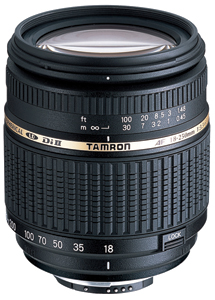 Although Tamron makes some wide aperture, pro-grade lenses, the affordable "multi-platform" 28-300mm zoom and the "digital only" 18-200mm zoom have been their best sellers. That's understandable, since those are unusually versatile and portable lenses. Now, Tamron is marketing a newer 18-250mm Di II model, the first lens on the market with a 13.9x zoom range, the broadest available. It's also exclusively for D-SLRs, providing a 27-375mm or 29-400mm equivalent depending on the camera that you use. For about $100 more than its 18-200mm Di II counterpart, this "super-zoom" provides far more telephoto "reach" but is very similar in size and weight.
This longer lens features an entirely new optical formula, including LD (Low Dispersion) and AD (Anomalous Dispersion) elements plus two hybrid aspherical lens elements. The Tamron engineers specified the different types of glass because the inherent optical flaws of broad-range zooms are quite different at wide angle and at telephoto. The combination addresses all types of aberrations; in fact, image quality is better at some focal lengths than with the earlier models, making the more versatile zoom even more desirable.
Construction And Design
Considering the broad zoom range, this is a reasonably portable lens with a rugged polycarbonate barrel and metal lens mount. According to Tamron, new mechanical devices helped to achieve high power, compactness, and light weight as well as precision and durability. Very nicely finished in matte black, the barrel features wide, rubberized focus and zoom rings, plus a focal length and distance scale; a gold stripe adds a touch of class to this affordable lens. When zoomed, the internal barrel extends--by a full 3"--but overall handling is not affected to a great extent because the components are light in weight.
The manual focusing ring is quite well damped, with enough friction for convenient operation. When the lens is set for autofocus, the ring rotates but the front element remains fixed thanks to an Internal Focusing (IF) system; hence, the effect of a polarizing filter never changes. The autofocus motor is conventional, not ultrasonic, so it's not silent but the low-pitched hum is certainly not objectionable. Zooming action is quite stiff (though not perfectly smooth) so I found no need for the zoom lock mechanism when carrying the camera/lens. A corner-cut lens hood is included with the lens; it shades the front element at all focal lengths, to minimize the risk of flare.
 |
|
 |
|
 |
|
|
Like all Tamron Di II lenses, this one is optimized for use with a D-SLR camera. Because a CCD or CMOS sensor produces the best results when all light rays strike the chip straight-on, a special system is used to maintain a similar "angle of incidence" across the entire frame. (With older lenses, the light strikes the sensor at an increasingly sharp angle near the edges; particularly at wide angle focal lengths, that can reduce resolution and brightness at the edges.) Because light reflecting from a very shiny silicon sensor can increase the risk of flare and low contrast, superior multilayered coatings are applied to all optical elements.
Note, too, that this is an unusually close focusing zoom that provides a high 1:3.5 magnification ratio at the 250mm end in terms of 35mm film photography. When it's used with a D-SLR with the smaller APS-C sized sensor, the "apparent" maximum magnification ratio is an even higher 1:2.3. That's actually produced by field of view crop--including less of the subject area in an image--but the effect certainly simulates greater magnification. (Do not use this lens on a 35mm camera; while it will fit, the edges of the image will be black at some focal lengths.)
 |
|
 |
|
|
Performance Evaluation
While shooting stock photos in the Southwest and during events closer to home, I gave this lens a good workout, indoors and out, using a 10-megapixel Canon EOS Digital Rebel XTi. The 29-400mm (equivalent) range was particularly appealing because it includes the focal lengths I use some 75 percent of the time in travel, action, and people photography. While working from a fixed position, I could vary framing instantly, for a variety of compositions; there was rarely a need to switch to a shorter or longer lens.
Considering the high-tech optical elements and mechanical systems, the Tamron 18-250mm zoom proved to be a fine performer. Autofocus response was quite quick, suitable for tracking the motion of vehicles and cyclists approaching my position, particularly at focal lengths from 18-190mm. At longer zoom settings, the maximum aperture shrinks to f/6.3, reducing the amount of light reaching the camera's AF sensor. Consequently, for the best AF performance, it's worth using shorter focal lengths, as with any small aperture zoom lens.
 |
|
|
| |||||||||
|

| ||||||||




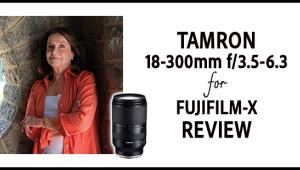






 FEATURED VIDEO


Get the Latest Photo Tips, News & Reviews from Shutterbug!







| Camera Reviews Other Reviews | |
Mobile Reviews Photography Reviews Columns | |
News | |
Features | |
How-To | |
Resources |
 © 2026 Shutterbug
AVTech Media Americas Inc., USA
All rights reserved