


- REVIEWS
Camera Reviews 
More Reviews Mobile Reviews Photography Reviews - GALLERIES
- VIDEOS
- BUYER'S GUIDES
The Leitz Thambar 90mm f/2.2
Why Is It Considered A Legendary Portrait Lens?
Photos © 2004, Roger W. Hicks, All Rights Reserved
 |
|
|
At most about 3000 were made, probably in eight batches, starting with 226xxx
(actually built in 1934) and going through 283xxx, 311xxx, 375xxx, 416xxx, 472xxx,
511xxx, and 540xxx (about 1940). It is anyone's guess how many have survived.
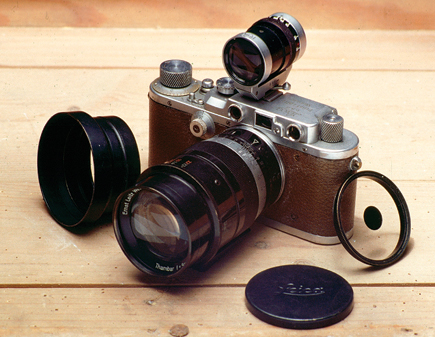
Today they are staggeringly rare and extremely expensive: you would be lucky
to get away with much less than $1500 for the lens without accessories (center
spot, shade, cap), and you could easily pay twice that for a good, complete
example with clean glass. In fact, I have seen people ask $4000 and more for
mint or near-mint examples. I was amazed when an old friend casually mentioned
that he had one and that I could borrow it if I liked.
Now, when it comes to "legends" I'm a bit of a cynic. I've
owned a lot of "legendary" lenses--I still have a few--and
as often as not, there are modern equivalents that are simply better. I'm
even more of a cynic when it comes to soft-focus lenses, especially on small
formats. I love my Dreamagon, but it's totally over the top: subtlety
is not where it's at. The few other soft-focus lenses I've used
for 35mm (and indeed for 120) have completely failed to impress me.
 |
|
|
I was therefore prepared to be underwhelmed by the Thambar: a quick test,
oh, yeah, very interesting, but who'd be fool enough to part with that
kind of money for a lens that is way past pensionable age?
Boy, was I ever wrong. Here's one fool who'd buy a Thambar like
a shot, if he could afford it. Fortunately, the owner is a good friend and I
can probably borrow it again from time to time. And I want to.
 |
|
|
The word that springs to mind is "flattering," which of course is precisely the purpose of a soft-focus lens. At full bore, or close to it, the Thambar makes a middle-aged woman look 10 years younger; it makes a teen-ager with flawless skin look like a dream of perfection; it makes a child look like a cherub. But even if you are shooting men, and using f/4.5 or f/6.3, it is subtly flattering without being obvious.
Well, OK, it was great in black and white, but how about color? And for other
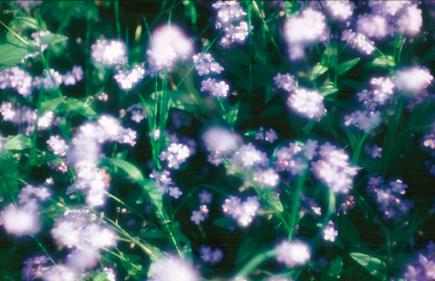
subjects than portraits? Once again, I was astonished. The results were gorgeous:
dreamy, romantic, just the right blend of sharpness and softness, and very subtle
control of sharpness via aperture. There were no problems with blueness, despite
the uncoated lens, though I did use the very deep Thambar lens shade. The only
problem I found was that with ISO 100 film (Kodak EBX, my favorite) I had to
shoot at 1/1000 sec to avoid overexposure at wide apertures.
Like all soft-focus lenses, the Thambar relies on undercorrected spherical aberration.
This means that a point is reproduced as a point plus a halo. As you stop down,
this effect diminishes, until by about f/9 it's fully sharp. F/9? Yes.
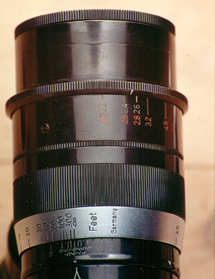
This is one of those prewar Leica lenses that is scaled in the old Continental
system, and to add to the fun, there are two iris scales, one in white and one
in red. The white scale goes f/2.2-2.4-2.6-big gap-9-12.
5-18-25 and the red scale goes f/2.3 (right alongside 2.2)-2.5 (alongside 2.4)-2.8 (alongside 2.6)-3.2-4.5-6.3.
 |
|
|
| |||||||||
|

| ||||||||


 FEATURED VIDEO


Get the Latest Photo Tips, News & Reviews from Shutterbug!







| Camera Reviews Other Reviews | |
Mobile Reviews Photography Reviews Columns | |
News | |
Features | |
How-To | |
Resources |
 © 2026 Shutterbug
AVTech Media Americas Inc., USA
All rights reserved