


- REVIEWS
Camera Reviews 
More Reviews Mobile Reviews Photography Reviews - GALLERIES
- VIDEOS
- BUYER'S GUIDES

Indy Ultra-Wide Zooms For Digital SLR Cameras; We Test The Sigma AF 10-20mm, Tamron SP AF11-18mm, And Tokina AF 12-24mm
As digital SLR cameras have become more affordable, an increasing number of photography and imaging enthusiasts have made the shift to digital capture. But there's one common complaint--the ultra-wide angle lenses designed for 35mm systems do not produce an expansive angle of view with any of the affordable digital SLRs. Because such cameras employ a sensor that's smaller than a 35mm film frame, the effective focal length of any lens is increased. The factor depends on the exact sensor size: 1.5x and 1.6x are most common, but it's 1.7x with Sigma digital SLRs and 2x with Olympus EVOLT cameras.
 |
 |
 |
Typically called "focal length magnification" to describe the apparent effect, this factor is actually caused by field of view crop: the small sensor records less of a scene than the familiar 24x36mm film frame. Consequently, the popular 20-35mm zooms provide only a moderately wide angle of view at the short end: equivalent to 30, 32, 34, or 40mm, depending on the camera. Unless you already own a large, heavy, non-versatile 14mm (or similar) lens, you'll probably want a new zoom for
ultra-wide angle effects with a digital SLR.
 |
|
|
All of the camera manufacturers have developed very short zooms for their digital SLRs with small sensors, with focal lengths starting at 10, 11, or 12mm. In this report we'll focus on those from the independent lens makers, namely Sigma, Tamron, and Tokina. Extensively optimized for digital capture (as discussed later) they were also designed to cover the smaller image circle of the cameras with smaller sensors. Mounting any of these lenses on 35mm cameras or digital SLRs with a full-frame sensor would cause vignetting (darkening at the edges) at most focal lengths.
We decided to test these models because they're available for various brands of cameras and are generally more affordable than the camera makers' products.
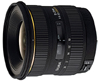 |
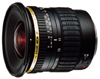 |
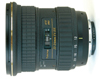 |
|
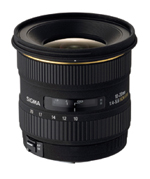
| Sigma AF 10-20mm f/4-5.6 EX DC HSM |
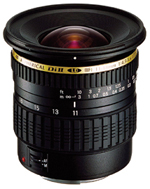
Tamron SP AF11-18mm f/4.5-5.6 Di II LD Aspherical (IF) |
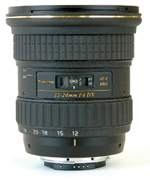
Tokina AF 12-24mm f/4 AT-X PRO DX |
|
| Approx. Equivalent Focal Lengths (35mm Format) | Canon Digital EOS Cameras: 16-32mm Nikon and Fuji Digital SLRs: 15-30mm Sigma Digital SLR's: 17-34mm |
Canon Digital EOS Cameras: 18-29mm Nikon, Fuji, and Maxxum Digital SLRs: 17-27mm |
Canon Digital EOS Cameras: 19-38mm Nikon and Fuji Digital SLRs: 18-36mm |
| Min. Aperture | f/22-f/32 | f/22-f/29 | f/22 |
| Construction | 14 elements in 12 groups | 15 elements in 12 groups | 13 elements in 11 groups |
| Min. Focus/ Max. Magnification Ratio | 9.4"; 1:6.7 | 9.8"; 1:8 | 11.8";1:8 |
| Focusing | Internal | Internal | Internal |
| Filter Size | 77mm | 77mm | 77mm |
| Dimensions | 3.3x3.2" | 3.3x3.1" | 3.3x3.5" |
| Weight | 16.6 oz | 12.5 oz | 20.1 oz |
| Accessory | Corner-cut lens hood, included | Corner-cut lens hood, included | Corner-cut lens hood, included |
| Available Mounts | Canon, Nikon, and Sigma SA | Canon, Konica Minolta, and Nikon | Canon and Nikon |
| Street Price | $409 | $569 | $499 |
| Distributor | www.sigma-photo.com | www.tamron.com | www.thkphoto.com |
Digital Optimization Technology
Lenses designed for 35mm systems can be used with most digital SLRs (except Olympus models) but they may not be ideal for digital capture. Particularly at wide apertures, internal reflections can cause flare, "ghosting" (reflections in the shape of the lens diaphragm), and low contrast. When light bounces to the rear element of the lens, it creates flare that can degrade image contrast. In digitally optimized lenses, new multilayered coatings are applied to more of the lens elements to minimize internal reflections.
There's another characteristic of CCD and CMOS chips that must be considered: the sensors produce the best results with light that strikes all pixels at a 90Þ angle. With many conventional lenses, particularly ultra wides, the light reflected by the subject strikes the image plane at an increasingly oblique angle as you move toward the edges of the frame. This can cause a darkening at the corners or light falloff. Aspherical elements (with a non-spherical surface)--and often, other unspecified measures--are used to produce more even brightness across the frame.
The aspherical elements provide additional benefits in the ultra-wide zooms. They correct "spherical aberration," an optical flaw that causes light rays entering through the edge of a lens to converge on a point different than those passing through the center of the lens. The result should be more consistent sharpness, noticeable especially at the edges of images made at wide apertures. And finally, these elements correct barrel distortion: the bowing outward of lines near an edge of the frame, most problematic at short focal lengths. While it may be possible to achieve all of these effects with conventional optical designs, the use of aspherical elements reduces the number of pieces of glass that are required. That allows for smaller, lighter, and less expensive lenses.
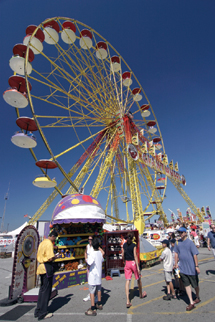
Note: Barrel distortion is well controlled with all of the three lenses tested. There's another type of distortion that occurs when a lens is tilted upward, to include an entire building, for example. Called keystoning, or converging verticals, this effect can make the structure appear to lean backward. This linear distortion occurs because the base of the building is closer to the lens than its top. Whenever we fail to keep the camera back parallel to a subject, the perspective seems unusual. Vertical lines will seem to converge or lean inward out of plumb, while the edges of the horizon bow upward. These effects are standard with any lens, but are exaggerated by ultra wides, and are not caused by any optical flaw.
 |
 |
|
 |
 |
|
|
||
All three independents also employ low dispersion elements in their ultra-wide lenses to minimize chromatic (color) optical aberrations to optimize color rendition and sharpness. The most visible benefit is reduced purple fringing around bright subject edges, a problem that's common with some lenses. Additional specifics about the technologies used in each of the independent brand zooms are included in the subsequent sections.
Test Parameters
During a six-week period, I traveled with all three ultra-wide zooms and used them on a Canon EOS Digital Rebel with the APS-C size sensor. (Canon digital SLR owners should note that these lenses are also compatible with cameras that do not accept Canon EF-S lenses: the D60 and 10D.) Whenever I found a suitable scene or subject matter, I shot it with each of the three lenses, at various focal lengths and f/stops. After downloading the images to my PC, I reviewed them closely on a color corrected 19" monitor. Subsequently, I made large prints of some images from each camera, after optimizing sharpness in Photoshop CS2. While comparing numerous images, I made notes as to the quality of each, in terms of edge to edge sharpness, contrast, vignetting, flare, chromatic aberration, resolution of fine detail, and so on. The results are summarized in my comments about each lens and in the Evaluation chart.
Note: Very few lenses produce optimal image sharpness at small apertures such as f/16 and especially f/22. That's because of diffraction: the extreme bending of light rays as they enter a tiny opening. As expected, none of the three zooms produced images suitable for large prints at f/22, but some made images that are quite sharp at f/16 at certain focal lengths. Frankly, with an ultra-wide angle lens, there's rarely any need to stop down even to f/16, because depth of field (the range of acceptably sharp focus) is very extensive even at f/11.
Sigma's AF 10-20mm f/4-5.6 EX DC HSM
Boasting the shortest focal length of the trio, this Sigma zoom is quite lightweight and compact. The aluminum-alloy barrel extends only 1/4" when zoomed to 20mm. It's beautifully finished in matte black, with wide focus and zoom rings (both well damped), markings for 10, 12, 14, 17, and 20mm plus a distance scale under glass. This lens incorporates the Hypersonic (ultrasonic) focus motor for very fast, nearly silent operation; manual focus override (in AF mode) is also available, great for slightly tweaking focus when desired.
In addition to an extensive multilayered coating, this zoom incorporates three SLD (Super Low Dispersion) glass elements plus three aspherical elements. Consequently, distortion and aberrations are well controlled; light falloff at the edges of the frame is also barely noticeable and is gone by f/5.6.
As hinted in the Evaluation chart, I was very impressed with this zoom with incredibly fast HSM focusing motor. Barrel distortion was surprisingly well controlled even at the 10mm end. Particularly at f/5.6 to f/11, and especially at short focal lengths, this lens produced images suitable for superlative 12x18" prints with high edge to edge sharpness. The images also exhibit great clarity and impressive definition of intricate detail. This Sigma lens seems to be optimized for the very finest results at focal lengths from about 10-14mm at most apertures. By 15mm, edge sharpness is a bit softer, although central sharpness remains very high.
| |||||||||
|

| ||||||||









 FEATURED VIDEO


Get the Latest Photo Tips, News & Reviews from Shutterbug!







| Camera Reviews Other Reviews | |
Mobile Reviews Photography Reviews Columns | |
News | |
Features | |
How-To | |
Resources |
 © 2026 Shutterbug
AVTech Media Americas Inc., USA
All rights reserved