


- REVIEWS
Camera Reviews 
More Reviews Mobile Reviews Photography Reviews - GALLERIES
- VIDEOS
- BUYER'S GUIDES

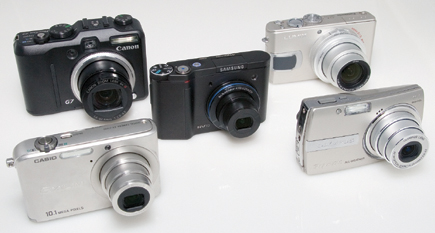
Five 10-Megapixel Digicams: Small Cameras, Big Files; Canon’s PowerShot G7, Casio’s EXILIM EX-Z1000, Olympus’ Stylus 1000, Panasonic’s Lumix DMC-LX2, Samsung’s NV10
Who would have thought that back when I bought my Olympus C-2100, which then
boasted a 2-megapixel CCD, that one day I would be writing about cameras a fraction
of its size with 10-megapixel imaging sensors? Interestingly, that camera sported
a 10x optical zoom with Optical Image Stabilization (both courtesy of Canon).
The cameras currently under discussion don't have 10x zooms, although
the Canon PowerShot G7 comes closest at 6x optical zoom with Optical Image Stabilization.
Each camera is a marvel in its own right and it took extensive testing to help
me choose the pick of the litter.
The main issue with all these cameras is sensor size and consequent image quality.
Are we losing anything by packing so many pixels onto a condensed sensor? Look
at it this way. A can of concentrated orange juice, when reconstituted, will
never have the same flavor and texture as a container of premium orange juice--even
though they deliver the same quantity in the end. The same with sensor pixels.
If you take the same overall number of pixels but shrink each pixel in order
to fit them onto a smaller platform to deliver the same resolution as a camera
with a larger sensor, when that file is "reconstituted" the logic
is that something gets lost--image quality suffers.
 |
|
|
The loss of image quality becomes most apparent when you expose at elevated
ISO (light sensitivity) levels. Think of driving tiny, inexpensive speakers
to the same volume as more robust, high-quality speakers: the sound comes out
harsh and tinny from the small speakers, whereas the larger, more robust speakers
deliver a sound we can enjoy for hours. With digital images, squeezing smaller
pixels onto a smaller sensor translates into noisy pictures. To some degree,
algorithms on-board the camera can successfully mediate this noise to deliver
reasonable, even high-quality, images--up to a point.
Pushing The Limits At 10 Megapixels
Just as you can only push film so far, you can only push light sensitivity in
a sensor so far before the image begins to seriously deteriorate. I put each
of the cameras to the test, mounting them on a tripod, and made exposures at
ISO 100 and 400, and, where available, ISO 800 and 1600. Because of the bright
subject/background tonality, I increased exposure by +1 EV universally. This
step benefited two cameras, but not the others in delivering a usable exposure,
which is also a testament to their metering prowess, or lack thereof--or
it may reflect a limitation of the camera's f/stop and shutter speed range.
Either way, a poor exposure is a poor exposure.
 |
|
|
My tests convinced me not to exceed ISO 400 with most of these 10-megapixel
cameras, although I would prefer to shoot at ISO 100 wherever possible for optimal,
virtually noise-free quality. The one camera that failed to deliver satisfactory
results at ISO 400 was the Casio. In fact, even at ISO 100, the EXILIM EX-Z1000
exhibited more noise than any other camera tested. The Canon fared best, delivering
reasonable results even at ISO 1600.
Digital Anti-Shake Vs. Optical Image Stabilization
These cameras utilize two different Anti-Shake systems, digital and optical.
Digital Anti-Shake processing means one thing: interpolated pixels. Optical
Image Stabilization (OIS in Canon's PowerShot G7 and Panasonic's
Lumix DMC-LX2) physically corrects for camera movement within the lens. Depending
on the camera, the effective range of shutter speeds with OIS varies but it
can be set to operate while the camera is held still, or alternatively, when
panned, or the camera may offer continuous motion correction.
To test the effectiveness of either approach, I made handheld exposures over
a range of relatively slow shutter speeds with and without this feature engaged.
Shooting in Shutter-Priority mode where applicable (not available on the Olympus
Stylus 1000 or the Samsung NV10), I selected a shutter speed of 1/8 sec as the
critical value where Image Stabilization proved effective on all models. Clearly,
my test results did not yield optimum exposure or color balance--but that
wasn't what I was looking for here. As expected, OIS was the winner, with
the Canon and Panasonic both proving their mettle (you have to look beyond the
focusing, which at this range, proved a problem for the Panasonic). The Casio
and Samsung cameras appear to suffer most from interpolated pixels, with very
noisy results, while the Olympus model didn't fare much better.
Other Tests
I also wanted to see how long each camera took to make an exposure once focus
was locked in, a test for what's commonly called shutter lag. The Canon
averaged about 1/10 sec, with the Casio coming in just over that. The Panasonic
and Samsung lagged behind at around 3/10 sec, with the Olympus taking a fraction
longer. Viewing and focusing in every test was done via the LCD monitor.
 |
|
 |
|
|
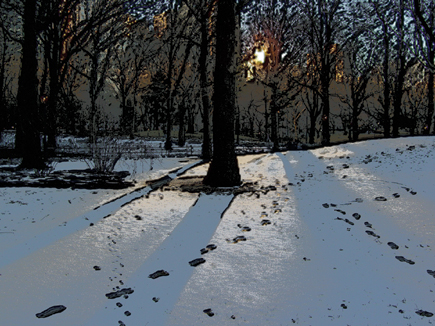
Next came color balance under a fluorescent light and shady window light. In AWB (Auto White Balance) with a daylight full-spectrum fluorescent bulb (an OTT-LITE desk lamp), none of these cameras delivered clean results, although the Canon and Olympus came closest, with the Panasonic on their heels. Worst was the Casio, with the Samsung falling midway. Interestingly, only the Casio produced a neutral color balance when daylight fluorescent WB was engaged.
| |||||||||
|

| ||||||||









 FEATURED VIDEO


Get the Latest Photo Tips, News & Reviews from Shutterbug!







| Camera Reviews Other Reviews | |
Mobile Reviews Photography Reviews Columns | |
News | |
Features | |
How-To | |
Resources |
 © 2026 Shutterbug
AVTech Media Americas Inc., USA
All rights reserved