


- REVIEWS
Camera Reviews 
More Reviews Mobile Reviews Photography Reviews - GALLERIES
- VIDEOS
- BUYER'S GUIDES

The Mecaflex; A Square Format 35mm SLR
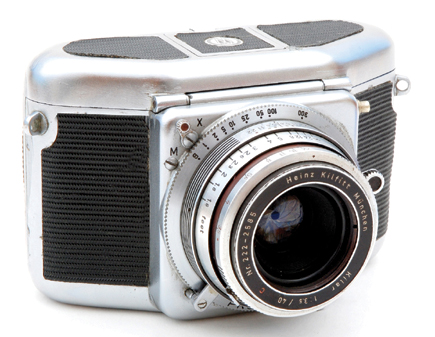
The Mecaflex was one of the smallest 35mm single lens reflexes ever made. It was designed by Heinz Kilfitt, who, in 1947, opened an optical company in Leichtenstein that subsequently relocated to Munich. It was here that he made a name for himself producing high-precision lenses that included the 40mm f/2.8 Kilar--the world's first 35mm macro lens--and the Zoomar, the world's first production zoom lens for a 35mm camera.
 |
|
|
But Herr Kilfitt was also a camera designer. He designed the Robot, which he sold to Otto Berning and Co. in Dusseldorf, and he designed the Mecaflex, which he sold to Metz at Fürth in Germany. The company, best known at that time as a radio and television manufacturer, made the bodies while Kilfitt supplied the lenses, and their version was launched in '53. Unfortunately the deal went sour, leaving Kilfitt with a lot of lenses and no cameras to put them on. So, in '58, he had the bodies made in France by SEROA in Monacco.
The way to tell whether you are looking at a German Mecaflex or a French one is to examine the logo on the top plate. Under a large "M," is either the word "Metz" or "SEROA."
 |
|
|
Measuring only 4x3x21/2", the Mecaflex sits comfortably in the palm of the hand. Mostly the cameras were made in an attractive satin chrome finish with a black leather covering, but the last 100, before production stopped, were made with an attractive light brown lizard skin covering. The camera took 50 exposures, 24x24mm, on a standard 36-exposure length of 35mm film, the only 35mm SLR to use this square format.
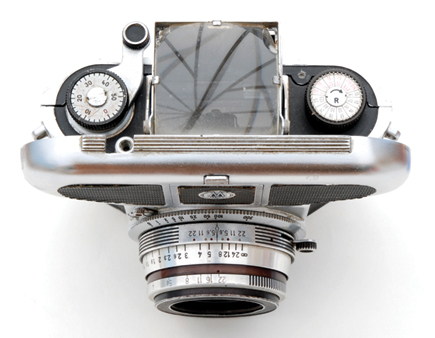
At first sight, it appears that the Mecaflex has certain basic controls missing, because there's no sign of a viewfinder, film wind lever, shutter release, or rewind knob.
Closer examination, however, reveals that they are all hidden beneath a top plate that hinges up at 90°. As that is lifted, a metal focusing hood unfolds and a large, square magnifier clicks into place just above a small ground-glass screen. Unlike most SLR waist-level viewfinders, this magnifier, which covers the whole area of the focusing screen, is not designed to be held close to the eye. Instead, the camera is held at waist height when the magnifier shows the whole image. It's a boon to composition, but not very good for fine focusing.
 |
|
|
A square aperture can also be opened in the front of the now vertical top plate, which couples with an opening in the back of the focusing hood to form a direct vision, eye-level viewfinder. Also under that top plate, on the right of the focusing screen, are the shutter release and single stroke film wind lever with an inset frame counter, and a rewind knob, incorporating a film-type reminder, on the left.
Moving around to the front of the camera, most controls fall in their expected places. A lever racks the lens in and out for focusing, while shutter speeds and apertures are set on their own rings at the front and rear of the lens. But although the controls for setting shutter speeds and apertures appear fairly conventional, the way each operates is a little out of the ordinary, because the camera has an early form of automatic aperture stop-down by means of an ingenious series of mechanical linkages between the body and the lens. Here's how it works.
| |||||||||
|

| ||||||||










 FEATURED VIDEO


Get the Latest Photo Tips, News & Reviews from Shutterbug!







| Camera Reviews Other Reviews | |
Mobile Reviews Photography Reviews Columns | |
News | |
Features | |
How-To | |
Resources |
 © 2026 Shutterbug
AVTech Media Americas Inc., USA
All rights reserved