Anyone who reads Shutterbug
regularly will know of my enthusiasm for modern Voigtländer cameras.
I’m also extremely fond of the postwar Prominent 35mm leaf-shutter
rangefinder camera, and I have a great (though guarded) admiration for
its prewar 120 namesake, one of the most advanced rollfilm cameras of
its day. But like other German makers, Voigtländer also offered
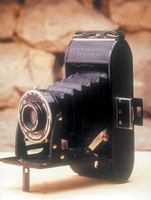
some pretty pedestrian machines. The Bessa illustrated is one of them.
It was introduced in about 1931 and re-appeared after the war: I suspect
that the model illustrated is an early postwar version, when they were
still using up some prewar parts.
To modern eyes it’s an odd compromise. Why make something so basic,
so well? The Anastigmat Voigtar 1:6,3 F=10.5cm lens is no more than
an air-spaced triplet, uncoated, with front-cell focusing. The focusing
scale is helpfully marked with distances (in meters—it appears
to have been built for the French market) plus three red dots, one each
for paysages (landscapes, about 20 meters), group (about 5 meters),
and portrait (about 2 meters). The shutter offers a mere 1/25, 1/50,
1/100, and (substantially for cosmetic purposes) 1/125, plus both B
and T—though amazingly, it also has a self-timer.
Lens And Shutter
Options
Of course, there were better lens and shutter options. Top of the line
was the much-prized Heliar in a Compur-Rapid shutter. After World War
II the camera was reintroduced for a few years, and the ultimate in
the Bessa line-up was the rangefinder-equipped Bessa II with the (very
rare) Apo-Lanthar lens. This sort of approach used to be very common
with folding cameras: the same basic chassis with an extraordinary range
of lens and shutter options, often with and without a rangefinder. This
one, unfortunately, is somewhere near the minimum possible specification.
But let’s get back to it.
Self-Erecting
It’s self-erecting. Press a button next to the film wind key and
the front pops out with the bellows: a slight pressure with the thumbs
clicks the supports into place. It’s all beautifully made and
finished, but there’s a bare minimum of (expensive) chrome: it’s
black paint wherever possible. The only concession to decoration, unless
you include the “Bessa” stamped in the covering, is a nod
in the direction of art deco with the two curved, tapered arrows on
the shutter. The little red arrow on the hinge of the strut is to show
you how to fold it up.
In addition to the usual features such as a folding foot so the camera
can act, in effect, as its own tripod, there are such refinements as
a left-hand shutter release that automatically retracts when the camera
is folded up; the linkage between the release and the shutter seems
unnecessarily complex, in a camera where shutter setting and film wind
aren’t interlinked, and there is no mechanism for preventing double
exposures.
120 Film Format
It takes standard 120 film, and an interesting feature is that when
you load the film, you just drop it into a cradle rather than locating
in on spindles. At the take-up end there’s a brilliant quick-load
system for the empty 120 spool. Like the feed cradle, this doubles as
a light trap to protect the film. Film counting is red window, of course,
with a slightly hard to use shutter worked by a little knob outside
the camera next to the window: the aim is to reduce light strike through
the backing paper.
Some Handling Foibles
Try to use it, and you realize a number of simple truths. Most are not
encouraging. Lens shades were a lot more important in the days of uncoated
lenses, and are pretty inconvenient when you have to take them off to
collapse the camera. This is especially true when they are 32mm push-on
fitting and obscure the focusing scale. Separate film wind and shutter
cocking take some getting used to. Red window film advance is horribly
inconvenient. Peepsight viewfinders give you only a rough idea of where
the camera is pointing, and there’s no parallax compensation.
Even the best folding cameras—and Voigtländers were always
among the best—can never be as rigid as a rigid-bodied camera.
On the bright side, you soon find that with a huge negative, over five
times the area of 35mm, you can live with an indifferent lens and less
than perfect film registration a lot easier than you can with 35mm.
An 11x14” print is rather under a 5x enlargement, while 8x10”
is well under 4x. Even the Voigtar doesn’t show up too badly under
these undemanding conditions, and the better lenses (predictably) do
better.
Compact Medium Format
For a camera delivering a negative this size, too, the Bessa is wonderfully
small: less than 17cm (about 63/4”) high, including the leather
handle on top, about 90mm (31/2”) wide, and maybe 38mm (13/8”)
deep when folded. The weight, almost exactly 500 gm (just under 18 oz)
reflects the quality of its construction but could not be called heavy.
If you want a knockabout camera that you can keep in the glove compartment
of the car; that is worth only a few dollars; and that does, after all,
bear one of the greatest names in the history of photography, then even
a basic Bessa like this one has its merits, especially when loaded with
something like Ilford HP5 Plus. You’re not worried about grain,
after all, and you’ll get that gorgeous Ilford tonality with a
minimum of grief and expense. Actually, I don’t think I’d
go for one quite this basic. I’d look for a coated and slightly
better lens, in a fully speeded shutter, but even then, I’d not
be looking at spending a fortune.