


- REVIEWS
Camera Reviews 
More Reviews Mobile Reviews Photography Reviews - GALLERIES
- VIDEOS
- BUYER'S GUIDES

Classic Cameras; The Final Countdown; The Top 20 Cameras Of All Time
This is the final installment of our Top 20 Cameras of All Time created by contributor Jason Schneider. To say the least this series has stirred controversy and compliments, the former from those who have decried the lack of their picks on the list and the latter from those who praise the scholarly and consummate effort of the task. You can read all the comments from fellow readers in our Top 20 Cameras Forum at www.shutterbug.com (click on Forums) and add your own picks. We'll follow up with some of the favorites that did not make the list as soon as Jason gets his wind back, which, knowing him, should not take too long. Here's the Final Five...
--George Schaub, Editor
5) Leica D (Or II)--1932
 |
The Leica D, known as the model II in Europe, was the first Leica with a built-in coupled rangefinder, and ties for first place (with the Contax I of 1932) as the first interchangeable-lens 35mm camera to incorporate this feature, which was destined to transform the breed into the world's first true system camera. The Leica D's 39mm threaded lens mount, standardized on later versions of the Leica C (or I) of '30-'31, was immortalized as the "Leica mount" used on Leicas up to the last screwmount model, the IIIg of '57-'60, all interchangeable-lens rangefinder Canons, rafts of Leica copies, and scores of enlargers. Perhaps the most ingenious aspect of the Leica D is how the engineers brilliantly grafted a small-but-effective short-base, high-magnification superimposed-image rangefinder with separate viewfinder on top of the classic Leica body, creating an exquisitely compact design. Equally impressive is the rangefinder-coupling system--a wheel-ended coupling arm in the camera contacts a precision cam on the back of each screwmount lens, so as you focus, the rangefinder's moving and stationary images coincide only at the proper object distance. The basic design of the Leica D was unchanged up to '56.
Like practically all Leicas, the Leica D is a prize collector's item, though not as stratospherically priced as some older models. More common in black finish than in chrome, a clean Leica D with an uncoated nickel-finished 50mm f/3.5 Elmar lens of the proper vintage sells in the $800-$900 range, a bit less for a chrome model.
4) Kine Exakta I--1936
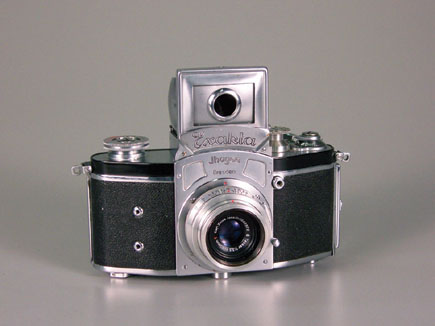 |
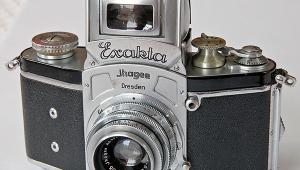
The Kine Exakta I, made by Ihagee Kamerawerk, Steenbergen & Co. in Dresden, Germany, was the first widely distributed 35mm Single-Lens Reflex (SLR) camera and its basic configuration profoundly influenced the legions of 35mm SLRs that succeeded it. According to some sources, the Russian-made Sport, which was first sold in 1936 or '37, ties the Kine Exakta for the title of first 35mm SLR. However, this fascinating machine had an odd shape and control layout, used special cassettes, and was distributed in limited numbers, mostly in Russia. The Sport thus had little influence on subsequent camera design.
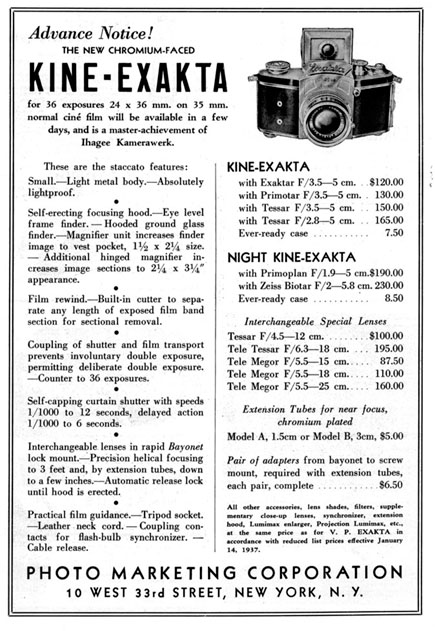 |
The Kine Exakta was called Kine because, unlike previous rollfilm Exaktas, it used 35mm cine film. It is also a very distinctive design, with its trapezoidal-shaped body, left-handed single-long-stroke film advance lever, left-handed shutter release, and flip-up waist-level viewfinder; but it still has the unmistakable look and features of a modern 35mm SLR. Its horizontal-travel cloth focal-plane shutter has speeds from 12 seconds to 1/1000 sec, plus B and T, with fast speeds (1/25-1/1000 sec) set via a dial next to the wind lever, and slow speeds (12 seconds to 1/10 sec) set on a second "wind-the-spring" dial atop the camera's right end. The non-removable waist-level finder has a convex ground-glass screen with round flip-down, critical-focusing magnifier (the second version of circa '37 had a rectangular magnifier).
Despite its charming quirks and distinctive personality, the Exakta was a pioneering camera and its impressive aggregation of lenses, finders, and accessories made it the first 35mm SLR to evolve into a true system camera. Its substantial and continuing influence on the design and development of the 35mm SLR can hardly be overestimated. All Exaktas (and their cute little brothers, the Exas) are collectible, but models produced after the VX 1000 of '67 and the rare West German Exakta Real of '66 are not avidly collected. An original Kine Exakta I of '36 with round magnifier in good condition is a true collector's heartthrob that presently fetches over $1000 with an uncoated 50mm f/2.8 or f/3.5 Zeiss Tessar lens.
3) Leica A--1925
 |
This is the camera that really put 35mm photography in the forefront and created widespread interest in this upstart "miniature" format. Contrary to widespread belief, and statements made in overly optimistic Leica ads of decades past, the Leica was not the first 35mm still camera in production, and it wasn't even the first to employ the 24x36mm format that it made famous (that distinction goes to the rather primitive Simplex of 1912, made in Long Island City, New York, an early center of cinematography).
Nevertheless, Oskar Barnack the principal inventor of the Leica, who tested it in prototype form (the Ur Leica) as far back as '12, certainly deserves to be called "The Father of 35mm Photography." The camera he painstakingly created under the
auspices of the venerable microscope maker E. Leitz of Wetzlar, Germany, and that was finally released as the Leica (subsequently called the model A) at the Leipzig Fair in '25, was the first high-quality 35mm camera to be mass produced, and a watershed design that defined and determined the direction photography was to take in the 20th century.
 |
It established the basic shape and control layout of 35mm cameras, the viability of 35mm as a serious contender, and the excellence and legendary status of Leica cameras that continues today. Certainly the Leica's exquisitely compact, magnificently integrated, supremely ergonomic design had something to do with its success, but its performance as a picture-making machine was equally important. Perhaps the greatest testimony to the rightness of Barnack's original design is the fact that, with the addition of an interchangeable lens mount and a coupled rangefinder, the basic concept endured for over 35 years, during which time the Leica name was widely revered as "the best camera in the world."
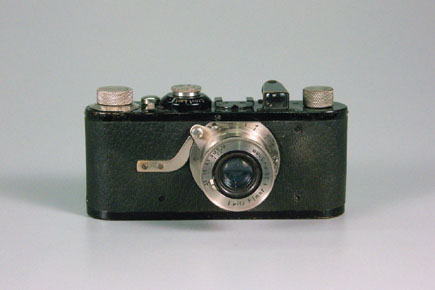
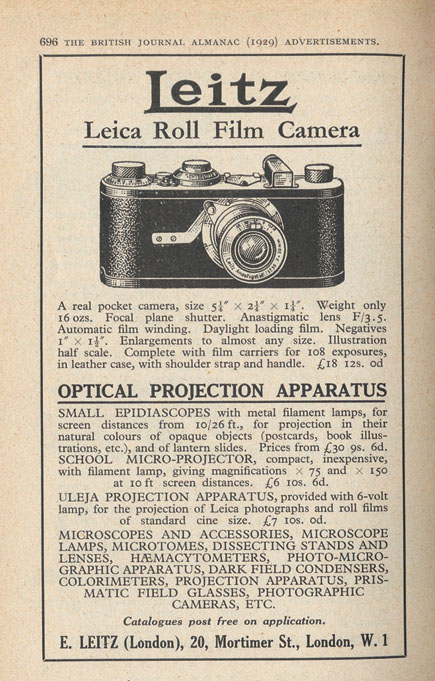
By modern standards, the Leica A (the name is a contraction of "Leitz" and "camera") seems very straightforward and basic, and that indeed is part of its charm. A true pocket-sized miniature, it's finished in black enamel with nickel-plated metal parts, including the distinctive "hockey stick" infinity lock on the front. Other features include self-capping, horizontal-travel cloth focal-plane shutter with speeds of 1/20-1/500 sec plus T set via a top-mounted dial that rotates as the shutter fires; a non-interchangeable, scale-focusing, collapsible, Tessar-type 50mm f/3.5 Elmar lens (rare early models had lenses labeled Leitz Anastigmat or Leitz Elmax) with an aperture ring (f/3.5, 4.5. 6.3, 9, 12.5) on the front; film wind knob with concentric, manually set frame counter; rewind knob; and a small optical viewfinder on the top.
| |||||||||
|

| ||||||||










 FEATURED VIDEO


Get the Latest Photo Tips, News & Reviews from Shutterbug!







| Camera Reviews Other Reviews | |
Mobile Reviews Photography Reviews Columns | |
News | |
Features | |
How-To | |
Resources |
 © 2026 Shutterbug
AVTech Media Americas Inc., USA
All rights reserved