


- REVIEWS
Camera Reviews 
More Reviews Mobile Reviews Photography Reviews - GALLERIES
- VIDEOS
- BUYER'S GUIDES

The Savvy Consumer’s Guide To Pre-Owned, Collectible, And Vintage Cameras; The Legendary Nikon F: What Makes It The Camera Of The Century?
Before launching into paeans of praise for the Nikon F, which, in my arrogant opinion, may well be the most important 35mm SLR of the 20th century, I must confess to being a tiny bit biased. When I acquired my first F as a teen-ager back in 1961 (alas after trading in a mint Leica IIIg with a 50mm f/2.8 collapsible Elmar) I knew I had finally arrived. I strutted around lower Manhattan with my imposing chrome F hung on a leather neckstrap over my black turtleneck sweater trying to look like a hard-bitten photojournalist. I didn't, but unlike me, the Nikon F was everything it was cracked up to be, namely an indestructibly rugged, truly professional camera that never let me down, delivered images of surpassing quality, was upgradeable due to its modular design, and was and is a stunning example of first-rate craftsmanship and non-obsolescence.
A Collection Of Classic Components
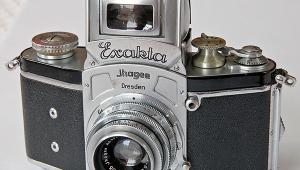
Perhaps the most amazing thing about the original Nikon F of '59 is that it's not really a technological landmark. Aside from being the first SLR to offer an electric motor drive accessory, and the first system to provide a Perspective Control (PC) lens, all the elements of its magnificent modular design can be found in previous 35mm SLRs. The first of the 35mm SLR breed, the Kine Exakta of '36, had interchangeable lenses and a focal-plane shutter, and by '50, had acquired an interchangeable penta-prism finder; the Asahiflex IIB of '54 had an instant-return mirror; and the rare, made-in-Japan Zunow reflex of '58 was first with fully automatic lens diaphragm operation.
Technically, the Nikon F wasn't even the first professional 35mm SLR. Many scientists and naturalists used Exaktas during the '40s and '50s, and the East German Praktina FX of '53 (which had an internal auto stop-down mechanism, interchangeable prism finder, bulk film back, and accessory spring motor) attracted a professional following on both sides of the pond, and may have even influenced the Nikon F's design.
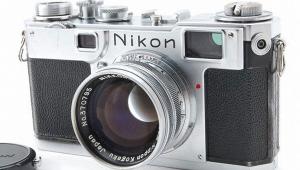
Of course, one camera line that definitely influenced the F was the Nikon S-series rangefinder cameras, especially the S3 and SP which, according to Nikon lore, were designed at the same time as the F. Whatever the truth may be, it is evident that the Nikon F successfully carried forth the shape and basic operational design of the exquisite Nikon rangefinder cameras in a way that Leica, Zeiss, and even Canon failed to match, and that is one of the prime reasons for its phenomenal success.
|
Deal Of The Month!
|
|
 |
|
|
|
| Note: This month's Deal of the Month was found at KEH Camera Brokers (www.keh.com) but similar great buys can also be found at other dealers who advertise in Shutterbug. |
A Masterpiece Of Integration
So what is it that makes the Nikon F so special? It's the way all of the existing technology and all of its components are seamlessly integrated into a functional whole that looks right, feels right, performs superbly, and is a pleasure to use. It was clearly conceived from its inception as the basic module in a high-quality professional SLR system, and that's why it remained in production, with relatively minor changes, for nearly 15 years (from '59-'74), and why it has now attained the status of a living (and, happily quite affordable) legend. The fact that its viewfinder shows 100 percent of the on-film image, and that the F-mount has endured--albeit with some operational changes--into the present digital era have also endeared it to hordes of pros and amateur enthusiasts worldwide.
The Agony And The Ecstasy Of The F
Of course, no camera design, even one as felicitous and successful as the Nikon F, is perfect. I'm sure that F-toting pros could come up with their own lists of pet peeves, but legions of photojournalists have cursed the F's removable back (which allows bulk film backs and motor drives to attach easily, but is a problem to load on the fly), and camera repairmen have had a field day repairing Nikon F prisms (metered and meterless) that have fallen off due to the dodgy, less-than-bulletproof mounting system.
The lack of a hot shoe--you can add one by sliding in an AS-1 shoe adapter over the rewind knob--is another bone of contention. Finally, all experienced Nikon repairmen know that the carbon-based variable resistor in early Nikon F meter prisms eventually fails and is now irreplaceable except by cannibalizing parts.
Of course, this stuff pales into insignificance when you see the brilliance of Nikon's externally coupling meter prism that let you upgrade your camera (albeit with mirror box mods) as the metering system advanced from non-TTL (the original Photomic of '62) to TTL (Photomic T of '65) to meter needle in finder (Photomic FTN of '65). Equally remarkable is their durability--I can think of no other camera that's 35-45 years old with a higher percentage of models in good working condition, but check those meter prisms!
 |
|
 |
|
 |
|
|
| |||||||||
|

| ||||||||










 FEATURED VIDEO


Get the Latest Photo Tips, News & Reviews from Shutterbug!







| Camera Reviews Other Reviews | |
Mobile Reviews Photography Reviews Columns | |
News | |
Features | |
How-To | |
Resources |
 © 2026 Shutterbug
AVTech Media Americas Inc., USA
All rights reserved