Site Links
|
 |
 |
 |
Classic Accessories The Shirley Wellard Universal Cassette Delightful Labyrinth-Style Doodad
By Roger W. Hicks June, 2004
| |
|
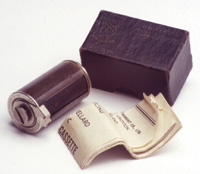
Shirley Wellard cassette with original box and (compendious)
instruction leaflet. |
|
Reloadable labyrinth-style
cassettes are nothing new: they were launched with the original Leica
when it became clear that darkroom loading and unloading was not going
to be outstandingly convenient. This is why a standard load is 36; the
original Leica prototype took 50 exposures, but the cassette took up
the space of 14 of them.
Labyrinth cassettes are designed to open in the camera, so that the
film has an unbound, scratch-free path between the feed spool and the
take-up spool and back again. They are then closed before the camera
is opened, so that the film goes through a very narrow gap between the
inner cassette and the outer cassette, providing a light trap—hence
“labyrinth.”
Most reloadable cassettes are designed for a single camera or (at most)
can be used in related cameras: thus, Kiev, Nikon, and Contax cassettes
should be interchangeable. But the British-made Shirley Wellard is,
as far as I am aware, the only attempt at a universal interchangeable
labyrinth cassette.
|
| |
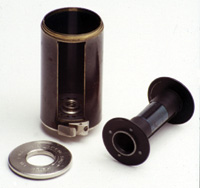
Shirley
Wellard, partially disassembled.
|
|
It can be used in almost any
camera with an opening back and a pull-up rewind knob. The premise is
that the rewind knob doesn’t seat fully with the cassette in place:
it’s about 1.5mm (1/16”) proud. Push down and twist anticlockwise,
and the cassette opens; push down and twist clockwise (the direction of
rewinding), and it closes. Admittedly, you have to remember to open and
close it, unlike camera-specific cassettes that normally open and close
automatically, but equally, it is (as it advertises itself) very nearly
“universal.”
For something as humble as a cassette, it’s a staggeringly complicated
piece of engineering. I counted 13 separate parts: inner sleeve, outer
sleeve, cap, tracking (height adjustment) screw, backlash stop, backlash
stop locking screw, locating peg, locating peg screw, spool, spool spring,
spool length adjusting screw, two film end locks.
|
| |
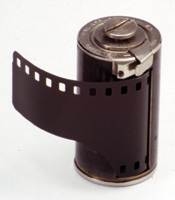
Shirley
Wellard, ready for use.
|
|
Materials are widely varied:
deep-drawn brass, die-cast light alloy, spring steel, turned brass, parted-off
extrusions, and quite possibly more for all I know. Finishes are equally
varied: chemically blacked brass, unplated brass, plated brass, blued
steel, and black paint on light alloy. It’s a delight.
The basic trick is the die-cast film spool, which has cast studs on the
bottom that engage with holes drilled in the bottom of the inner sleeve.
These are what twist the inner sleeve to open and close it. But there’s
much more to it than this. Film cassettes are standardized only within
quite wide limits, and the same is true of film chambers in cameras, but
once this thing is adjusted for a particular camera it fits perfectly,
as if it were a part of the camera: there is no shake, rattle, or roll.
First you set the backlash stop by slacking off the locking screw, opening
the backlash stop further than is needed, putting the cassette in the
camera, closing the camera back so that the backlash stop is pushed to
the right position, then opening it up and tightening the backlash locking
screw. Then you set the tracking screw, which is split so it doesn’t
turn too easily. If necessary (if the rewind fork on the camera doesn’t
reach deep enough to activate the opening mechanism), you can also set
the spool length screw.
|
| |
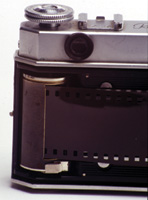
Shirley
Wellard open in in Retina IIa: you can see how the rewind
knob stands slightly proud.
|
|
This is a Type C (I think the
earlier types had fewer adjustments). In England, in 1955, it cost just
under two pounds, or $5.50 at the rate of the day. Adjustments for inflation
are always suspect, but if you called it 10x as much you’d probably
be understating and 20x might not be unrealistic.
In other words, the price equated to something between $50 and $100 today.
For one cassette! But with that much engineering, the price is hardly
a surprise; you literally couldn’t afford to make and sell something
like this in the 21st century. The least they go for at camera fairs is
usually a couple of dollars, and the most is about $10. At $5 or so, they
are not only fascinating little bits of camera history: they are also
fully usable with many classic cameras, and even a few new ones.
Shirley Wellard Universal Cassettes were distributed by K.G. Corfield
Ltd., also famed for the Corfield Lumimeter enlarging exposure meter,
the Corfield Periflex camera, and (more recently) the Corfield WA67 “Architect.”
Sir Kenneth Corfield—whom I am proud to have met several times—is
very much the Grand Old Man of the British camera industry, a man of legendary
knowledge and experience who is still a major influence in Gandolfi Corfield
Ltd.
And the name of the cassette? Well, the designers apparently came from
Shirley, in the English Midlands. And one of them, wondering if they would
ever perfect this delightful little doodad, said, “Well, if we do
make any money, it’ll be well ’ard earned.” Hence, Shirley
Wellard.
Thanks to Tim Goldsmith of
Monark Price Guide (www.cameravalues.com)
for help in establishing fair prices.
|
 |
|
 |
|
|
 |
 |
 |
|