Site Links
|
 |
 |
 |
Classic Cameras The Mamiya Super 23
By Harry Price May, 2004
Mamiya introduced the Super
23 in 1967 and it would be the next to the last design the company would
release as part of their series of “press” cameras. The
term “press camera” was already an anachronism when the
model was introduced as photojournalists had long since adopted the
35mm camera as their tool of choice. Instead, Mamiya found willing customers
for the new camera among the ranks of professional photographers who
appreciated the Super 23’s combination of quality, versatility,
and fast handling ideal for the bread-and-butter work of wedding, portrait,
architectural, and studio photography.
The Super 23 and its sister camera, the Universal (Mamiya’s final
press camera design released in ’69), would dominate the final
years of the press camera market by offering photographers far more
versatility and value when compared to competitors such as the Graflex
XL, the Koni-Omegas, or the various medium format Linhofs of the day.
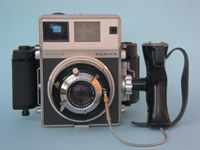
The Camera
Super 23s follow the basic design criteria of the press camera as they
are rangefinder focusing, medium format cameras offering interchangeable
lenses and backs. Mamiya’s design stands out as unique by combining
the most useful features of all the press camera models in a single
unit.
The combined range/viewfinder is large, bright, and projects frames
for the 100mm, 150mm, and 250mm lenses. Corners of the frames show coverage
of these lenses in both the 6x7 and 6x9 formats. All of the lenses produced
by Mamiya for the camera provide coupled rangefinder focusing.
The camera body is fairly large at 7” high by 43/4” wide
and a depth of 21/2”. Super 23s actually handle like much smaller
cameras due to the effectiveness of the standard handgrip that allows
for a steady hold in either the vertical or horizontal position.
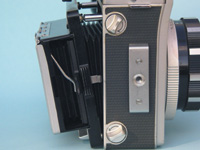
Two revolving keys on the back of the body allow for the attachment
or removal of rollfilm holders and other attachments. The four knobs
on the sides of the camera are what make the Super 23 so unique. Loosening
these knobs allows you to extend the bellows back mount 13/16”
and then apply up to 15Þ of swing or tilt for perspective correction
or depth of field control making the Super 23 something of a mini-view
camera. The additional back extension was also useful when shooting
close-ups as it provided an ability to get just under 1/2 life size
with the standard 100mm lens.
The Lenses
Mamiya offered a wider range of lenses for the Super 23 than any of
the competitive systems. Ten different lenses in eight different focal
lengths were available to Mamiya users, all rangefinder coupled in helical
focusing mounts. The lenses used the reliable Seikosha #0 shutter and
provided for flash sync at all speeds.
Wide angle lenses included focal lengths ranging from the 50mm extreme
wide angle to the general-purpose 65mm to the very moderate 75mm. Each
of these lenses was supplied with its own parallax-corrected viewfinder
that would attach to the accessory shoe on top of the camera body. Focusing
was achieved using the coupled rangefinder and the separate viewfinder
would be used for framing and composition.
Normal lenses included the older 90mm f/3.5 from the Super 23’s
predecessors in the Mamiya press line, the standard 100mm f/3.5, and
the outstanding high-speed 100mm f/2.8. The 100mm f/3.5 is the most
commonly encountered and the f/2.8 is one of the more sought after lenses
today.
In terms of telephoto lenses, Mamiya provided a 150mm f/5.6 for general-purpose
use and two different 250mm lenses. The 250mm f/8.0 offered about as
long a lens as was useable on a rangefinder camera while the massive
250mm f/5.0 was one of the fastest lenses of this focal length ever
offered for a medium format camera. Intended for use as a normal lens
on a Universal equipped with a Polaroid back, a 127mm lens was also
offered.
Lens accessories included various styles of metal and rubber lens hoods
and screw-in filters sized for each lens. An extension tube set was
available for extreme close-up work that allowed magnifications of up
to 1.5 times life size with the 100mm lens.
|
| |
| Super
23’s tilting back and locks. |
|
Camera Backs And Accessories
The standard backs for the Super 23 were lever-advanced rollfilm holders
for either the 6x7 or 6x9 format. By adjusting the pressure plate in the
holders, users could set the back to handle either 120 or 220 film. Advancing
the film required two strokes of the lever.
For close-up work, or when using the camera’s tilt/swing capability,
Mamiya offered a ground-glass focusing back that would attach in the same
manner as a rollfilm holder. Called the Focus Screen Holder, it provided
accurate viewing of the subject through the lens. The holder also permitted
insertion of Mamiya’s plate or cut film holders for a single 6x9
exposure. A rare accessory today is the Reflex Viewer that provided a
right-side-up, waist-level viewfinder when used with the ground-glass
back.
One final rollfilm holder worth noting was called the “K”
back. This unit offered three formats—6x4.5, 6x6, and 6x9—in
a single unit. Using a knob advance and masks for the smaller formats,
the back was versatile but awkward to use since the camera’s viewfinder
could not provide references for anything but the 6x9 format.
While the “press camera” designs have faded into history,
the influence of these cameras can be seen in the recent revival of the
medium format rangefinder in models from Mamiya, Fuji, and Bronica.
Easily deserving the label “classic,” Mamiya Super 23s continue
to have a loyal following over two decades since their production ceased.
Their unique combination of versatility, easy handling, and high quality
are still valued by thousands of photographers today. In today’s
used market, Super 23 outfits consisting of the camera, 100mm f/3.5 lens,
and 120 rollfilm holder will generally sell for between $250 and $350,
based on condition, making this a real bargain in a professional-quality
medium format camera. Accessories and lenses are widely available on the
used market at reasonable prices and the camera’s well-earned reputation
for being virtually indestructible ensure that Super 23s will continue
to serve for many more years.
|
 |
|
 |
|
|
 |
 |
 |
|